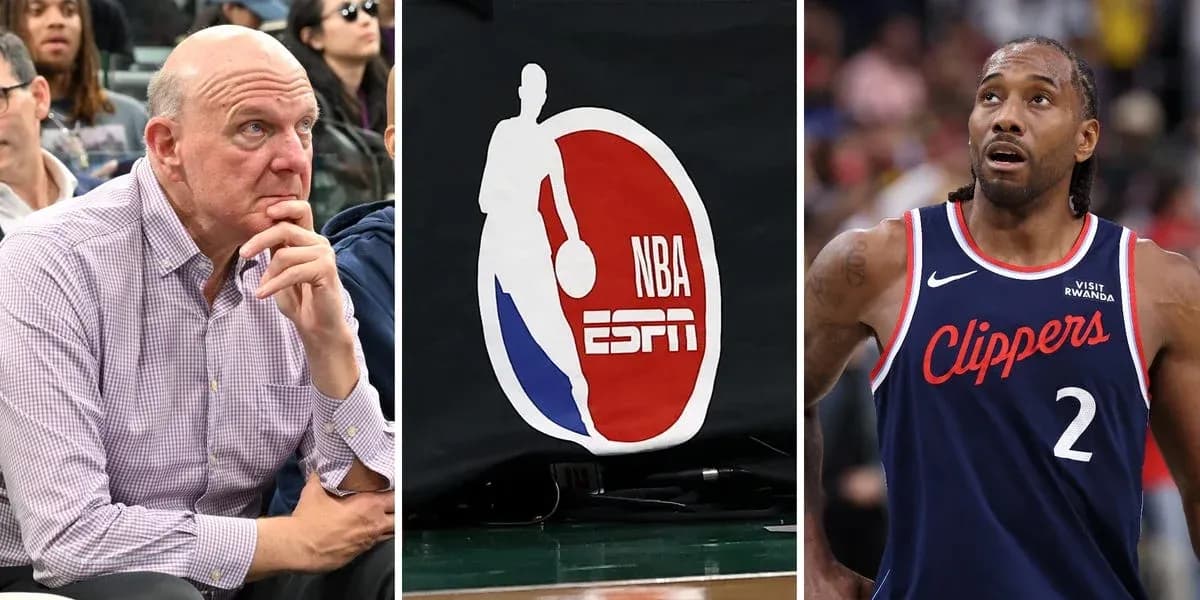
NBA's Ruling on Clippers Exposes ESPN's Misreporting
The NBA lowered the boom on the Los Angeles Clippers this week. The shockwaves are hitting Bristol almost as hard as they are hitting Ballmer.
A landmark ruling for salary-cap circumvention — a $30 million fine for the Clippers, $700,000 for Kawhi Leonard, and a one-year suspension for Steve Ballmer — has turned into a public-relations crisis for ESPN, the network that built its empire on being the definitive voice of sports.
This time, the “Worldwide Leader” is the one under review.
A story that aged badly
On August 17, before the NBA’s investigation wrapped, ESPN published a story built around three unnamed sources. Those sources insisted the league had “no evidence” Ballmer funneled money through team sponsors to pay Leonard. One anonymous voice even dismissed the idea that sponsorship introductions could count as salary-cap circumvention as “dead on arrival.”
Then came Wednesday.
After nearly a year of digging, the NBA announced that the Clippers and Ballmer had, in fact, broken league rules by facilitating sponsorship deals with Leonard. Commissioner Adam Silver hit the franchise with the largest penalty of its kind, directly contradicting the tone and implications of ESPN’s earlier reporting.
The ruling did more than punish a team. It validated the work of Pablo Torre, the former ESPN journalist whose Pulitzer-winning reporting on Leonard’s ties to Clippers sponsors had framed the issue from the start.
Online, the storyline hardened: “ESPN vs Pablo.”
Torre vindicated, ESPN exposed
Torre’s investigation, now backed by the league’s findings, painted a picture of improper relationships between Leonard and Clippers sponsors. ESPN’s mid-August piece, by contrast, leaned heavily into the idea that the league had nothing concrete and that a serious penalty was unlikely.
The result? Two competing narratives, one from a legacy giant and one from a former insider now working with The Athletic.
Public relations professionals say ESPN’s problem isn’t a stray fact. It’s the framing.
“While it might be accurate in the wording, the substance of the story was very misleading,” said Brian McWilliams, VP at LA-based Spelling Communications. Fans, he argued, don’t parse legalese — they absorb the thrust of a story. And the thrust of ESPN’s was clear: this probably wasn’t going anywhere big.
The NBA went somewhere very big.
The Clippers blasted the league’s ruling as “the result of a heavily biased investigation” and said they “vehemently reject the NBA’s findings.” Leonard, in a carefully worded statement, said he accepts “full responsibility for lapses in judgment by people within my inner circle.”
The league’s conclusions lined up with Torre’s reporting and left ESPN’s version of events looking badly out of sync with reality.
Silence from Bristol, questions from everywhere else
ESPN has not issued any corrections to its August story. An ESPN spokesperson said the company stands by the piece and declined further comment.
That silence hasn’t stopped the questions.
The NBA itself publicly challenged ESPN’s reporting even before the ruling. After the August article ran, league spokesman Mike Bass said on social media that the story contained “numerous and significant inaccuracies” that would “be made clear once the investigation is concluded.”
The investigation is now concluded. The contrast between ESPN’s framing and the NBA’s punishment is stark.
Torre has also peeled back the curtain on how that August story came together. He said he provided ESPN with a statement for the piece, affirming that he stood by his reporting and was eager to see the NBA’s findings. According to Torre, ESPN chose not to publish his comment, even as it used parts of his work while positioning itself as a counterweight to his narrative.
The omission only fuels the perception that ESPN tried to soft-pedal the gravity of the allegations.
Trust, access, and the tightrope
For ESPN, this isn’t just about one story. It’s about what it stands for at a time when the company is betting its future on direct-to-consumer streaming and its relationship with fans.
The network sells itself as both insider and watchdog — plugged into leagues and teams, but also willing to hold them to account. That balance is fragile. When coverage appears to lean toward powerful owners or institutions, trust erodes quickly.
The sports giant could “risk a lot of damage to the brand,” McWilliams warned, especially now that “fans see the outcome, which is starkly in contrast with ESPN’s reporting.”
“The audience just needs an explanation,” said Sam Gauchier, a New York-based brand and communications consultant. Not spin. Not legalistic defenses. A clear account of how ESPN got here, and why its story sounded so different from the final reality.
Bradley Akubuiro, a partner at PR firm Bully Pulpit International, put the challenge more bluntly: ESPN’s PR team must show that its reporting reflects “not only the technical accuracies, but the overall expectation of truth that their readers have.”
That “overall expectation of truth” is where the damage lies. If fans start to believe ESPN protects its relationships with leagues and owners at the expense of hard truths, the network’s entire value proposition comes under threat.
Shams, Kawhi, and the optics of access
The fallout didn’t stop with one article.
On Thursday, top NBA reporter Shams Charania went on television and said Leonard “did not have any knowledge” of the salary-cap circumvention. In the same breath, Charania acknowledged that Leonard “pocketed tens of millions of dollars” from Clippers sponsors.
The juxtaposition raised eyebrows. How does a star player earn tens of millions through sponsor deals tied to his team while remaining unaware of the implications?
Torre pounced. He responded on X with a screenshot of Leonard’s signature on what he said was a contract with former Clippers sponsor Aspiration Partners, undercutting the idea that Leonard was in the dark.
McWilliams pointed to the broader tension reporters like Charania face: insiders who “walk a very fine line between wanting to be first, wanting to be accurate, and also wanting to maintain access, which can be revoked.”
That line has never looked thinner.
The cost of being the “Worldwide Leader”
ESPN has always lived closer to the leagues than almost any other outlet. It pays billions for rights, builds prime-time shows around star players, and trades on unparalleled access. That intimacy is both its greatest asset and its biggest vulnerability.
When the Clippers scandal broke open, the network had a choice: lean into the uncomfortable questions or lean on the comfort of its sources. The NBA’s ruling made clear which side of that line looks more credible today.
The league has rendered its verdict on the Clippers and Ballmer. The public is still working on its verdict on ESPN.