2026 FIBA Women’s Basketball World Cup: Team USA Faces New Challenges
The 2026 FIBA Women’s Basketball World Cup is less than a day away, and the United States is walking into Berlin with a familiar burden: anything less than gold will feel like failure.
On Friday morning, Team USA opens against China (8:15 a.m. ET, TruTV/TNT/HBO Max), the first step in a nine-day sprint the Americans hope ends with a fifth straight world title on Sept. 13. The names are different in places, the hierarchy is not. Everyone is still chasing them.
Yet this version of Team USA is already being forced out of its comfort zone.
A’ja Wilson and Kelsey Plum, two pillars of the program and the Las Vegas Aces dynasty, are out injured. No safety net. No default lineups. For head coach Kara Lawson, that means a tournament of adjustments, matchups and trust in a group that, for all its talent, has never been through a senior World Cup together.
The stakes are clear. So is the opportunity.
Clark steps into the World Cup glare
“Even getting to play here in the World Cup, that's special within itself, too,” Caitlin Clark told FIBA. She didn’t bother downplaying the challenge. “Sometimes this is an even harder competition than the Olympics. I think one of the most fun parts is the international game and talent is growing and growing. These competitions are only getting harder to win.”
Clark arrives in Berlin as the face of the new generation, but not the presumptive starter. Lawson is expected to lean on a veteran at the point to open games, with Clark unleashed as a devastating change of pace.
That veteran is Chelsea Gray.
Gray to steady the backcourt
Chelsea Gray, the Las Vegas Aces floor general, is the logical anchor at point guard. Lawson’s backcourt is loaded with skill but light on World Cup and Olympic reps. Gray has both, and she has the temperament to run a game when the ball feels heavy and the crowd gets loud.
Her numbers in the March qualifying window — 5.6 points and 4.8 assists in limited minutes across five games — don’t tell the full story. Those games were auditions, not a settled rotation. In Berlin, the question isn’t whether Gray starts. It’s how long Lawson rides her and how much of the offense she hands over to the 32-year-old.
The ball will start in Gray’s hands. It may not stay there for long.
Jackie Young’s two-way edge
Next to her, Jackie Young looks poised to claim the shooting guard spot. She has never played in a senior World Cup, but she does bring Olympic experience and the kind of two-way reliability coaches cling to in tournaments like this.
With the 2024 U.S. Olympic team in Paris, Young averaged 9.5 points, 2.3 rebounds, 2.3 assists and tied for the team lead with 1.5 steals per game. She can score at all three levels, facilitate when needed and take the toughest perimeter assignment without blinking.
On a roster that mixes established stars with ascending ones, Young is the glue guard. She won’t need the ball to change the game.
Collier’s positional shift
The frontcourt is where Lawson’s creativity really shows.
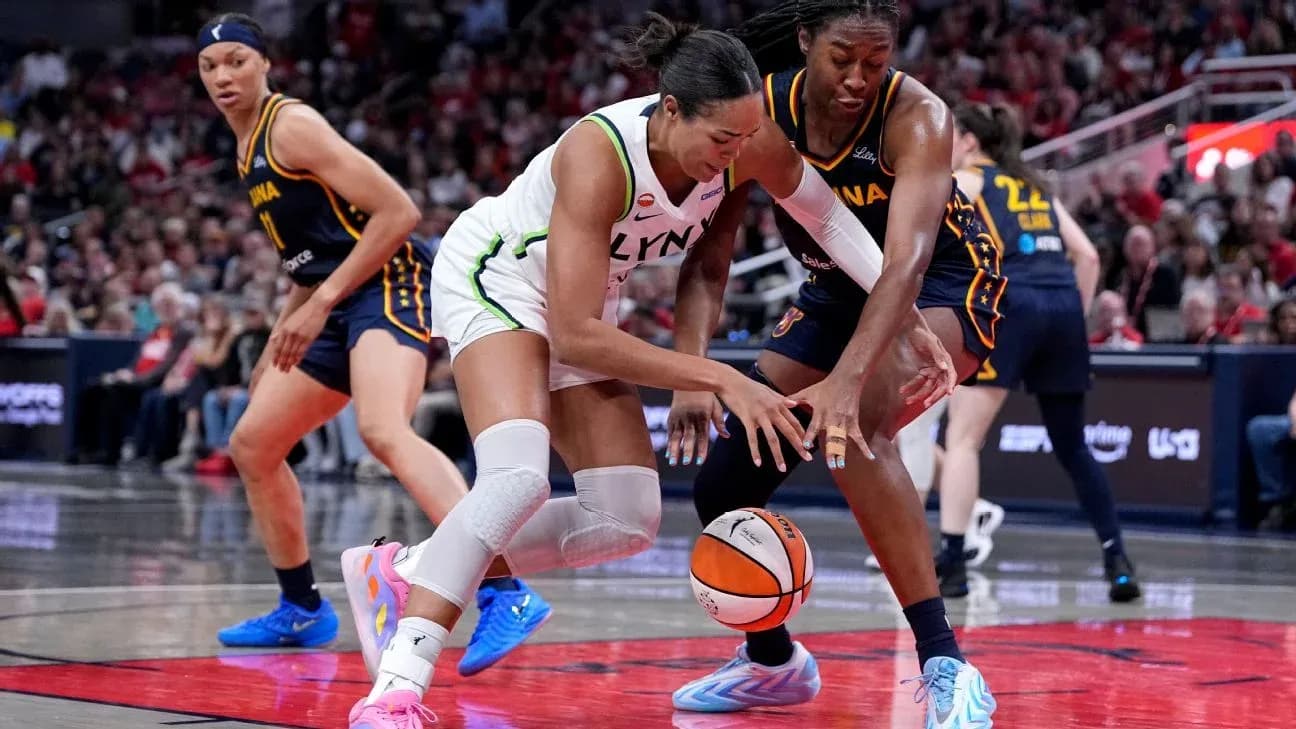
Napheesa Collier, typically a power forward for the Minnesota Lynx, is expected to slide to small forward. It’s a positional tweak that says plenty about Lawson’s priorities: size, length and defensive versatility across the wing.
Collier has never played in a senior World Cup, but she has two Olympic gold medals to her name from Tokyo 2020 and Paris 2024, where she averaged 6.7 points, 6.5 rebounds and 1.3 assists. She knows the rhythm of international basketball, the physicality, the spacing. She can switch across positions, rebound like a big and still stretch the floor.
If Lawson wants to suffocate teams defensively, Collier at the three is a statement.
Stewart, again the fulcrum
Breanna Stewart remains the heartbeat of this team.
Three World Cup gold medals. Tournament All-Star Five in 2022 after averaging 12.8 points, 6.6 rebounds, 3.0 assists, 1.3 steals and 1.4 blocks. She is the one player on the roster with a fully formed World Cup résumé, and she’ll likely start at power forward with the freedom to slide to center when matchups demand it.
Lawson will lean on Stewart to anchor the defense, control the glass and carry a heavy share of the scoring, especially with Wilson out. Paint production, rim protection, leadership — Stewart is expected to touch every part of the game.
When the offense stalls, it will often be Stewart who breaks the possession open.
Boston’s moment in the middle
With Wilson unavailable, Aliyah Boston steps into the starting center role. It’s a natural progression for the Indiana Fever star and a major test on the world stage.
Boston withdrew before the 2026 World Cup Qualifying Tournament, but she featured in the 2024 Olympic Qualifying campaign, averaging 5.0 points, 5.5 rebounds, 1.0 steal and 1.0 block in nearly 23 minutes per game. Those numbers hint at what Lawson will demand now: physical one-on-one defense, sharp footwork in the paint and relentless work on the boards.
Her agility and timing can punish slower bigs, while her strength can hold up against the bruisers. If Boston controls the interior, Team USA’s margin for error widens considerably.
Firepower off the bench
Behind that starting five sits a bench that could start for most national teams.
Clark is expected to spell Gray at point guard, but “relief” hardly captures her impact. She arrives as the MVP of the World Cup qualifying tournament, where she averaged 11.6 points and 6.4 assists. Her range stretches defenses to midcourt, her passing warps coverages, and her pace changes the feel of a game in a single possession.
Next to her, Paige Bueckers should see minutes behind Young. Bueckers brings a similar two-way balance — a guard who can create, shoot and compete defensively. When Lawson pairs Bueckers with Clark, the U.S. backcourt becomes a blur of movement, reads and shot-making.
On the wing, Kahleah Copper offers a different kind of punch behind Collier. Copper attacks the rim with force, runs the floor hard and injects instant aggression. As a one-two option at small forward, Collier and Copper give Lawson the choice between control and chaos.
The frontcourt depth is just as intriguing. Kiki Iriafen, coming off a breakout rise, and Angel Reese, now logging minutes at center for the Atlanta Dream, both figure to get real opportunities.
Iriafen can stretch the floor, attack off the bounce and guard multiple spots. Reese brings relentless rebounding, interior toughness and the versatility to slide to the five, a role she has embraced this WNBA season as the Dream dealt with injuries. How Lawson staggers Stewart, Boston, Iriafen and Reese will reveal how she wants to dictate tempo and physicality.
For now, the rotation remains a puzzle. The pieces, though, are elite.
A new path to the same expectation
Team USA heads into Berlin without Wilson and Plum, without a fully tested core, and without the luxury of easing into the tournament. The opener against China will demand focus from the first possession.
The names change. The pressure doesn’t.
The question now is simple: can this reshaped, younger, deeper United States team turn all that promise into another gold medal when the rest of the world has never been closer?