A strange, brilliant, broken year in men’s tennis has delivered us to Milan with a field that feels as intriguing as it is imperfect.
Carlos Alcaraz has already completed the career Grand Slam. Jannik Sinner finally cracked Wimbledon. Both then disappeared for long stretches through injury, and into that vacuum stepped Alexander Zverev, who quietly scooped up two majors and the No. 1 ranking. The sport has moved, violently at times, but it hasn’t settled.
Now the best eight of 2026 gather for the year-end finals in Italy – minus Sinner, whose season ended early – to try to make sense of a season that never quite felt whole.
Two groups. Three matches each. Top two go through to the semifinals. Then it’s straight knockout. Simple format, complicated stories.
Group A: The Uneasy No. 1 and the New Blood
(1) Alexander Zverev
The numbers say Zverev is the man to beat. World No. 1. First major at Roland Garros. Another in New York. Runner-up at Wimbledon. On paper, it looks like the coronation of a long-heralded talent.
Look closer and the picture blurs. Both majors arrived in fields stripped of some of their sharpest teeth. His record against Top-10 opponents this year? A stark 3–9. That’s the question hanging over Milan: how can the top-ranked player in the world look so vulnerable against his peers?
What he does bring is reliability. He turns up, he goes deep, he rarely implodes. It’s not box-office tennis, but it wins points, rankings, and trophies. Whether it wins over this arena, and silences the doubts, is another matter.
(3) Ben Shelton
Across the net in Group A stands Ben Shelton, whose left arm might be the most explosive weapon in American tennis. The big-serving southpaw made his breakthrough in New York, riding the home hard courts all the way to the US Open final before Zverev stopped him.
Shelton is no serve-and-forehand cliché. His all-court game has matured, and his first Masters 1000 title in Canada underlined that he’s more than a highlight reel. Among the American contingent, he looks the most complete package: power, variety, and a temperament that seems to relish the biggest stages.
Milan gives him a chance to prove that New York was a launchpad, not a one-off.
(6) Arthur Fils
Arthur Fils arrives as the season’s sharpest leap forward. The Frenchman has hovered on the radar for a couple of years; 2026 is when he finally burst through. His maiden 1000 series title came with a statement win over Frances Tiafoe in the final, a performance that showcased heavy ball-striking and fearless shot-making.
The majors, though, told a different story. His Grand Slam campaign was a disappointment, a series of early exits that jarred with his form at tour level. Milan offers him a chance to show that his level in the week-in, week-out grind can translate to the biggest stages, even if the Slams will have to wait until next year.
(8) Rafael Jodar
Then there is Rafael Jodar, the wildcard in every sense. The first player ever to qualify for the ATP Finals in his professional debut season, the 20-year-old has rocketed through the rankings with a mix of raw talent and raw edges.
His record against Top-10 opponents stands at 2–5, a reminder that the very top still sits just out of reach. He made the quarterfinals at Roland Garros, but couldn’t back that up on the grass in London or at Queen’s. His best work came at the 1000s, where he reached the last eight or better in five events, proof that he can sustain a high level over demanding weeks.
The questions around Jodar aren’t about his game as much as his temperament and professionalism. The talent is obvious. Whether he can harness it under the lights of a year-end finals is what makes him one of the most compelling stories in Group A.
Group B: The Fallen King, the Enigma, and the Chasers
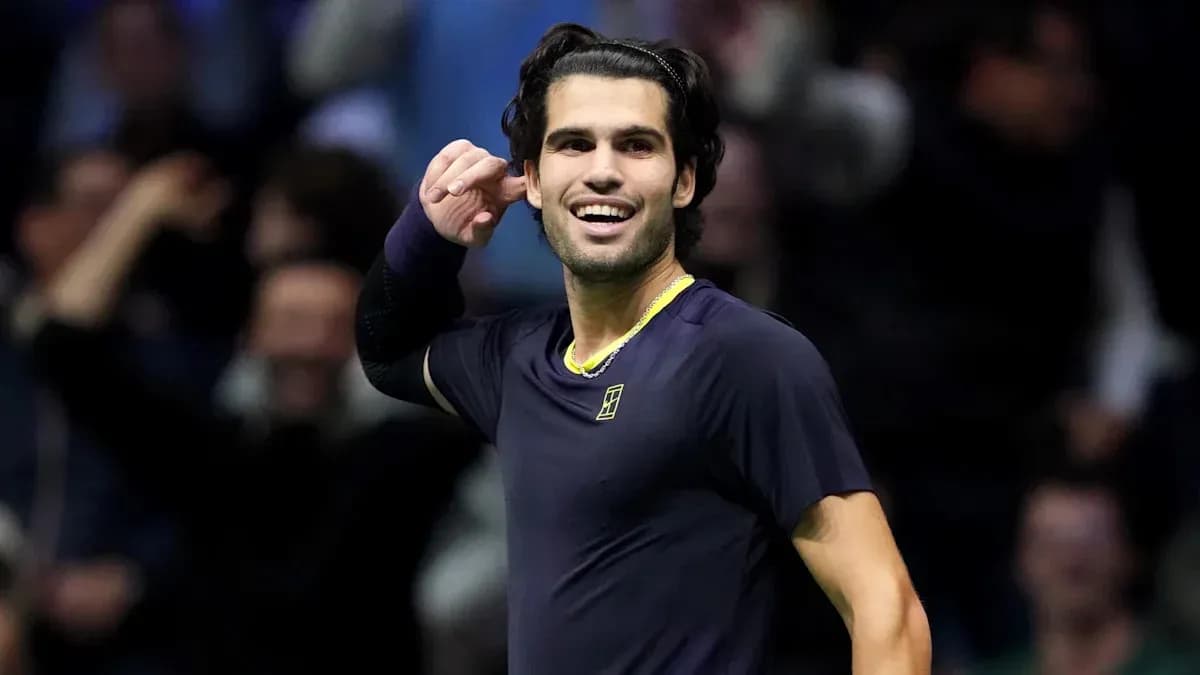
(2) Carlos Alcaraz
Carlos Alcaraz started the year chasing history and caught it in Australia, completing the career Grand Slam while still in his early twenties. The cost was brutal. The physical toll forced him to miss most of the clay swing and Wimbledon, stripping the season of its brightest star at its traditional high point.
He returned at the US Open but looked short of rhythm and edge, bowing out early. Then the old electricity flickered back to life. Titles in Vienna and Paris restored his timing, his confidence, and his aura.
He arrives in Milan no longer No. 1, but still the man whose ceiling towers over the rest. On his best day, he doesn’t just beat this field, he runs away from it. The question is whether his body and his timing allow those best days to appear on demand, one more time this year.
(4) Daniil Medvedev
Daniil Medvedev remains one of tennis’s great puzzles. On one day, he looks like the sport’s ultimate problem-solver, absorbing pace, redirecting angles, and turning matches into tactical chess. On another, he unravels, spraying errors and looking miles off the pace.
Yet here he is again, back in the top five, armed with four titles this season and a résumé that refuses to fade. His presence in Milan carries a certain nostalgia, a reminder of the player who once owned the hard courts and took the US Open by storm.
If the version that won in New York years ago resurfaces even briefly this week, Group B becomes a very different proposition.
(5) Flavio Cobolli
Flavio Cobolli’s season is a riddle. He finished runner-up at the French Open, a result that should scream consistency and elite performance. At the same time, he has won fewer than half of all the points he has played this year. That statistical quirk sums him up: streaky, dangerous, but hardly watertight.
What he does have is proof he can hurt the very best. Four wins over Top-10 opponents mark him out as more than just a passenger in this field. He may not control matches from start to finish, but he doesn’t need to. A few hot bursts, a few purple patches, and suddenly a favourite is in trouble.
(7) Frances Tiafoe
Frances Tiafoe arrives at a career-high No. 8 in the world with something still to prove. He has long been a force in North America; now he wants to show he can carry that threat to every corner of the calendar.
His fourth career title came on the grass of Halle, a timely reminder that his game translates beyond hard courts. Yet it was again the North American swing that defined his year. A semifinal run at the US Open, then a surge to the Cincinnati final, where Fils denied him the trophy.
Milan offers him a different kind of test: indoor courts, elite company, and no home-court comfort. If he wants to be more than a crowd favourite and summer specialist, this is the stage to prove it.
The Shape of a Shifting Era
On paper, this is not a vintage ATP Finals lineup. Novak Djokovic is absent, his best days now clearly receding into the past. Sinner, the season’s Wimbledon champion and a pillar of the tour’s future, is sidelined. The old guard is fading, the new order still feels provisional.
Alcaraz brings star power and a sense of inevitability when he catches fire. Zverev brings the ranking and the results, if not the romance. Medvedev still carries the memory of past brilliance. Around them, a cluster of challengers, all talented, all flawed, all trying to turn promise into something more permanent.
It may not look like the golden years, but this is what men’s tennis is now: fractured, unpredictable, and wide open.
From that chaos, someone in Milan is about to step forward and claim the right to call this their season.