The engines rose to a shriek over the Styrian hills, 1977, as the grid for the Austrian Grand Prix waited for the lights to snap to green.
On pole, in front of his own people and barely a year removed from a fireball at the Nürburgring that nearly killed him, sat Niki Lauda. His scarred face had already become part of Formula One’s mythology. Behind him, James Hunt, the blond British playboy Lauda once admitted was the only man he ever envied. Third, Mario Andretti, the American superstar with a résumé that would stretch across eras – an F1 title, four IndyCar crowns, a Daytona 500.
And way back in 14th, in a car that had never won a thing, sat Alan Jones.
No glamour. No mystique. Just a stocky 30‑year‑old from suburban Melbourne who had joined the season only months earlier, drafted in after the tragic death of Tom Pryce in South Africa. On paper, he was a bit-part player in a cast of giants.
He would leave as the leading man.
An unfashionable outsider
Jones, who died on Thursday aged 80, never looked or sounded like the archetypal F1 hero. Where Hunt oozed rock-star charm and Lauda radiated cold, clinical intensity, Jones was often labelled overweight, laconic, underprepared. He’d once sold Holdens at his dad’s dealership. He carried the air of a bloke you might bump into at the local, not a future world champion.
What he did possess, in heavy supply, was feel. Car control. Instinct. Raw, unvarnished talent.
The Austrian Grand Prix would drag that talent into the spotlight.
The weather toyed with the field. The track sat damp as the grid formed, half the paddock gambling on wet tyres, the rest committing to slicks and a leap of faith. When the race burst into life, Lauda’s Ferrari squirmed and slid, the hometown hero tumbling backwards. Andretti pounced, slicing past both Lauda and Hunt after a minor clash between the two rivals.
Eyes locked on the Lotus in front and, from nowhere, on a flying Swede.
Gunnar Nilsson, starting 16th, tore through the spray on wets, vaulting himself into second and onto every commentator’s lips. The cameras chased him. The crowd buzzed. The narrative felt set: Andretti vs the charging Nilsson.
Almost unnoticed, Jones crept into the picture.
The quiet climb
From 14th to fourth, the Shadow on slicks threaded through the traffic with a kind of stubborn bravery. Others hesitated over tyre choice; Jones committed and lived with it. Lap after lap, he picked his way past more fancied names, the black car carving its own line.
Then the track changed.
As the clouds thinned and the surface began to dry, Nilsson’s advantage evaporated with his tyres. He dived into the pits, his shredded wets finished. Moments later, Andretti’s race detonated – literally. The Lotus engine let go in a violent burst, flames and smoke ending his victory bid in an instant.
Suddenly, the script flipped. Hunt inherited the lead. Jones sat second. Lauda, now on fresh rubber and back in his element, thundered through to third.
Three men. Three very different stories. One race tightening around them.
Hunt and Lauda, the duelling centrepieces of the later Hollywood film “Rush”, were split on the road only by the solid, unsmiling Australian in the Shadow. Jones didn’t posture, didn’t play to the cameras. He just drove.
The break that changed everything
The tension built. Hunt tried to edge clear. Jones hung on. Lauda loomed, relentless.
Then came the moment that altered Jones’s life.
Hunt’s McLaren suddenly burst into sparks and flame, his engine expiring in a spectacular shower. The car coasted to the side of the circuit, marshals sprinting in, smothering it with a blizzard of extinguisher dust. Just like that, the glamour boy was out.
From that cloud of smoke and powder, the unlikely silhouette of the Shadow emerged in front.
Jones led.
He still had Lauda’s Ferrari to contain, the Austrian now charging with the authority of a man intent on winning his home race. But the Australian refused to fold. Lap after lap, he held his nerve and his line, shutting the door on one of the sport’s great closers.
When the chequered flag fell, it wasn’t Lauda, Hunt or Andretti who claimed the day.
It was Alan Jones – taking the first of his 12 grand prix victories, and the only win the Shadow team would ever record in its eight-year F1 existence.
A team, a nation, and a new anthem
The scene that followed was pure, unfiltered joy. Shadow mechanics poured onto the track, barely believing what they’d pulled off. The circuit announcer tried to catch up with history, his voice cracking with uncertainty as he told the crowd it was Australia’s first F1 win in seven years.
“The first Grand Prix win for Alan Jones, and the first Grand Prix win for the hard-working Shadow team,” he declared over the PA.
“And, we think, the first Grand Prix win for Australia in seven years.”
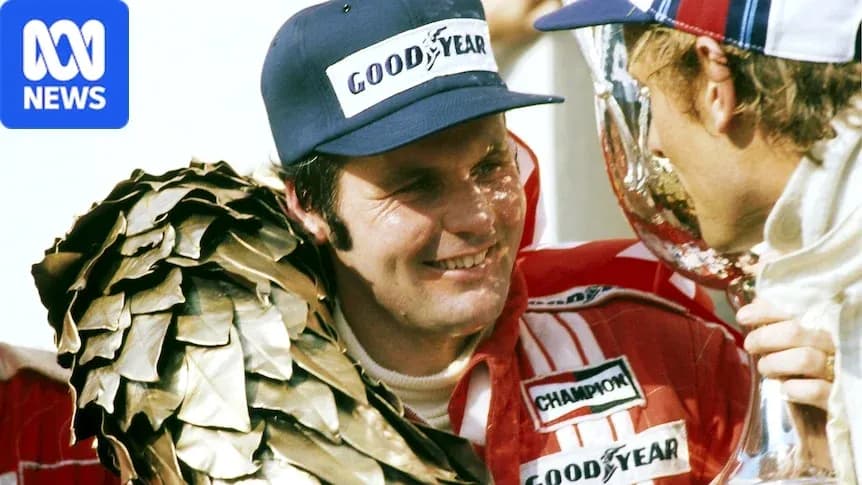
Down in pit lane, Jones disappeared under a wave of handshakes and backslaps. With his then-wife Beverley in one arm and a bottle of champagne in the other, he planted a huge kiss on her, then – at her urging – popped the cork. He took a hefty swig before being shepherded to the podium, where a golden wreath landed on his shoulders and a band struck up in the background.
That soundtrack would spawn one of the enduring – and not entirely accurate – tales of his greatest day.
“[The win] was a bit of a surprise to everybody,” Jones later told Wide World of Sports co-host Daryl Eastlake. “In fact they had trouble finding the Australian national anthem, so some drunk played Happy Birthday on a trumpet.
“That’ll give you an idea how prepared they were for me to win.”
The actual audio from the day tells a slightly different story. Trumpeters in the distance blasted out La Cucaracha and a handful of other tunes before launching into Advance Australia Fair as Jones accepted his trophy.
The complication? At the time, Advance Australia Fair wasn’t officially the national anthem. God Save the Queen had been reinstated in 1976, after Gough Whitlam’s government had briefly installed Advance Australia Fair two years earlier. The old anthem had become the new anthem, then the old one again – and would eventually return as the new one for good.
In the confusion, it’s easy to imagine Jones mishearing Advance Australia Fair as Happy Birthday. Or blotting out the anthem entirely amid the trumpets, the cheers, the champagne and the shock. Maybe he simply didn’t recognise a song that, politically and culturally, was still in limbo.
What can’t be argued is what followed.
As the years rolled on, Formula One organisers heard Advance Australia Fair plenty. Jones kept dragging it onto podiums around the world, stamping his name – and his country’s – on the sport’s golden era.
He never looked like a matinee idol. In an age of poster boys and playboys, Australia’s leading man resembled a bank teller who’d wandered onto the grid by mistake.
That, in the end, became the charm. An understated champion in an overstated sport – and a legacy that still makes Australian motorsport fans stand a little taller.