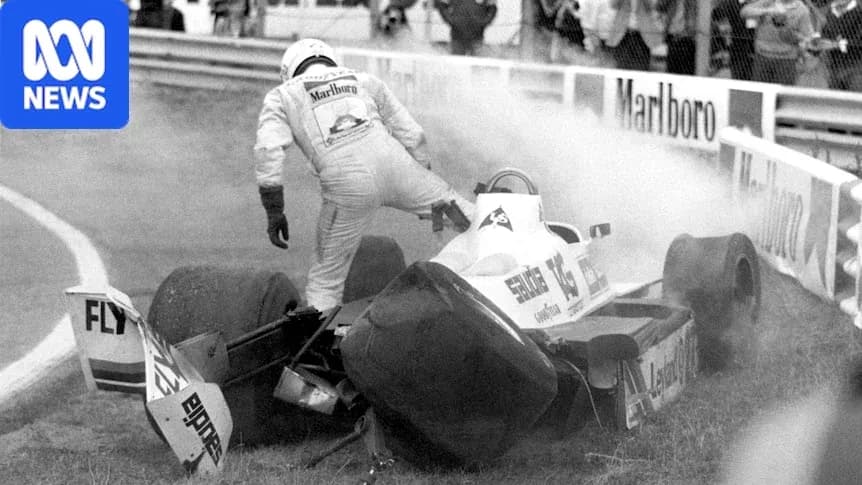
Alan Jones has died at the age of 80, and with him goes one of the last, raw links to Formula 1’s most unforgiving age. A world champion, a 12-time grand prix winner, an Australian icon. But also a survivor of a sport that routinely asked its drivers to stare down death and get back in the car the next day.
His career was framed by tragedy from the moment he stepped into a Formula 1 cockpit. The dangers that shaped him now feel almost unthinkable in an era of halos and high-tech barriers, but they were the reality of his time.
Baptism of fire in Barcelona
Jones’s first F1 start came at the 1975 Spanish Grand Prix at Montjuïc, a weekend that still sits in the shadows of the sport.
The alarm bells rang early. Drivers doubted whether the barriers around the Barcelona street circuit had even been bolted in properly. Members of the Grand Prix Drivers Association refused to take part in practice, protesting conditions they believed were flatly unsafe.
The race went ahead anyway. Rumours swirled in the paddock that the Guardia Civil would seize the cars if they didn’t line up on the grid.
Jones, driving for Hesketh Racing, qualified 21st. His debut lasted just three laps before a collision ended his race. In another era, that would have been the story: a rookie’s short first outing, a footnote in a long career.
But Montjuïc had far darker plans.
On lap 26, race leader Rolf Stommelen’s Hill-Ford suffered a rear-wing failure. The car speared off the track, vaulted the barrier and tore into the crowd. Five spectators were killed. Stommelen was badly injured. The race limped on for four more laps before officials finally stopped it.
Amid the chaos, history still found a way to write a different line: Lella Lombardi finished sixth and became the first – and still the only – woman to score Formula 1 world championship points. On the same day, the sport showed both its potential and its cruelty. Jones had entered F1 at full speed, straight into one of its darkest chapters.
A seat born from catastrophe
By the end of 1976, Jones had fallen out with Team Surtees and slipped out of Formula 1. At the start of 1977, he was on the sidelines, watching others risk what he had already risked.
His way back came from another disaster.
At Kyalami in South Africa, Renzo Zorzi’s Shadow suffered a fuel leak and pulled off to the side of the main straight. A small fire broke out. Two marshals sprinted across the live track carrying fire extinguishers. One car managed to jink away at the last second.
Tom Pryce never saw them.
The Welshman hit 19-year-old marshal Frederik Jansen van Vuuren at full speed. The impact killed the teenager instantly. The heavy extinguisher he carried smashed into Pryce’s helmet, killing him on the spot.
Niki Lauda won the race but had his celebrations stopped before they began when a Goodyear representative reached him with the news. The scene at Kyalami became another brutal marker of an era when safety systems lagged far behind the speeds the cars were reaching.
Out of that wreckage came an opportunity. Shadow needed a driver. They called Jones for the next race in the United States.
Later that season, at the Österreichring in Austria, Jones delivered the team its only grand prix victory. A maiden win, for a midfield outfit, on one of the fastest circuits in the world. It was the breakthrough that pushed him towards the front of the grid and, eventually, the world title.
The price paid to open that door, though, was written in lives.
The Ferrari that never was
From 1979 to 1981, Alan Jones was the beating heart of Williams. Aggressive, uncompromising, fast. Those three seasons brought 11 grand prix victories and, in 1980, the world championship that would define his career.
Yet his story could easily have worn Ferrari red.
Before that Williams glory run, Ferrari had sounded him out. The Italian giants told Jones he was their second choice if they failed to land Mario Andretti. They did miss out on Andretti, who went on to win the 1978 title with Lotus, but chose a different direction: Gilles Villeneuve.
Jones headed to Williams instead. The partnership clicked. Williams rose, Jones took the title, and the combination etched itself into the sport’s history.
Ferrari’s path turned darker. In 1982, a year after Jones first stepped away from Formula 1, the Scuderia was shattered twice.
Villeneuve died during qualifying for the Belgian Grand Prix at Zolder. Chasing a time, he ran into the back of a much slower car, was launched into the air, and thrown from the wreck as it smashed back to the ground. The sport lost one of its most electrifying talents.
Weeks later in Germany, Didier Pironi’s Ferrari struck the rear of Alain Prost’s Renault in heavy spray. The crash left Pironi with devastating leg fractures and ended his Formula 1 career.
Jones later said Ferrari contacted him that year to fill in for the final races of the season. He hesitated, took too long to respond. Ferrari moved on to another replacement. In a career shaped so often by events beyond his control, this was a sliding door he chose not to walk through.
A champion in a fatal age
The numbers around Jones’s era remain stark. Five drivers were killed on grand prix weekends during his time in Formula 1. Two more died in testing. Australian Brian McGuire lost his life at Brands Hatch in 1977 while driving an F1 car.
This was the landscape in which Alan Jones built his reputation: circuits lined with unforgiving barriers, rudimentary medical facilities, marshals running across live tracks, and cars that went faster every year without the safety net catching up.
When Jones retired from Formula 1 in 1986, the sport was finally starting to change. Circuits were altered, run-off areas extended, medical response improved. For a time, the worst headlines stopped coming.
Then came Imola in 1994. The San Marino Grand Prix weekend claimed Roland Ratzenberger in qualifying and Ayrton Senna in the race. Two more names added to a list that drivers of Jones’s generation knew far too well.
Since then, only one Formula 1 driver has died from injuries sustained in a grand prix: Jules Bianchi, who went off in wet conditions at Suzuka in 2014 and hit a recovery crane attending to Adrian Sutil’s stranded car.
The sport that Alan Jones once entered at Montjuïc is almost unrecognisable now. The Halo device, that curved wishbone over the cockpit, has already justified its existence several times over: Romain Grosjean’s inferno in Bahrain in 2020, Lewis Hamilton trapped under Max Verstappen’s Red Bull at Monza in 2021, Guanyu Zhou’s terrifying roll and fence strike at Silverstone in 2022.
Each of those incidents might have been another fatal chapter in the age Jones raced through. Instead, they became escapes, slow-motion replays of survival rather than disaster.
Alan Jones leaves behind a world championship, 12 grand prix victories, and a place in Australian sporting folklore. He also leaves a reminder: Formula 1 did not drift gently into modern safety. It was dragged there, one awful weekend at a time, by men who kept climbing back into the car.
He was one of them.