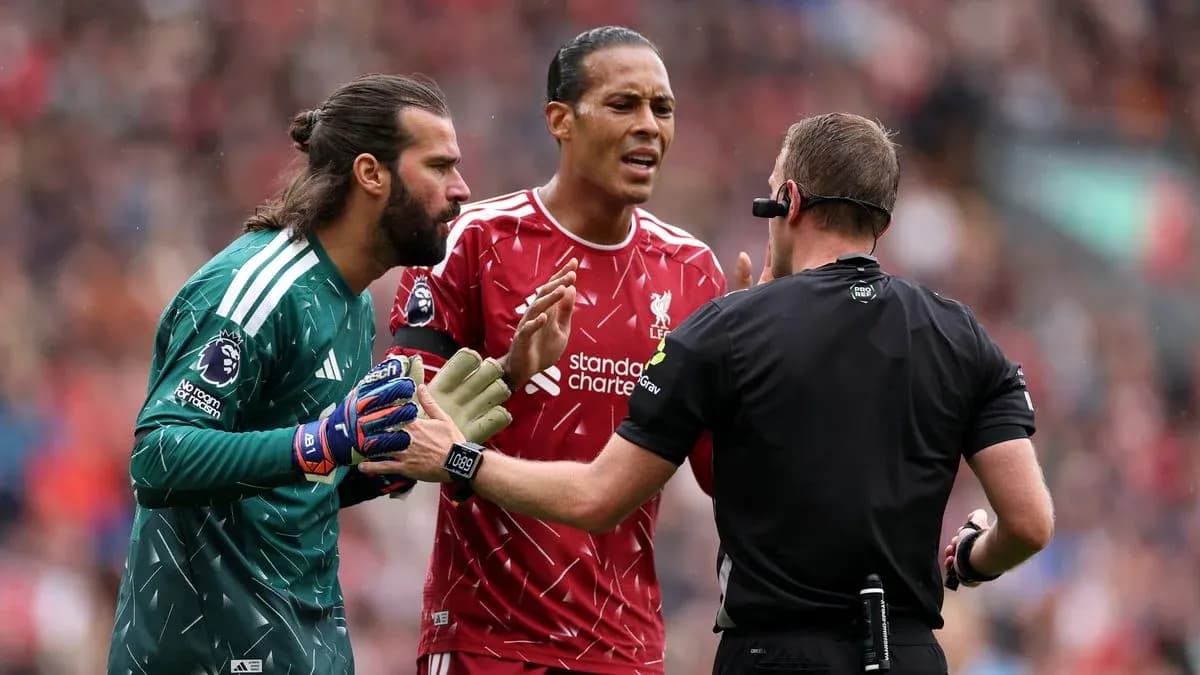
Alisson Becker has been hit with an £8,000 fine after accepting an FA charge for misconduct stemming from Liverpool’s ill-tempered 2-2 draw with Nottingham Forest last month.
The Liverpool goalkeeper’s frustration boiled over at the City Ground after he was penalised for a late challenge on former team-mate Neco Williams, a decision that allowed Morgan Gibbs-White to put Forest in front from the spot.
What followed summed up the chaos of the afternoon.
Flashpoint at the City Ground
With Liverpool preparing a triple substitution in the build-up to the incident, the fourth official’s electronic board malfunctioned, causing a delay on the touchline. Moments later, Alisson was adjudged to have fouled Williams, and Forest seized the moment.
Gibbs-White converted, Forest surged ahead, and Anfield’s usually unflappable No. 1 was incensed.
Andoni Iraola’s side – having seen that lead wiped out by a late Victor Munoz equaliser – still left with a point, but Alisson’s anger did not subside at full-time. As he walked off, he was seen kicking the fourth official’s board, the same piece of equipment that had already caused such confusion during the substitutions.
That act has now brought formal punishment.
“Liverpool’s Alisson Becker has been fined £8,000 for misconduct at the Premier League fixture against Nottingham Forest on 29 August,” an FA statement confirmed. “It was alleged that the goalkeeper acted in an improper manner around the tunnel area after the final whistle. Alisson Becker has subsequently accepted the charge against him and received the standard penalty.”
Penalty called wrong – but decision stands
To deepen the sense of grievance on Merseyside, the Premier League’s Key Match Incidents Panel has since ruled that the penalty award itself was incorrect.
Three of the five panel members felt Alisson’s challenge on Williams did not meet the threshold for a foul. Their view was blunt.
“The contact from Alisson was inevitable as a consequence of his momentum in attempting to save the ball,” the panel said. “The contact made was not reckless and below the threshold for a penalty.”
Yet the same panel backed the VAR, Michael Oliver, for staying out of it. Referee Sam Barrott was not sent to the pitchside monitor, and the panel unanimously agreed that was the right call under current protocols, judging the on-field decision not to be a “clear and obvious error”.
So the sequence stands in the record: a penalty that should not have been given, a VAR that could not intervene, and a goalkeeper now fined for the fury that followed.
For Alisson and Liverpool, the incident lingers as more than just a number on a charge sheet. It is another flashpoint in an already simmering debate about officiating standards, technology, and where the line lies between human error and accountability.