
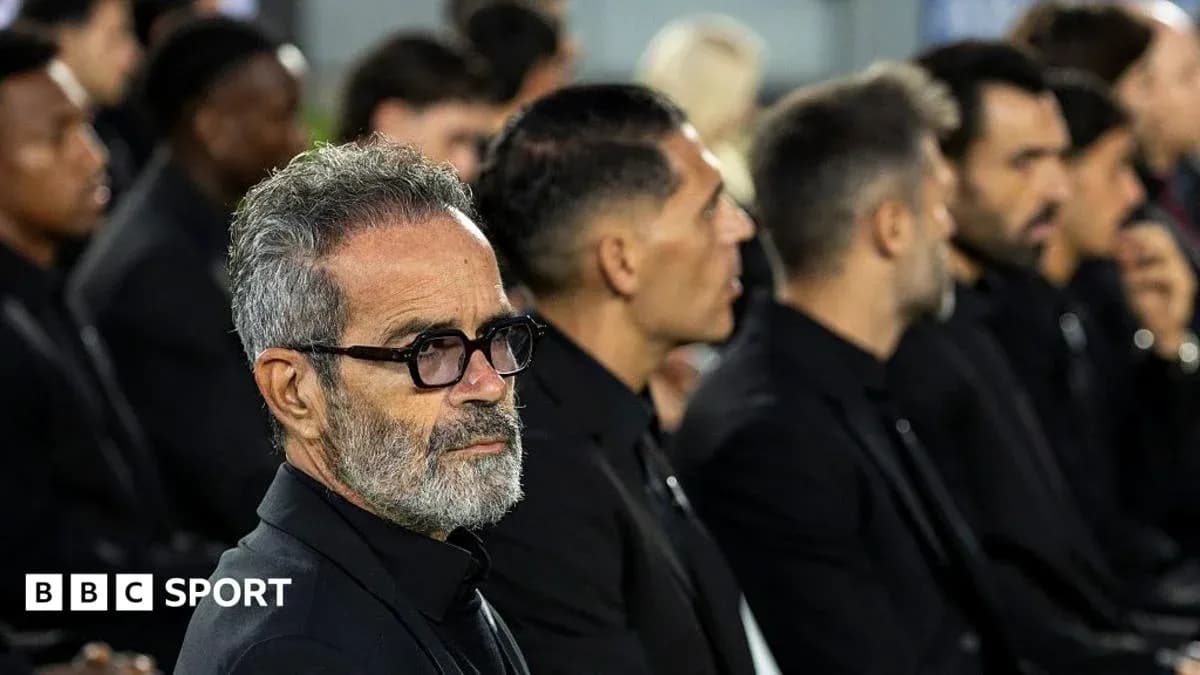
Alvaro Cervera stood in front of the microphones and did what football people often find hardest in moments like this: he accepted the rules, while living with the fact that they cannot touch the scale of the tragedy.
The Tenerife coach was asked about the 12‑match ban handed to FC Andorra goalkeeper Jesus Owono, sent off after the collision that led to the death of Tenerife forward Jesús de Miguel. The incident came late in their Segunda División match on 2 November. De Miguel died the following day, aged 30.
On Friday, the Spanish football federation’s disciplinary committee confirmed Owono’s suspension. Twelve games. The maximum available under the current framework.
To many, it will sound harsh. To others, painfully small. Cervera understands both instincts, but he keeps coming back to the same point: the regulations only see the foul, not the funeral.
“I think that, just as in other areas of life, there are rules or laws that must be followed,” he said, speaking before Tenerife’s fixture against Ceuta on Sunday, the club’s first game since De Miguel’s death. “Since the current regulations don't specifically account for what happened, I believe they have simply adhered to the rules and imposed the number of matches permitted by the regulations.
“Anything else I might say would just be my own personal opinion, which I'll keep to myself. It might seem a bit light when compared to other cases, but in reality, I don't think the rules allow for anything else.”
The committee’s hands were tied. Its decision, it stressed, had to rest “on the facts expressly recorded in the referee's report”. That report stated that Owono “was sent off for violently striking an opponent in the chest with his leg, using excessive force, while the ball was in play”.
No mention of what followed. It cannot. The code does not stretch to the unthinkable.
For Cervera, 61, the last days have been about something much less defined than a legal framework: grief, guilt, silence in the dressing room, and the fragile process of asking his players to return to work when football feels like the last thing that matters.
He called it “tough” and “complicated”. Those were the first words that came to him when he tried to describe the return to training.
“When we're together, we're fine, during our sessions, we're doing well,” he said. “It feels like the group is gradually getting back to normal. What we don't know is how everyone is doing when we're apart and that's a significant factor.
“Everyone has their own way of coping and their own thoughts; some have people at home to support them, while others are more on their own.
“We’re making progress, a very slow process, but we are moving forward – it's tough, it's complicated.”
Inside the training ground, the structure of the day helps. Warm-up, rondos, tactical work. Familiar drills offer a kind of shelter. Outside, there are long hours to fill and thoughts that do not switch off. Cervera is acutely aware of that divide.
He also admitted he does not know if his players are truly ready to compete again. Some crave the distraction of a matchday, the routine of travel, the comfort of the dressing room. Others are not there yet, and he refuses to dismiss either reaction.
“Both positions are reasonable,” he said. “On one hand, you want to return to some sense of normality though you know that true normality isn't something you'll find right now.
“This isn't something you can just set aside or push to the back of your mind to focus on your own work; it's not like other life events you might encounter. It's always there, constantly on your mind, yet we have to keep going.”
That is where Tenerife find themselves now: between a rulebook that has reached its limit and an emotional reality that has no such boundary. The sanction has been set. The calendar moves on. The league will play, goals will be scored, points tallied.
For Cervera and his squad, the real test is not how they respond to a suspension they cannot change, but how they live with an absence that no regulation could ever hope to measure.





