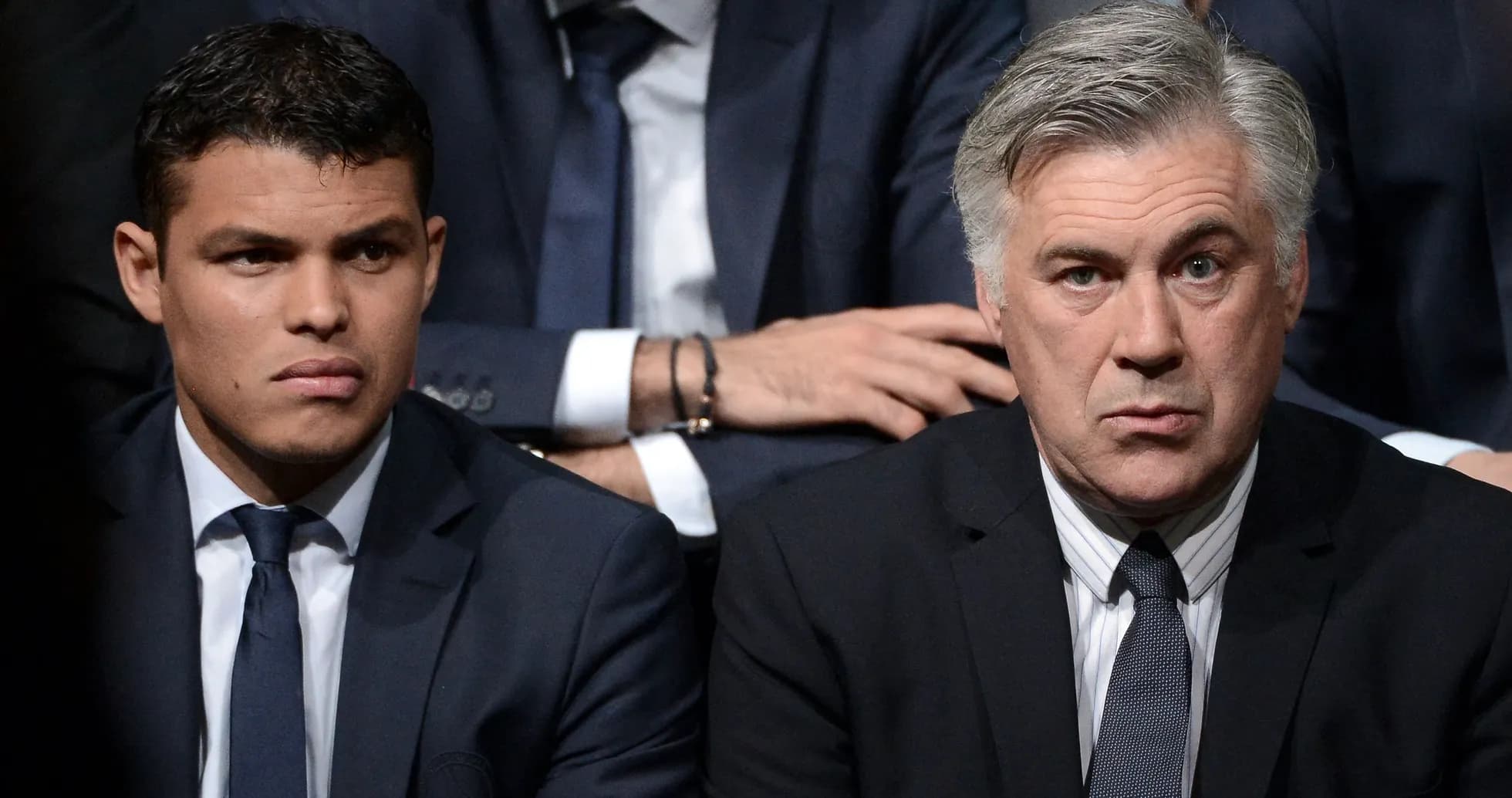
Carlo Ancelotti and Thiago Silva are no strangers to each other. They built a bond at Paris Saint-Germain in 2012-13, when the Italian coach famously called the Brazilian centre-back “the best defender in the world.”
Now they find themselves on opposite sides of a debate that cuts to the heart of Brazil’s future.
From admiration to open disagreement
The flashpoint came as Ancelotti unveiled a 26-man squad for Brazil’s upcoming friendlies against Australia and India, a list loaded with ten domestic-based players and a clear tilt toward youth.
Thiago Silva, watching from the outside, did not hold back.
Speaking to Radio Tupi in the afterglow of Fluminense’s Copa Libertadores win over Platense, the 113-cap veteran challenged the pace and scale of Ancelotti’s rebuild. Left out of the most recent World Cup squad despite a strong loan spell at FC Porto, Silva framed his criticism as a choice between honesty and diplomacy.
“Do you want me to lie or tell the truth? You can't rule out players who are 31, 32 or 33,” he said. For him, the national team is not a laboratory for sweeping experiments. “In the Brazilian national team, things have to be done step by step. You can't just get rid of everyone and bring in new players.”
Then came the sharper edge. “He comes from European football, where it's easier to make changes,” Silva added. “It doesn't work like that here. I don't agree with it, but he's the one in charge.”
That last line landed like a reluctant full stop: respect for the hierarchy, disdain for the method.
Ancelotti stands firm
Ancelotti did not duck the issue. Facing the media at CBF headquarters in Rio, he was asked directly about Silva’s comments. The Italian’s first reaction was as brief as it was telling.
“I don't look,” he said, brushing away the noise before laying out his thinking.
For this international window, he insisted, the squad reflects a specific objective: testing the next wave. “For the objectives we have in these friendlies, it's a balanced list,” Ancelotti explained. “I don't generally look at players' age. Right now, the priority is young players. But if a 34 or 35-year-old is prepared to play in an important competition, he will be in the national team.”
It was a subtle but important distinction. The door, he stressed, is not locked to older players. The key, though, now lies in performance and readiness rather than reputation or birth date.
A new wave in yellow
The list itself underlines the shift. Ten uncapped players under 30 have been pulled into the senior setup, a clear signal that Ancelotti wants to accelerate the transition.
Goalkeepers Hugo Souza, Pedro Morisco, and Otavio headline the newcomers at the back, while defenders Arthur Dias, Jair, Mauro Junior, Matheuzinho, and Manchester City prospect Vitor Reis flesh out a back line that looks more like a project than a finished product.
In midfield, Breno Bidon and Gabriel Bontempo receive their first senior invitations, stepping into a dressing room that still features established attacking stars such as Vinicius Junior, Endrick, Estevao, and Raphinha.
On paper, it is a squad built for experimentation. On the pitch, it will be judged on whether that experimentation can coexist with the demands and expectations that come with the Brazil shirt.
A fault line in Brazil’s rebuild
Strip away the names and the tension between coach and former captain is familiar. Silva argues for continuity, for a measured handover in a football culture that venerates experience and memory. Ancelotti is pushing for renewal, using friendlies to stretch the squad’s age profile and test how quickly a new core can emerge.
Brazil’s last-16 exit at the World Cup provided the backdrop. Ancelotti’s response has been bold: a clear-out of several senior figures and a deliberate move toward players who will peak in the next cycle, not the last one.
For some, that looks ruthless. For others, overdue.
What is not in doubt is that the debate has moved out into the open. One of the most respected defenders of his generation believes the national team is discarding know-how too quickly. One of the game’s most decorated coaches is betting that the future cannot wait.
The next chapter arrives on the pitch. Brazil face Australia on September 25 and 29, then travel to Kolkata to meet India on October 3 — three friendlies that suddenly feel like an early referendum on Ancelotti’s vision and on just how fast a giant of world football dares to change.