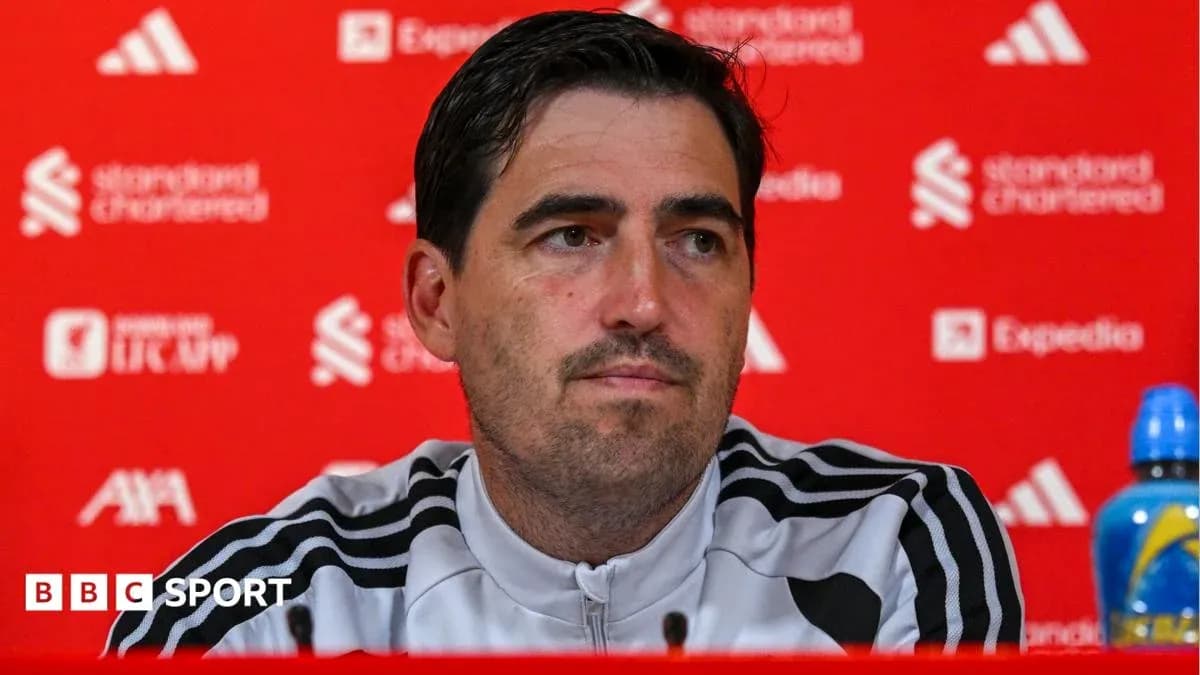
Andoni Iraola is only four league games into his Anfield reign, but the lesson could not be clearer: the calendar does not care how much you paid for your forwards.
Three days after Liverpool tore into Atletico Madrid in the Champions League, they laboured through a goalless draw with Fulham that felt like a different team, a different mood, almost a different season. The zip had gone. The crowd felt it. So did the head coach.
Now comes Tottenham in the Carabao Cup, and with it the first real stress test of Iraola’s squad management.
Iraola’s balancing act
Asked whether he can simply roll out his strongest XI again, Iraola did not pretend.
“You can decide and put the same players in every game,” he said. “The problem is there'll be a moment when they're really tired. And there is more risk of injury.”
This is the heart of his early Liverpool project. Not tactics. Not pressing triggers. Durability.
“There are players who play every three days with no issues. They are very robust, their performances don't change too much,” he explained. “There are other players where the risk is bigger and the performances are different. I have to learn who is ready to play games every three days and who needs a rest so their performance level isn't affected.”
He thought he knew. With some, he still does. With others, this is new territory – for the players as much as for him. More minutes, more intensity, more demands. “We are learning,” he admitted.
The learning curve is steep. Liverpool face at least seven more Champions League fixtures, domestic cups, and a Premier League campaign that has already started to ask awkward questions.
Flat after the high
Those questions grew louder on Saturday.
Two home games in the league. Two draws. For just the third time in 63 years, Liverpool have failed to win either of their opening home league matches. It is not a crisis, but it is not the launch Iraola imagined.
Fulham arrived at Anfield with three defeats from three under Alvaro Arbeloa, short on confidence and leaking goals. They left with their first point of the season and the feeling they might have taken all three.
Liverpool, by contrast, looked physically and mentally drained. The midweek win over Atletico had been full of urgency and edge. This was the hangover. Slower. Looser. Less certain.
On the first real glimpse of how Iraola’s style copes with two games a week, the verdict was stark. Six points from four league matches, with four dropped at home to Nottingham Forest and Fulham and another draw at Newcastle, is not the return expected from a team with title ambitions.
Unbeaten, yes. Convincing, no.
A £364m attack still finding itself
The spotlight inevitably swung to the front line. The £364m trio of Alexander Isak, Bradley Barcola and Florian Wirtz started together for the first time in a league game. On paper, it looks devastating. On grass, it remains a work in progress.
Liverpool created chances, but nowhere near enough. Isak’s numbers told their own story: just 16 touches in 90 minutes, the second fewest for an outfield Liverpool player on record – and he holds the lowest mark as well, with 14 against Forest two weeks earlier.
Wirtz, so bright and incisive against Atletico, looked a shadow of that player. Barcola and Isak produced flashes, little combinations, half-moments. A partnership, not yet a front line. It will take time, and time is precisely what the schedule does not grant.
Behind them, the changes were constant. Iraola brought in Kostas Tsimikas, Ryan Gravenberch and Victor Munoz for Milos Kerkez, Alexis Mac Allister and Rio Ngumoha. Tsimikas struggled and was hooked at half-time for Kerkez. By the hour, Gravenberch and Munoz had made way for Mac Allister and Cody Gakpo as Iraola tried to wrench the game in Liverpool’s favour.
It never truly shifted.
Fulham stand firm
Fulham, under pressure and under scrutiny, arrived with a plan and stuck to it.
Arbeloa, returning to the club where he played 98 games between 2007 and 2009, made two bold calls: Austrian centre-back David Affengruber came in for his debut in place of Joachim Andersen, and Sander Berge replaced Cesar Palacios in midfield. Both helped add a layer of resilience that Fulham had badly lacked.
The visitors should have led early. A mix-up between Alisson and Gravenberch left Gonzalo Garcia with a clear sight of goal, only for Jeremy Jacquet to bail Liverpool out with a desperate goal-line clearance. It was a warning, and it came entirely from Liverpool’s own carelessness.
Fulham were the better side in the first half but failed to turn that into a lead. Josh King saw a shot from inside the box saved by Alisson. Antonee Robinson headed wide when well placed. Liverpool, by contrast, had to rely on moments: a Munoz header clawed away by Bernd Leno, a Bradley Barcola volley deflected behind by Timothy Castagne.
After the break, Liverpool tried to raise the tempo. Isak fashioned an opening, but Leno saved comfortably. The Fulham keeper then beat away a powerful strike from Dominik Szoboszlai. Iraola threw on Ngumoha and Jeremie Frimpong with 18 minutes left, chasing a late surge that never came.
Isak headed wide from a stoppage-time corner. Fulham, still threatening on the break through King and Kevin, held their nerve and their shape to claim a point that felt like a small turning point in Arbeloa’s early tenure.
History, expectation and a Cup dilemma
All of this feeds into Tuesday night.
Liverpool’s relationship with the League Cup is woven into the club’s modern history. Ten titles, more than anyone else. Four in a row from 1980-81 to 1984. Steve McManaman’s brace in 1995. Gerard Houllier’s sides lifting the trophy in 2001 and again in 2003 against Manchester United. Kenny Dalglish guiding them past Cardiff City on penalties in 2012. The extraordinary 11-10 shootout against Chelsea in 2022 under Jurgen Klopp. And then Klopp again, delivering the 10th crown in 2024, once more at Chelsea’s expense.
The competition has been a staging ground for eras, for managers, for squads. Now it is Iraola’s turn to walk into it.
Only this time, the early-round script is different. No lower-league opponent, no gentle introduction for fringe players and academy hopefuls. Tottenham come to Anfield. A Premier League rival, even if they are stumbling through a difficult start.
So the question bites: does Iraola go strong to restore rhythm after the Fulham flatline, or does he gamble on rotation with the season already straining at the seams?
He knows some of his players can run every three days without blinking. He also knows others cannot. He thought he had that balance mapped out. The last week has told him he is still discovering it.
Liverpool’s history in this competition demands ambition. Their current schedule demands caution. Somewhere between those two poles, Andoni Iraola must find a team capable of beating Tottenham and a squad capable of lasting until May.
Can he take Liverpool to League Cup number 11 while keeping his stars fresh enough to chase everything else? The answer starts to reveal itself on Tuesday night.