Mercedes mechanics have learned to watch their backs. Not for errant wheel guns or rogue tyre blankets, but for the sharp fingers of their new world champion.
Andrea Kimi Antonelli, 20 years old and already a Formula 1 title winner, stalks the W17 garage with a grin and a habit: a greeting, a hug, and, when his crew least expects it, a stinging pinch to the nipples. No one is safe. Not the senior mechanics, not the power unit crew, not even those just passing through.
It sounds childish. It is. And that’s exactly the point.
Behind the slapstick, behind the whipped cream ambushes and tickle attacks before qualifying, sits the foundation of Mercedes’ new era: a young champion who has made the garage his home, and the people in it his inner circle.
The joker who runs a title campaign
"When he comes into the garage, it's quite a show," said Nathan Tupper, the man who tends to the power unit in Antonelli’s car. "He grabs everyone, pinches people's nipples, slaps them all over and generally causes chaos. At the end of the day, he's 20 years old. That's just Kimi."
Ash Jones, the second senior mechanic on the car, barely bothers trying to catalogue the mischief. "There are so many practical jokes that it would be difficult to list them all. He comes over, says hello and then gives you a pinch. That's how he jokes around with us. He likes having a good relationship with everyone, laughing and having fun together."
The chaos doesn’t pause when the pressure spikes. Quite the opposite.
Tom Mason, Antonelli’s number one mechanic, has watched the pre-qualifying ritual enough times to stop being surprised. While rivals lock into a thousand-yard stare, Antonelli is still prowling the garage, grabbing arms, tickling ribs, winding people up.
"It always makes me laugh watching him getting ready to get into the car before qualifying," Mason said. "He's still joking around, grabbing the guys, tickling them. Even when the pressure is enormous, he's there having fun. He's incredibly relaxed."
The same driver who shows a veteran’s calm when the visor drops becomes a 20‑year‑old the moment he steps back into the garage. On birthdays, the warning signs are obvious: whipped cream at the ready.
Callum Wooldridge, who works on the front end of the car, knows the routine all too well. "When you work in Formula 1, you spend so much time away from home that sometimes you end up celebrating your birthday during a grand prix weekend,” he said. "It's not always easy. Sometimes you really miss being at home. Kimi started this thing with whipped cream in people's faces, and I don't think there are many other garages in the paddock where something like that happens. It's funny. It happened to me on my birthday in September last year."
These aren’t just pranks for the sake of it. They’ve helped create one of the loosest, most natural atmospheres in a front-running F1 garage.
"It's one of the best atmospheres I've ever experienced working with a driver," Jones said. “With Kimi, you feel completely comfortable. It's like talking to one of the guys you work with every day. There's no awkwardness, no tension when you speak to him."
That tone is not accidental. Race engineer Peter Bonnington, the man who once guided Lewis Hamilton through his golden years, is again at the centre of it.
"Bono encourages us to interact with him, to have a laugh," Mason explained. "Kimi is very approachable and loves joking around with the guys. It's a really good environment to work in."
A world title has merely confirmed what the people in that garage already knew: they don’t just work with a champion. They like him.
The kid in the blue cap and the early crashes
To understand how that bond formed, you have to wind back to 2024 and a teenager in an oversized blue cap, hair spilling out in all directions, about to climb into a Formula 1 car for the first time.
"I remember all that hair coming out of his cap, looking a bit messy," said mechanic Franck Bougeard, smiling at the memory of those first tests in Austria. "He really looked like a little kid. And there he was, about to drive a Formula 1 car."
The speed was obvious. So were the rough edges.
At Abu Dhabi, Antonelli hit the barriers hard enough to damage the chassis. "Luckily, we'd brought a spare one, which is something we hardly ever do at those tests,” Bougeard said. "I don't even know why we'd brought it, but thank goodness we had, because we needed it."
Then came Monza. Another crash. Another damaged car. Another reminder that raw pace comes with a bill.
"At that point I was starting to think, ‘brilliant, every time this kid leaves the garage, we're going to end up changing a chassis!’,” Bougeard admitted. "He was very quick, but sometimes he pushed too hard. He needed to learn where the limit of the car was, and a few crashes were part of that process. That's exactly why we were there, to give him the opportunity to learn."
When Antonelli walked back into the garage after that Monza shunt, the bravado vanished. He was just a teenager who knew he’d made more work for the people around him.
"He kept apologising," Bougeard recalled. "He was saying how sorry he was for having destroyed the car again. I told him it wasn't a problem and that the important thing was that he was OK. Then I asked him: 'What did your dad say?'"
The answer has stayed with him. "He gave me a telling-off for half an hour!,” Antonelli told him. His mother, he added, had been terrified, in tears over the crash.
That’s the other side of the story: a boy young enough to be scolded by his father, to frighten his mother to tears, yet already dealing with the violence of an F1 car at the limit.
Marco Antonelli’s own passion sometimes spilled over. During a test in Abu Dhabi, when he heard his son had gone into the barriers, he simply ran, even crossing the track to get to him.
"Marco was on the other side of the track. When Kimi crashed, he immediately set off to get to him,” Bougeard said. "I had to speak to him afterwards. I said: 'Marco, there are professionals here, there are ambulances. The last thing I want is for you to get run over by an ambulance while you're crossing the circuit!'"
Marco accepted he’d gone too far. But those early days shaped the way Kimi approached the people around him. The guilt after crashes never really went away.
Replacing Hamilton and the weight of expectation
When Antonelli arrived in the race team at the start of 2025, he stepped into the most daunting vacancy in modern F1: the car vacated by Lewis Hamilton.
"We didn't really know what to expect," Mason admitted. "We'd worked with Lewis for so many years and knew his habits inside out. With Kimi, everything was going to be new. I wondered how many accidents he might have, how long it would take him to adapt and how much extra work he might create for us."
The adaptation wasn’t painless. There were hard weekends, and Spa in particular cut deep.
"There were difficult moments, particularly during the 2025 season," Mason said. "Spa was particularly difficult for him. But we weren't angry. If anything, we felt sorry for him because we could see how much he was suffering. He was so young and had an enormous amount of pressure on his shoulders."
Antonelli felt that pressure most acutely when he made mistakes. The guilt towards his mechanics resurfaced every time he hit something solid.
"Whenever he made a mistake, he felt incredibly bad about it,” Mason said. “He kept apologising for the damage to the car and for all the work he'd caused us. Eventually, I told him he needed to stop worrying about that."
Mason’s message was simple, and it cut to the heart of the relationship between driver and crew. "I told him: 'You don't need to apologise to us. If something goes wrong, you don't have to worry about the car or the work we have to do. We're happy to do our jobs. As long as you give everything you've got, we'll do exactly the same for you.'
What impressed the garage wasn’t that Antonelli never struggled. It was how quickly he learned to leave the bad days behind.
"He can have a terrible weekend, or a practice session where everything goes wrong,” Mason said. "When he gets out of the car, he's angry. You can clearly see it. But the next time you meet him, he's already completely different. He comes back into the garage full of enthusiasm, ready to start again. He doesn't carry that negativity around with him. It's almost as if he starts again from zero every time."
That reset button matters. A sulking driver can poison a garage. Antonelli does the opposite.
"If a driver is constantly in a bad mood, the people working with him eventually end up feeling the same way,” Mason said. "With Kimi, it's the opposite. He's so positive that his enthusiasm rubs off on everyone. For me, having to coordinate the work of the guys, that's an ideal situation."
Two days to learn a family
Ask anyone in the Mercedes garage and they’ll mention the same detail: Antonelli didn’t just learn faces. He learned people.
"That's one of the things that impressed me most," said Jones. "He knows everyone in the garage. Not just their names, but details about their personal lives too. If you tell him something about yourself, he remembers it."
Before he officially joined the race team, Mason went to Rosa, Antonelli’s press officer, with a suggestion: organise something so the mechanics and their new driver could get to know each other. Kimi was keen, but with one condition.
"He wanted to do something with the guys who'd worked with him during testing first," Mason said. "He was very conscious of that. He wanted to make sure he met up with the people from the testing programme first, the guys who had been with him up to that point. Then he would get to know everyone else."
When he finally walked into the race garage, the introductions didn’t drag on.
"After a couple of days, he already knew everyone's name,” Mason said. "And that's incredible when you think about how much he had to learn at the same time: a new car, how the team operated, all the procedures, working with the engineers. Yet he still found the time to get to know every single person."
That attention to people runs through the Antonelli family. Tupper has felt it too.
"You can be working away and suddenly someone comes up and gives you a hug from behind. You turn around and discover it's Marco,” he said. "That's just how he is. They're a very open, affectionate family. They make you feel part of their world."
Wooldridge watched the transformation from shy newcomer to the heartbeat of the garage.
"But really, he's still the same person. He's just learned to feel at home. He's part of the family now. He behaves exactly like the rest of us. And the nice thing is that his attitude doesn't change depending on the results. Whether he's had a good day or a bad one, he's always the same kid."
Melbourne: the all-nighter that changed everything
For all the laughter, the bond between Antonelli and his crew has been forged in crisis as much as in celebration. Melbourne, at the start of the 2026 season, is the race the mechanics still talk about.
Antonelli smashed his car in FP3, leaving the garage staring at a wreck and a clock that refused to slow down. The rebuild was brutal: a full-on thrash to get the W17 turned around in time for qualifying.
"After qualifying, I went to speak to him," Jones said. "He told me: 'I've no idea how you managed to get my car back on track.' He genuinely couldn't believe it!"
The car not only made it. Antonelli stuck it on the front row.
"He was incredibly grateful for what we'd done. He just kept thanking us,” Jones said. "That's something that has really stayed with me."
From that point on, the mechanics didn’t just work on a car. They rode the same emotional rollercoaster as the driver inside it.
"When Kimi has a bad day, we feel bad too," Wooldridge said. "Whether the problem is down to him or the car doesn't really matter. We're so close that we all go through the same emotions together. It's like being on a rollercoaster."
The results that followed turned belief into conviction. For Jones, the moment he truly thought a world title was possible came at Monza: Antonelli storming from 19th on the grid to win on home soil. For Wooldridge, it was Austin: an unlikely pole converted into a measured, mature victory.
Tupper’s standout memory is China, Antonelli’s first grand prix win, coming just one race after the Melbourne drama. Bougeard, who had seen him as the messy-haired kid in the blue cap, prefers to zoom out.
"It's incredible to think how much he's grown in such a short space of time,” he said. "We knew he had talent, but I never imagined he'd come this far, this quickly."
A champion who never stopped being a kid
Spend long enough in the Mercedes garage and you’ll hear a version of the same line.
"It's difficult not to like him,” Bougeard said. "Even if you woke up one morning thinking you really didn't want to put up with Kimi that day, the moment you see him, you change your mind. He's got a great sense of humour and loves teasing people. He gives you the feeling that he's genuinely enjoying what he does."
That, in the end, is the contradiction at the heart of Antonelli’s story.
He is the kid with the messy hair turning up to his first F1 tests looking like he’s wandered in from the kart track. The teenager who comes back to the garage in tears of frustration, apologising for broken chassis while his father tells him off and his mother cries at home. The 20‑year‑old who has just become the youngest world champion, yet still roams the garage pinching nipples and smearing whipped cream on birthday faces.
He has grown up. He has learned how to live with pressure, how to carry a factory team, how to replace a legend without pretending to be one. He has earned authority without ever losing the spontaneity that first disarmed the people around him.
His mechanics have seen every step. They’ve rebuilt wrecked cars in the middle of the night, watched him crumble at Spa, watched him soar at Monza and Austin, felt their stomachs knot through a title fight that looked unthinkable only months earlier.
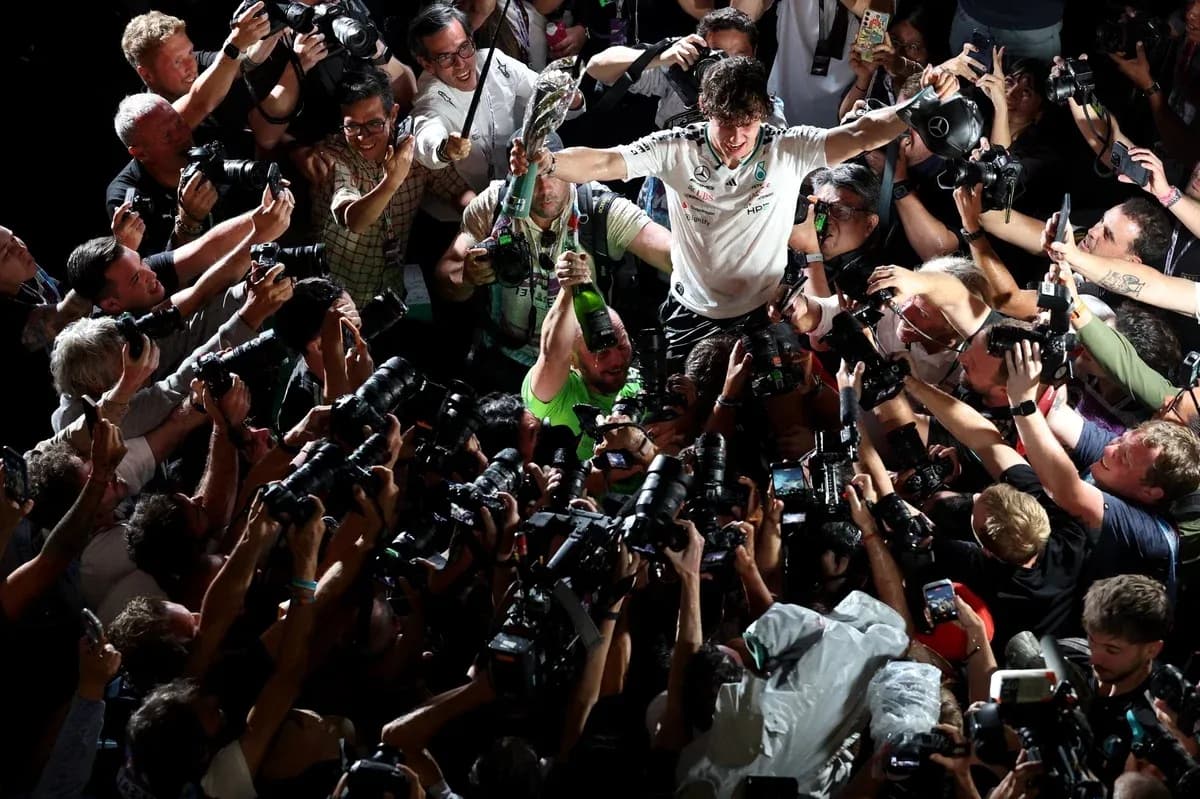
And then came Sunday night in Mexico City.
No corporate handshakes. No distant congratulations. Just hugs, tears and the raw emotion of a group of people who realised they hadn’t just helped a prodigy win a world championship. They’d watched a boy grow into a champion, and somewhere along the way, he’d become family.
The trophy will sit in a cabinet. The real question now is what this kid-at-heart, with a world title already in his pocket and a garage utterly behind him, does with the rest of his Formula 1 life.