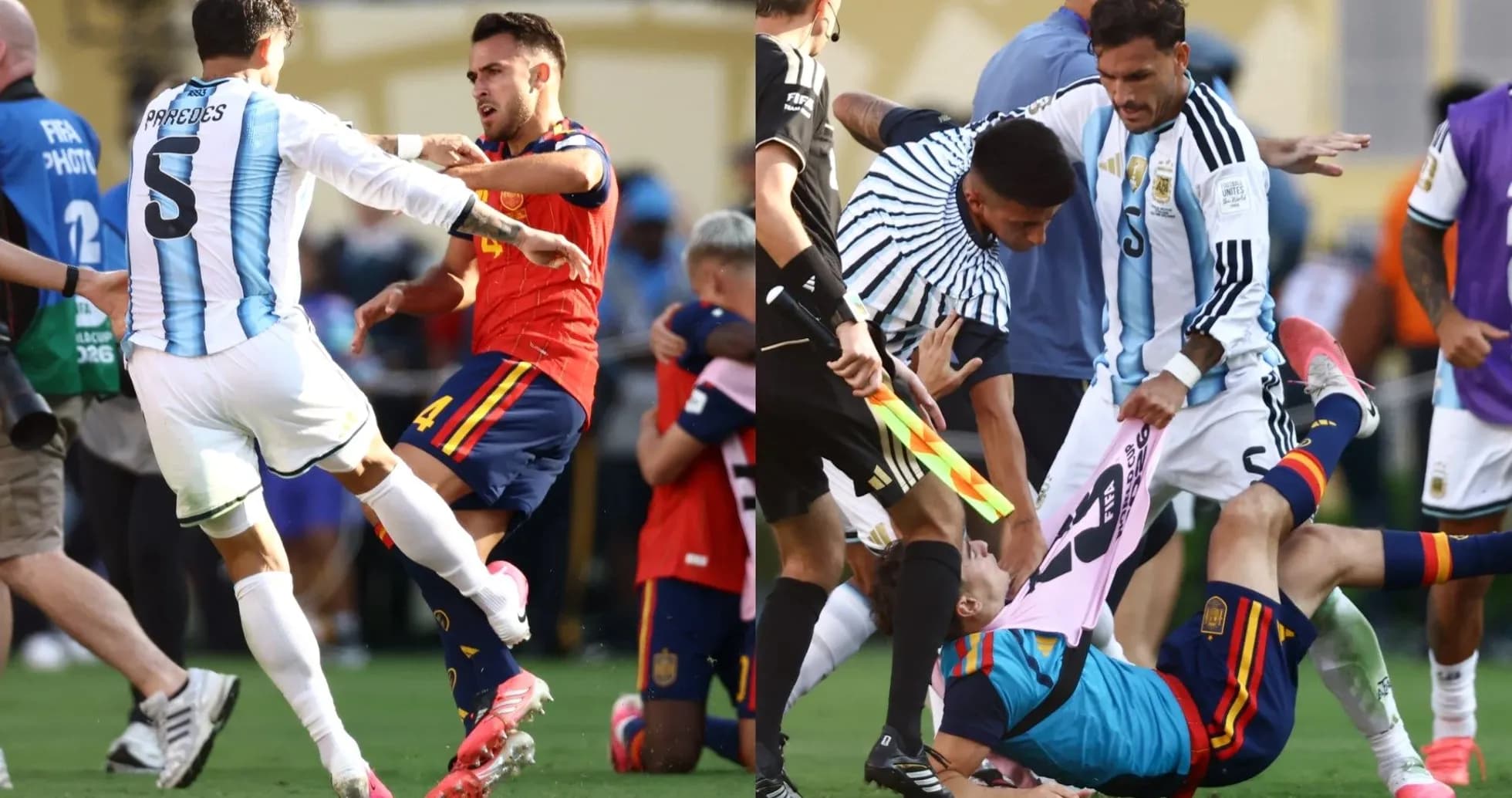
The 2026 World Cup final was supposed to be remembered for Spain’s 1-0 win. Instead, its legacy is a disciplinary dossier and a scramble inside the Argentine FA to limit the damage.
FIFA has come down hard on several members of the Albiceleste setup after the violent scenes that followed the final whistle, with assistant coach Roberto Ayala among those punished. But one name sits above the rest.
Leandro Paredes.
The 32-year-old midfielder received the heaviest sanction of all: a 10-match suspension and a £65,000 fine. FIFA cited a series of flashpoints in its ruling — Paredes grabbing Eric Garcia by the throat, striking Gavi in the face, then shoving the teenager to the ground. It was the kind of sequence that leaves no room for mitigation in a disciplinary chamber.
Nahuel Molina did not escape either. The right-back was hit with a seven-match ban after striking Spain captain Rodri in the torso, an incident that lit the fuse between the two sides and dragged players from both benches into the confrontation. Thiago Almada and Gavi each picked up one-match suspensions for their roles in the melee.
AFA’s damage-limitation play
Once the dust settled, Argentina’s focus turned from the pitch to the paperwork.
The AFA moved quickly, lobbying FIFA to reshape how those bans would bite. The federation issued a statement outlining a clear strategy: get the suspensions served in games that matter least.
“The AFA has formally requested FIFA to allow the sanctions imposed on its players during the 2026 World Cup final, and on the association itself, to be served in Class A friendly matches and/or official matches, whichever comes first,” the statement confirmed. FIFA’s Disciplinary Committee has approved that request in line with current regulations.
That decision changes everything for Argentina. Instead of losing Paredes and Molina deep into the next competitive cycle, the AFA can burn through those bans in friendlies, clearing the slate before the next major tournament kicks off.
The federation is not dropping its guard, though. It stressed that it is still awaiting the written reasoning behind the sanctions and is prepared to escalate.
“The AFA, in defence of its rights and those of its players, is awaiting the written justification for the decisions in order to file the corresponding appeals with FIFA's Appeals Committee, with the Court of Arbitration for Sport (CAS) potentially as the final recourse.”
The legal battle may yet stretch on. The sporting calculation is already under way.
Political flashpoint and financial pain
The brawl in the final was only part of Argentina’s disciplinary trail in this World Cup.
After their semi-final win over England, several players — including Lionel Messi, Cristian Romero, Giovani Lo Celso and Lisandro Martinez — celebrated with a banner asserting that the Falkland Islands belong to Argentina. The images raced around the world and triggered calls for individual bans on the grounds of political messaging.
Those calls did not translate into personal suspensions. Instead, FIFA targeted the AFA itself, issuing a £235,000 fine, with £73,000 of that amount suspended. The message was clear: the governing body would punish the institution rather than sideline some of the sport’s biggest names.
There is more. Argentina must also play their next two home fixtures in front of reduced crowds. Stadium capacity will be capped at 50 per cent, with one of those partial closures suspended. For a national team that feeds off a feverish home atmosphere, it is a tangible blow, even if it stops short of full stadium bans.
Friendlies as a lifeline
This is where Argentina’s unique position in the next World Cup cycle comes into sharp focus.
As co-hosts of the centenary edition, they already hold a guaranteed place at the tournament. No qualifiers. No play-offs. No high-stakes trips into hostile territory just to book a ticket.
That security gives the AFA room to manoeuvre. With their next competitive fixtures not arriving until the 2028 Copa America, Argentina can load the calendar with Class A friendlies and start chipping away at those suspensions immediately.
Ten games without Paredes. Seven without Molina. On paper, those numbers sound brutal. In practice, if most of those matches are friendlies, Lionel Scaloni and his staff can manage the absences while continuing to build the next version of the national team.
It also sets up a curious picture for the coming years. Argentina, world champions in 2022 and finalists again in 2026, will spend a long stretch without competitive edge, relying on exhibition games to keep sharp and to reintegrate sanctioned players.
The bans will pass. The fines will be paid. The stadiums will fill again.
What lingers is a more uncomfortable question: when Argentina finally walk into the 2028 Copa America at full strength, will they be remembered more for their football — or for the chaos that followed a World Cup final?