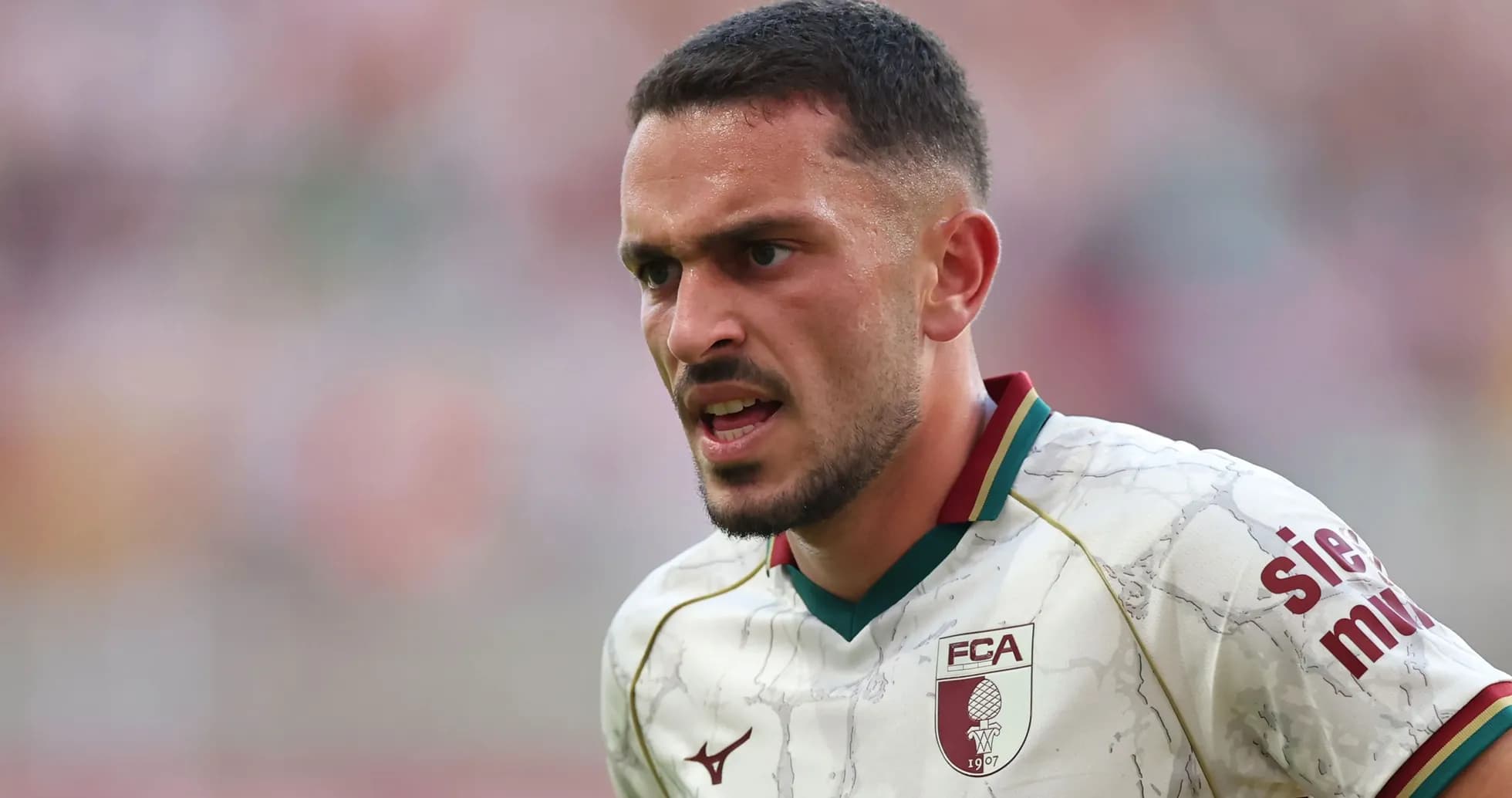
Two months. That is all it took for FC Bayern’s grand plan for Arijon Ibrahimovic to flip on its head.
On 7 July, the club’s message was loud and polished. “FC Bayern are planning firmly with Arijon Ibrahimovic,” blared the headline as the German record champions extended the 20-year-old’s contract. Christoph Freund beamed into the club camera and delivered the line every academy talent dreams of hearing: this was no longer just about learning, he said. Now it was about “making an attack, here at FC Bayern.”
Fast forward to early September and Ibrahimovic is indeed on the attack – just not in Munich’s red.
He has one Bundesliga appearance and one goal to his name this season, and he sits atop the table with two wins from two. Not with the juggernaut from the state capital, but with FC Augsburg, a club that moved quickly when Bayern suddenly loosened their grip on one of their most intriguing youngsters.
From cornerstone to collateral
For Ibrahimovic, the summer must have felt like a whirlwind that never quite settled. The attacking midfielder, already familiar with loan spells, could be forgiven for feeling like the character in Hannes Wader’s song: “Here today, gone tomorrow, I'm hardly here before I must leave.”
He had just spoken of his delight at getting “the chance to play for the biggest club in the world.” The plan, at least publicly, was clear. He was meant to be the understudy to the tireless Luis Diaz, learning in the shadows but close enough to the spotlight to feel its heat.
Then came Max Eberl.
Shortly before deadline day, Bayern’s sporting boss stepped in front of the microphones and cracked open a door that Ibrahimovic and his camp thought was firmly shut. “If there is something there that is ready to be announced, that could be interesting for both parties, then we would be open to that again,” Eberl said.
The message landed like a cold shower.
How open Ibrahimovic truly was to another departure remains murky. Officially, Freund later framed it as a joint decision. In the 1 September press release, he spoke of an agreement with the player that “it is best for his development if we loan him out for another season.” The wording suggested a carefully managed step, a continuation of the Bayern pathway.
Behind the scenes, the mood sounded very different.
Irritation, confusion and a late scramble
According to Sport1, Ibrahimovic was said to be “extremely irritated” by the sudden change of course. His agent, Roman Rummenigge, reportedly felt “blindsided” by Eberl’s uncoordinated move. From their perspective, nothing in the previous weeks had hinted at a U-turn. On the contrary, the signals had suggested growing trust and a realistic shot at minutes.
Werder Bremen sensed an opening and tried to pounce. Augsburg pushed harder.
In the end, FCA did not just secure a straight loan. They negotiated an option to buy, worth eight million euros, a figure that underlines both Bayern’s lingering belief in his potential and their willingness to let someone else carry the risk. Freund continued to talk him up publicly, calling Ibrahimovic “a young player with great attributes” who “needs regular match practice at this stage. He will get that at FC Augsburg, and we will continue to support him closely along the way.”
Between the lines, the question hung in the air: was this really about development, or about Bayern quietly deciding he is not yet – or perhaps not ever – at their required level?
The backdrop did not help him. In pre-season, Ibrahimovic passed up several big chances, and the online debate turned sharp. Sections of the Bayern fanbase questioned whether he possessed the class for the biggest games, the touch and ruthlessness demanded at the very top. For a 20-year-old still learning the trade, the margin for error felt brutally thin.
Augsburg’s instant payoff
If Ibrahimovic carried any of that baggage to Augsburg, he dropped it quickly.
Under coach Manuel Baum, he walked straight into the starting XI for his first game. No cautious easing-in, no late cameo. Just a clear vote of confidence. He responded in the best possible way, scoring in a 4-1 win at Eintracht Frankfurt and immediately stamping his name on the new project.
The contrast with his situation in Munich could hardly be sharper. At Bayern, every missed chance was a data point in a wider argument about squad planning, youth development and the impatience of a superclub. At Augsburg, every touch is an opportunity. Every run, every shot, a step in building a team that can punch above its weight.
For now, the hasty exit from Säbener Straße has worked in his favour. He has minutes, a goal, and a coach willing to trust him from the start. Augsburg hold an option that could reshape his career trajectory. Bayern, for all their talk of long-term planning, must watch from a distance as a player they once showcased as part of their future tries to prove he belongs on the biggest stage.
If he keeps striking like he did in Frankfurt, the next decision about Arijon Ibrahimovic’s future will be far more expensive – and far more uncomfortable – for the club that first promised him an attack on the Bayern first team.