
Aston Villa’s furious director of football operations Damian Vidagany has taken direct aim at Roy Keane after the club’s wild 4-4 draw with Manchester United – and, more pointedly, at the decision to allow a chaotic late equaliser to stand.
At the heart of the row: a scrambled corner, a floored goalkeeper, and two very different interpretations of what “contact sport” really means inside a six-yard box.
Eight goals, one flashpoint
For 90 minutes, Villa looked ready to walk out of Old Trafford with a statement win and a reminder that Unai Emery’s side intend to live among the Premier League elite, not just visit.
They tore into United. Two goals up inside three minutes, Alysson and Nicolas Jackson silencing the home crowd and shredding United’s defensive shape. It was ruthless, direct, exactly the kind of away performance Emery has been trying to bottle.
United, though, clung on. Bruno Fernandes dragged them back into it from the penalty spot, then Youri Tielemans – facing his former club – struck to level before the interval. The game swung, then swung again.
Villa refused to fold. Early in the second half, John McGinn restored the lead from the spot, and when Leon Goretzka finished off a set-piece routine, the visitors were cruising at 4-2. Emery’s team had control, territory, and belief. Old Trafford had anxiety.
Then came stoppage time.
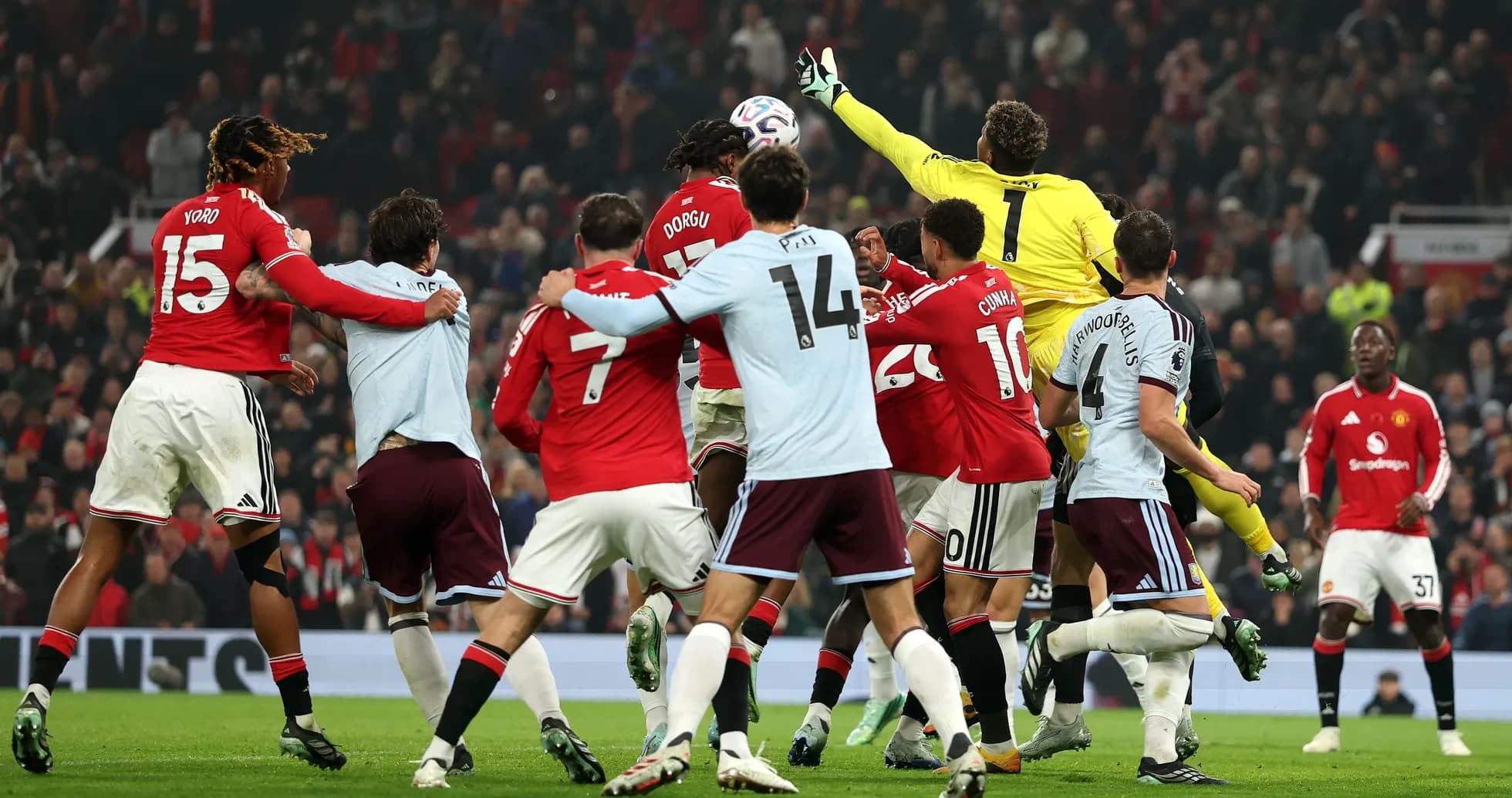
Joshua Zirkzee struck in the 92nd minute to make it 4-3 and crack the door open. Villa, suddenly jittery, retreated. United poured forward. From a last-gasp corner, the ball ricocheted around, bodies everywhere, and Patrick Dorgu forced it over the line.
As United celebrated, Villa’s players sprinted at the referee, pointing furiously at Zion Suzuki sprawled on the turf, claiming he had been deliberately blocked by Senne Lammens. The officials weren’t interested. The goal stood. Two points vanished.
Keane’s blunt verdict
In the Sky Sports studio, Roy Keane had little time for Villa’s complaints or Suzuki’s protests.
“I don’t think Suzuki gives himself the best chance of getting it, he’s underneath it, just take a step back and attack it,” Keane said, dissecting the corner. “There are bodies in the way, but there’s lots going on, football is a contact sport. I have no problem with it.”
He doubled down.
“I’ve said it before, a goalkeeper in this situation should take command of it. If he’s talking about getting blocked and pushed, why doesn’t he do that to the opposition players? He’s got to come and be aggressive, take command of it, when the ball comes in he’s on his heels and he’s got to be more aggressive and take command of that six-yard box.”
Keane’s message was clear: stop complaining, start dominating.
Vidagany hits back: “Rules are the rules”
Villa’s hierarchy did not let that go unanswered.
Vidagany went straight to X to challenge both the narrative and, by extension, the officials’ interpretation of the laws after a summer of briefings about goalkeeper protection.
“To put in context this convenient narrative of ‘contact sport’ we’ve been told by referees during the summer that this season to go to unbalance or push the GK on purpose on the six-yard box was not going to be allowed anymore,” he wrote.
He then turned the spotlight firmly on Lammens’ role in the melee.
“Lammens not even look at the ball, went straight to do a contact with the hip over Zion. Having said that we played good Match and we must do better than last 6 minutes. We will do and we will improve. But the rules are the rules and must be respected. That is a fact.”
No nuance. No softening. For Vidagany, this was not a grey area of interpretation. It was a failure to enforce what clubs had been told to expect.
Emery takes the long view
While his director raged online, Emery cut a more measured figure in front of the cameras, though the frustration still leaked through.
“Angry? To accept the two late goals is difficult,” he admitted in his press conference. “It is a process and a good example. How we conceded this last goal, it is adaptation for Suzuki. They are pushing and disturbing him.”
The Spaniard has managed across Europe. He knows the contrasts in officiating and physicality, and he framed Suzuki’s struggles as part of a broader culture shock.
“Other countries, they do not permit it. Here, yes,” he said. “We have to continue analysing and having experiences and trying to avoid situations like we conceded. Am I angry? We must accept that this is the process of adaptation.”
No public condemnation of the officials. No direct swing at Keane. Instead, a clear message: this is England, this is the Premier League, and Suzuki has to learn fast.
Set-piece scars and a test of character
The collapse was brutal. From 4-2 up and cruising to 4-4 and shell-shocked in stoppage time, Villa saw a landmark away victory ripped away in the most predictable, old-fashioned Premier League manner: corners, chaos, and a goalkeeper targeted under pressure.
Emery and his staff now have little choice but to turn the final six minutes into a teaching tool. Defensive set-pieces will dominate the video room. Body positions, blocking runners, protecting Suzuki’s space – all of it will be under the microscope.
For Suzuki, the scrutiny will be immediate and unforgiving. Opponents will have watched those closing moments and taken notes. Corners will rain in. Players will crowd him, lean on him, test both his temperament and his understanding of what referees will allow in English penalty areas.
Villa’s director has made his stance clear. His manager has outlined the adaptation required. The officials have shown where the line currently sits.
The next time a high ball drops into Suzuki’s six-yard box with the game on the line, will he get the protection Vidagany expects – or the rough treatment Keane demands he learns to survive?





