Atlanta Hawks: Embracing a New Identity After Trae Young
The Atlanta Hawks didn’t just survive the post-Trae Young era. They accelerated through it.
A franchise that looked headed for a long reset last fall ripped off the biggest post-All-Star break surge in nearly three decades, went toe-to-toe with the eventual champion New York Knicks, and now enters the new season with a roster that is deeper, nastier defensively and unapologetically built in Quin Snyder’s image.
This is no soft reboot. This is a team built to bother you for 48 minutes.
A New Identity, No Looking Back
Last season’s 46-36 finish and sixth-place spot in the East barely tell the story. Atlanta was minus-1.3 points per 100 possessions before the break, 19th in the league. After the break? Plus-9.7, fourth in the NBA. That 11.0-point jump per 100 possessions was the largest post-break leap by any team in the last 27 years.
The inflection point was clear: the Trae Young trade and the arrival of CJ McCollum.
Atlanta didn’t get younger or stockpile picks in that deal. They got better. Immediately. With McCollum in the lineup, the Hawks went 27-14, climbing from ninth to sixth in the East over the final two months. The schedule helped – only eight of those 20 post-break wins came against teams that finished with winning records – but the transformation was real enough to carry into the playoffs.
They led the Knicks 1-0. Then 2-1. For three games, Atlanta made the eventual champions look ordinary. New York needed three straight wins to survive, and outside of that series, the champs lost just once the rest of the postseason.
That’s the bar the Hawks now measure themselves against.
Star Power With an Edge
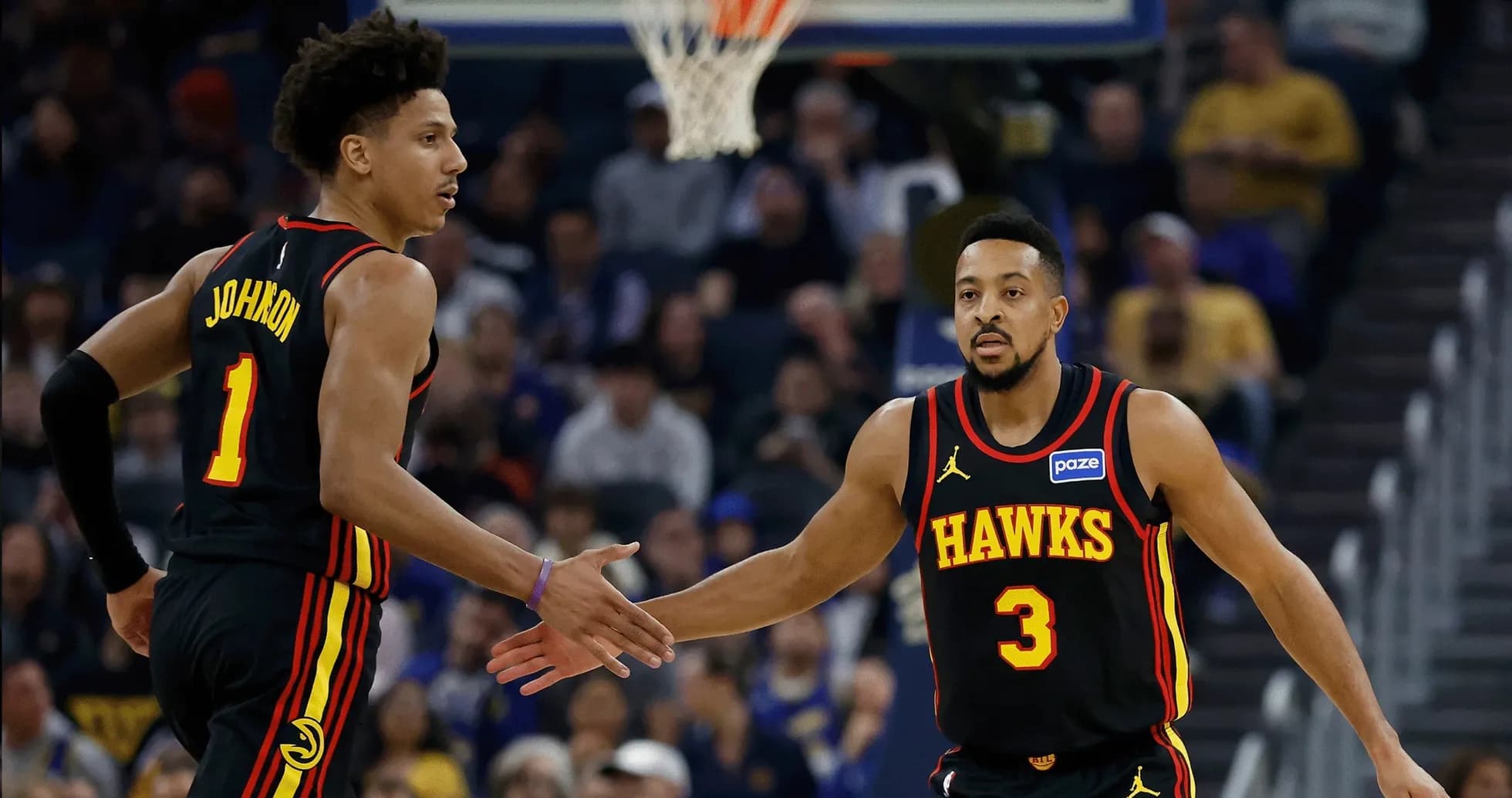
Jalen Johnson is no longer a “promising young forward.” He’s the engine. An All-Star and All-NBA selection last season, Johnson averaged 22.5 points, 10.3 rebounds, 7.9 assists and 1.2 steals. Those are franchise-player numbers, and they came with an all-court presence that fits perfectly with Snyder’s aggressive, turnover-hunting defense.
Beside him, Nickeil Alexander-Walker exploded. The Most Improved Player winner delivered 20.8 points, 3.7 assists and 3.4 rebounds a night, hitting 45.9% from the field, 39.9% from deep and 90.2% at the line. He went from “nice rotation guard” to full-on offensive weapon.
Add in McCollum’s 18.7 points per game and Atlanta suddenly boasts three perimeter creators who live in the 18–22 point range, each capable of carrying stretches of offense while the others rest or space.
Onyeka Okongwu anchors the middle with 15.2 points, 7.6 rebounds and 3.1 assists per game, giving the Hawks a big who can finish, facilitate and defend in space. Dyson Daniels provides more size and length on the perimeter, another long-armed piece in a defense designed to suffocate ball-handlers and turn mistakes into threes the other way.
Snyder wants his group flying around, forcing turnovers, then letting it rip from beyond the arc. Nearly 40 three-point attempts per game is the target. The Hawks were good from deep last season. He wants them ruthless.
Depth With Teeth
The starting five of McCollum, Alexander-Walker, Daniels, Johnson and Okongwu posted a 20-10 record with a blistering plus-20.3 net rating last season. That was before the front office loaded the bench.
Now, Snyder can turn to Luguentz Dort, Aaron Wiggins, Jock Landale, Zuby Ejiofor, Kingston Flemings, Asa Newell, Buddy Hield, Corey Kispert and Ryan Nembhard. That’s a full second unit and then some, with different looks for every opponent and every matchup.
Dort instantly raises the defensive floor on the wing. Wiggins brings efficient scoring and playoff experience. Hield and Kispert stretch the floor. Flemings, the lottery pick, is the long-term swing, a young talent who gets to learn the NBA game next to a veteran guard like McCollum.
The real challenge now isn’t talent. It’s sorting it.
Snyder has to decide: who starts, who finishes, and who thrives as a reserve? Last season’s best lineup didn’t include Dort or Wiggins. This season, he has to find the balance between continuity and upgrading the defense and shooting with his new options.
The backup power forward spot is another preseason battleground. Behind Johnson, Mouhamed Gueye, Newell and Ejiofor will fight for minutes. Atlanta doesn’t need all three to pop. It just needs one to stick.
Aaron Wiggins, Waiting to Be Unleashed
If there’s a breakout candidate hiding in plain sight, it’s Aaron Wiggins.
In Oklahoma City, he was the definition of “useful role player” on a loaded young roster – a contributor to the Thunder’s 2025 championship and 2026 Western Conference Finals run, but never a featured piece. His career-high in minutes per game (24.2) came as a rookie in 2021-22. He’s averaged double-digit scoring just once, at 12.0 points per game in 2024-25.
The efficiency, though, has always been there: 48.7% from the field, 38% from three for his career.
Atlanta needs exactly that profile. They were a good three-point shooting team last season but still chasing better efficiency. Give Wiggins more opportunity in a system that thrives on drive-and-kick threes, and he becomes a clean fit as a secondary scorer and spacer, especially with defenses tilted toward Johnson, Alexander-Walker and McCollum.
On a deep roster, he won’t get star usage. He won’t need it to change games.
The Numbers Say “Contender in Waiting”
The Hawks finished 14th in offensive efficiency and 10th in defensive efficiency last season. Respectable, not terrifying.
But that post-break surge, the lineup data, the playoff push against the eventual champs – it all points to a team that already made a jump and might still be only halfway through its climb.
They forced more turnovers, ran more, and leaned into Snyder’s vision of a modern, aggressive, three-heavy offense. The roster moves this summer only hardened that identity: more length, more defense, more shooting, more versatility.
The question now isn’t whether Atlanta is competitive. It’s how quickly this version of the Hawks can break into the East’s true inner circle.
Dates That Will Define Them
Some games on the schedule carry more weight than others, even before the season tips.
On Oct. 21, the Hawks host the Magic in a Southeast Division clash between last season’s top two teams in the division. Four teams in the Southeast believe they’re playoff locks; the margin for error is tiny. These head-to-heads matter.
On Nov. 29, the Knicks return to face the team that had them wobbling in the first round. Atlanta led that series 1-0 and 2-1 before New York flipped the switch and dropped just one more game the rest of the postseason. For the Hawks, that night is a measuring stick, and maybe a reminder.
Feb. 1 in Washington will feel different. Trae Young faces Atlanta for the first time since the trade, wearing Wizards colors. For a franchise that pivoted so sharply away from its former star, that evening will say plenty about where both sides are headed.
A week later, on Feb. 8, the Heat come to town in what could be a battle for the top of the division, just three days before the trade deadline. By then, the Hawks will know what they are – and what they might still need.
And on April 4 in Philadelphia, Atlanta walks into a late-season gauntlet: its eighth road game in an 11-game stretch, against a star-studded 76ers team. If seeding is tight, that night could swing their finish.
Preseason Questions, Regular-Season Ambitions
Training camp and preseason won’t be about survival. They’ll be about sorting abundance.
Can Snyder keep that devastating McCollum–Alexander-Walker–Daniels–Johnson–Okongwu lineup together and still carve out real roles for Dort and Wiggins? How quickly can Flemings pick up the pace playing off McCollum? Who wins the job behind Johnson at the four?
Atlanta already proved it could reinvent itself on the fly last season. Now the Hawks arrive with clarity, depth and a clear style.
They pushed the eventual champions to the edge once. With this roster, this coach and this identity, how long before they’re the ones everyone else is chasing?