Atlantic Division Arms Race: Knicks, Celtics, Sixers, Nets, Raptors
The Atlantic Division used to be chaotic. Now it’s something else entirely: an arms race. Champions in New York. A superteam experiment in Philadelphia. A proud giant in Boston trying to reset on the fly. Brooklyn hoarding youth and finally adding muscle. Toronto quietly sharpening the edges of a dangerous core.
Training camps are around the corner. The stakes are already sky-high.
New York Knicks: Champions, Finally – and Hungry for More
For 53 years, New York told stories about the past. Now it has a fresh one.
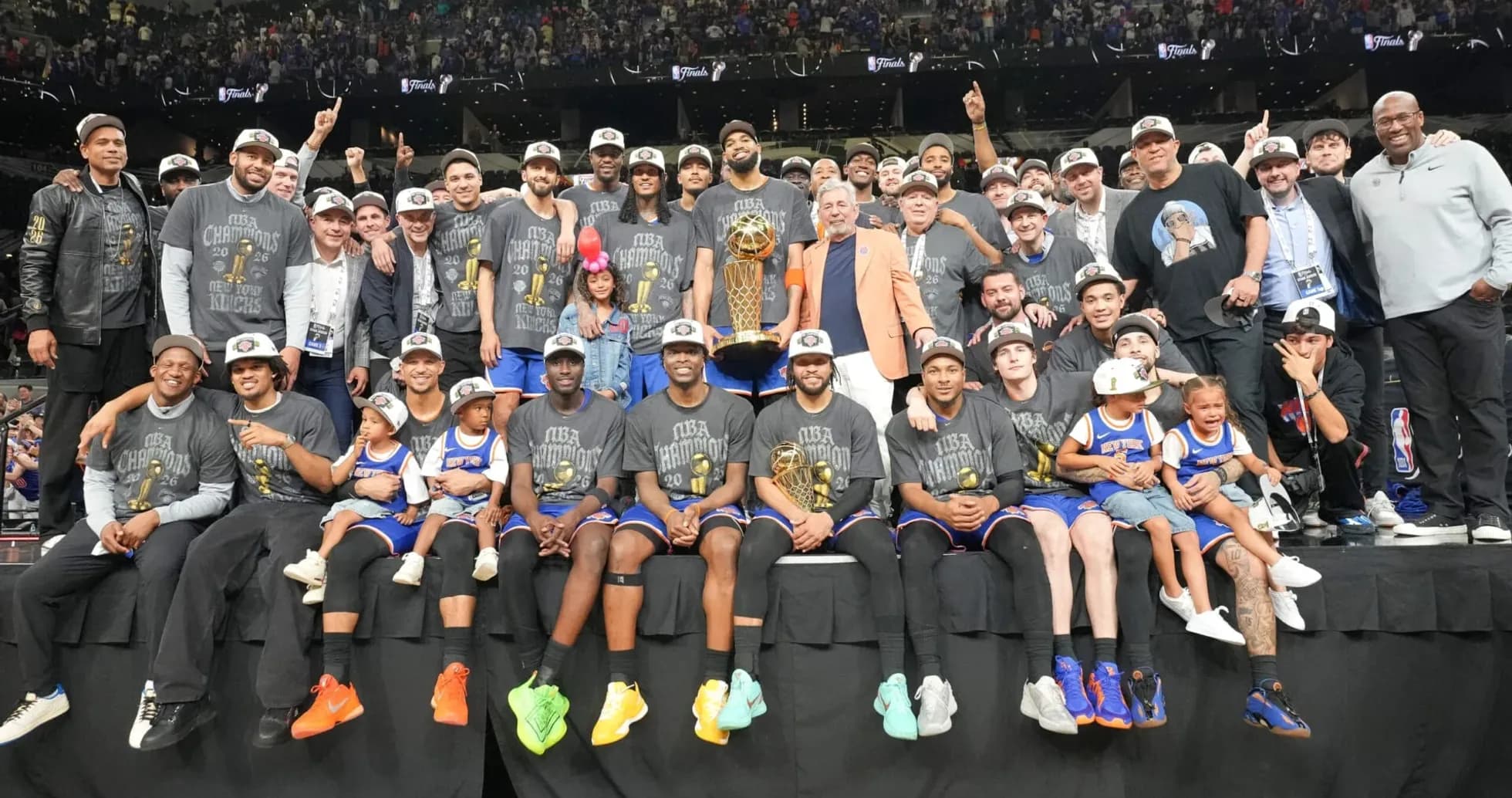
A 53-29 season ended with the Knicks back on the canyon of Broadway, riding through a parade the city had been waiting on since the early ’70s. That alone buys time in a market that usually has none to spare. There is no mandate to repeat. No ultimatums. No talk-radio edicts.
They don’t need external pressure. The roster supplies its own.
Mitchell Robinson, the anchor in the middle of that title run, cashed in elsewhere, heading to Boston in the aftermath of the championship. That’s the cold side of success: not everyone gets paid in the same zip code. New York’s answer was simple and unsentimental — Andre Drummond arrives as insurance behind Karl-Anthony Towns, still a force on the glass and a steadying veteran presence.
That was essentially the Knicks’ offseason. No sweeping overhaul. No panic moves. Just Drummond, Jack Kayil and Tyler Nickel in, Robinson, Ariel Hukporti and Jeremy Sochan out.
They can afford continuity. With Towns stretching the floor, OG Anunoby locking down wings, Josh Hart doing a bit of everything and Jalen Brunson — the 2026 Finals MVP and the heartbeat of the franchise — steering the offense, the Knicks bring back a core that already knows the way through four playoff rounds.
The drought is over. The banner is up. The question now isn’t if the Knicks can win a title.
It’s how long they can keep the wait in New York measured in months instead of decades.
Boston Celtics: Tatum’s Burden and a New Reality
Boston lived a split-screen season. On one side, Jayson Tatum spent most of the year in recovery, only returning late in the regular season. On the other, Jaylen Brown put together an MVP-caliber campaign, dragging the Celtics to 56 wins and a 56-26 record.
Then came the crash. A first-round exit and, soon after, a franchise-altering trade.
Brown is gone, shipped inside the division to Philadelphia in a move that sent shockwaves through New England and lit a fuse under the rivalry. In his place, the Celtics retooled with a mix of size, experience and one big bet.
Mitchell Robinson arrives to patrol the paint. Paul George comes in as the headliner, a former All-NBA wing trying to reestablish his star level after an uneven stretch. Mike Conley adds another veteran brain in the backcourt. Chris Cenac Jr. and Dillon Mitchell bring fresh legs to a rotation that suddenly looks deeper, if not as explosive.
The subtractions are significant. Brown’s departure is obvious. Dalano Banton, Chris Boucher, Max Shulga and John Tonje also move on, trimming some of the back-end depth.
Now the spotlight returns, fully and unapologetically, to Tatum.
Boston will lean on him to carry more scoring, more playmaking, more everything. He’s equipped for that. If George finds his rhythm, Derrick White recaptures his best form and Robinson shores up the interior, the Celtics have more than enough to punch their postseason ticket again.
But the dynamic has shifted. Brown is no longer Tatum’s running mate — he’s an in-division rival, flanking LeBron James and Joel Embiid. Boston isn’t just chasing a title.
It’s chasing ghosts of what might have been.
Brooklyn Nets: From Draft Room to the Grown-Up Table
Brooklyn spent last season in developmental mode, and the standings reflected it. A 20-62 record, fifth in the division, and a ton of minutes shoveled toward a young core.
That kind of year tests patience. This summer, the Nets signaled they’re ready to accelerate.
The headline move: Julius Randle. A former All-NBA forward, a familiar face in New York, and exactly the kind of bruising, ball-dominant presence who can ease the workload on Michael Porter Jr. Randle’s best years with the Knicks showed how he can carry an offense for long stretches. Brooklyn will ask him to do something similar, only this time in black and white.
Nic Claxton and Ziaire Williams exit, but the Nets don’t just plug Randle in and call it a day. They continue to layer in youth with purpose.
Mikel Brown Jr., taken at No. 6, brings polished combo-guard skills from Louisville. On a roster still in transition, he walks into a legitimate chance at early rotation minutes. That’s the reward for joining a team that isn’t pretending to be finished yet. Joshua Jefferson, selected at No. 28 with an additional first-rounder acquired in the Randle trade, adds another young forward to the mix.
Keon Ellis, Moritz Wagner and Tyler Bilodeau round out a group designed to give the coaching staff options and Porter Jr. some much-needed help on both ends.
There’s another layer of urgency: Brooklyn doesn’t control its own first-round pick outright next season. The Rockets hold swap rights. Tanking is off the table.
The Nets have to get better now — not someday.
Philadelphia 76ers: LeBron, Brown and Embiid Chase 1983
The Atlantic’s biggest detonation came in Philadelphia.
The 76ers once again watched a season bend under the weight of Joel Embiid’s health. Even with another injury-plagued stretch from their franchise center, they finished 45-37 and pushed into the conference semifinals. The foundation remained strong.
Then the front office lit a match.
Jaylen Brown arrived from Boston, a former rival turned co-star, already capable of carrying an offense and defending the best wing on the floor. That alone would have made the Sixers one of the most talked-about teams of the summer.
LeBron James made sure they became the most talked-about.
By choosing Philadelphia over other suitors, LeBron elevated the Sixers from dangerous to must-watch. He joins Embiid, Brown, All-NBA guard Tyrese Maxey and All-Rookie guard VJ Edgecombe in a starting five that can legitimately claim to be the league’s best on paper.
The supporting cast changed shape as well. Kentavious Caldwell-Pope adds championship experience and perimeter defense. Ariel Hukporti replaces Andre Drummond as the big man in reserve. Labaron Philon Jr. and Anfernee Simons deepen the guard rotation, with Dean Wade offering frontcourt flexibility.
Out go Paul George, Kelly Oubre Jr., Quentin Grimes, Drummond, Dalen Terry, Trendon Watford and Johni Broome. In come stars, shooters and role players built to orbit around Embiid and LeBron.
The questions are obvious and unavoidable. Can LeBron’s 40-year-old body handle another long run? Can Embiid stay upright long enough to anchor a title chase? If both cooperate, the Sixers are positioned to end a championship drought that stretches back to 1983.
Expectations aren’t high in Philadelphia.
They’re sky-high.
Toronto Raptors: Barnes at the Center of a Slow Burn
Toronto doesn’t roar as loudly as its divisional neighbors. It just keeps building.
The Raptors claimed the East’s No. 5 seed last season and pushed their first-round series to a Game 7. That’s not a moral victory. It’s a marker of how close they already are.
Their offseason was quiet by comparison. Kyle Anderson arrives as a savvy, shape-shifting forward. Jaden Bradley and Allen Graves join as young pieces. Sandro Mamukelashvili departs. No seismic trades. No superstar drama.
They don’t need it. Few teams in the league can match Toronto’s offensive balance. On any given night, three — sometimes four — Raptors can drop 20 points, and they can do it while holding up their end defensively.
The real bet is internal growth.
Collin Murray-Boyles is the early focal point. He developed steadily as a rookie, then exceeded expectations in the postseason with composed post moves and soft touch around the rim. Guards Ja’Kobe Walter and Jamal Shead appear on similar upward curves, hinting at a backcourt that could grow alongside the frontcourt instead of merely complementing it.
All of this orbits around Scottie Barnes.
Barnes is the franchise cornerstone, the player Toronto is determined to build around. With RJ Barrett flanking him on the wing and an emerging supporting cast around them, the Raptors have the depth, versatility and scoring to remain a problem in an Eastern Conference that only got tougher.
They’re not chasing headlines. They’re chasing continuity, development and another crack at the postseason with a sharper, older, more seasoned group.
In a division obsessed with instant fireworks, Toronto is betting the slow burn will eventually light up June.