
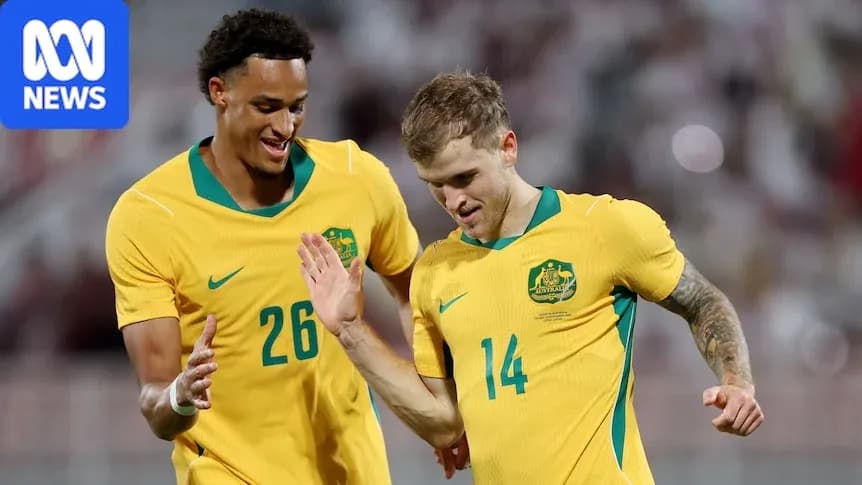
Australia didn’t just beat the Asian champions in Doha. They walked into the holders’ backyard, ripped up the script and left with a 3-0 win that felt like a marker for the Tony Popovic era.
By half-time, it was over.
Riley McGree, Tete Yengi and Nestory Irankunda all hit the scoresheet in a ruthless first 45 minutes, as the Socceroos swarmed a strangely lifeless Qatar side and exposed them with a mix of intensity and opportunism. The scoreline flattered the hosts. The performance did not flatter Australia.
Chaos at the back, composure up front
The tone was set almost immediately.
Five minutes in, new Qatar goalkeeper Mahmoud Abunada suffered a nightmare introduction. Trying to play out from the back, he rolled a short pass straight to McGree, who could hardly believe his luck. One touch to steady, a calm left-foot finish into an empty net, and Australia were up and running.
It was McGree’s second international goal, four years after his first, and a sharp reminder of what the Socceroos missed when injury ruled him out of the World Cup. He dictated early on, drifting into pockets, snapping into challenges, and almost doubling his tally with a crisp volley that flew just over in the 17th minute.
Qatar, under Julen Lopetegui, never really woke up. They looked slow, loose and oddly passive for reigning back-to-back Asian Cup champions. Every time they tried to reset, Australia hunted them down.
The pressure told again just after the half-hour. Another poor Abunada clearance, another Australian pounce. Connor Metcalfe intercepted, drove forward and slipped Yengi in behind. One touch, then a neat finish. 2-0, and Qatar were unravelling.
Australia smelled blood.
On the left, Irankunda was enjoying himself. He repeatedly isolated his full-back, drove at defenders and forced Qatar deeper and deeper. Five minutes before the break, more midfield thievery from Metcalfe opened the door again. He nicked possession, found Irankunda in stride, and the Sporting Lisbon forward hammered home his eighth international goal with authority.
Three up inside 40 minutes. The first time in five years the Socceroos had scored three in an overseas international. It could easily have been six by the interval. Qatar looked stunned; Australia looked like they were in a training drill.
Popovic experiments as debutants flood in
The second half was a different kind of exercise.
Popovic, satisfied with the damage already done, went to his bench and kept going. The changes came in waves and, as he admitted afterwards, the cohesion inevitably suffered. The slick combinations of the first half gave way to something far more disjointed, but the control never really left Australian hands.
Brotherly storylines added a human touch to the night. Kusini Yengi replaced his brother Tete at the break, continuing the family theme up front. On 65 minutes, Kasey Bos came on to join his absent older sibling Jordy in the ranks of full-fledged Socceroos. Late on, Diesel Herrington entered the fray, replacing Lucas Herrington, who had enjoyed what could fairly be described as an armchair outing in defence.
Eli Adams and Sam Klein also stepped onto the international stage for the first time, each banking valuable minutes in what had long since become a procession.
Qatar, for their part, barely laid a glove on Australia. Their first shot of any description arrived in the 72nd minute, and even then it was tame. Across the 90 minutes, the hosts managed just three attempts, none on target, barring an offside effort in the 88th minute that was swiftly chalked off.
Australia finished with 14 shots and the sense they had left goals on the table. Popovic’s irritation on the bench as chances went begging in the second half was clear enough, but so was his satisfaction at the overall body of work.
A statement in Doha, and a glance towards Jordan
This was exactly the kind of night Popovic would have wanted: a convincing win, a dominant first half, and a cluster of debuts in a low-risk environment.
“We set the game up with a very good first-half,” he told Paramount+, noting how his side won the ball high and stayed aggressive despite the Doha heat. Several players had come straight from cooler European conditions, yet Australia still pressed with a bite Qatar never matched.
There was another bonus. Instead of travelling to Amman for their next hit-out, the Socceroos will stay in Doha, with Asian Cup finalists Jordan coming to them on Tuesday. After this performance, they will approach that clash with genuine confidence.
They might also feel a twinge of frustration that they won’t be back in the region in January for the Asian Cup, now pushed to December 2027 in Saudi Arabia because of the regional conflict.
If this night in Doha is any indication, though, Australia plan to arrive at that tournament as something far more dangerous than plucky outsiders.





