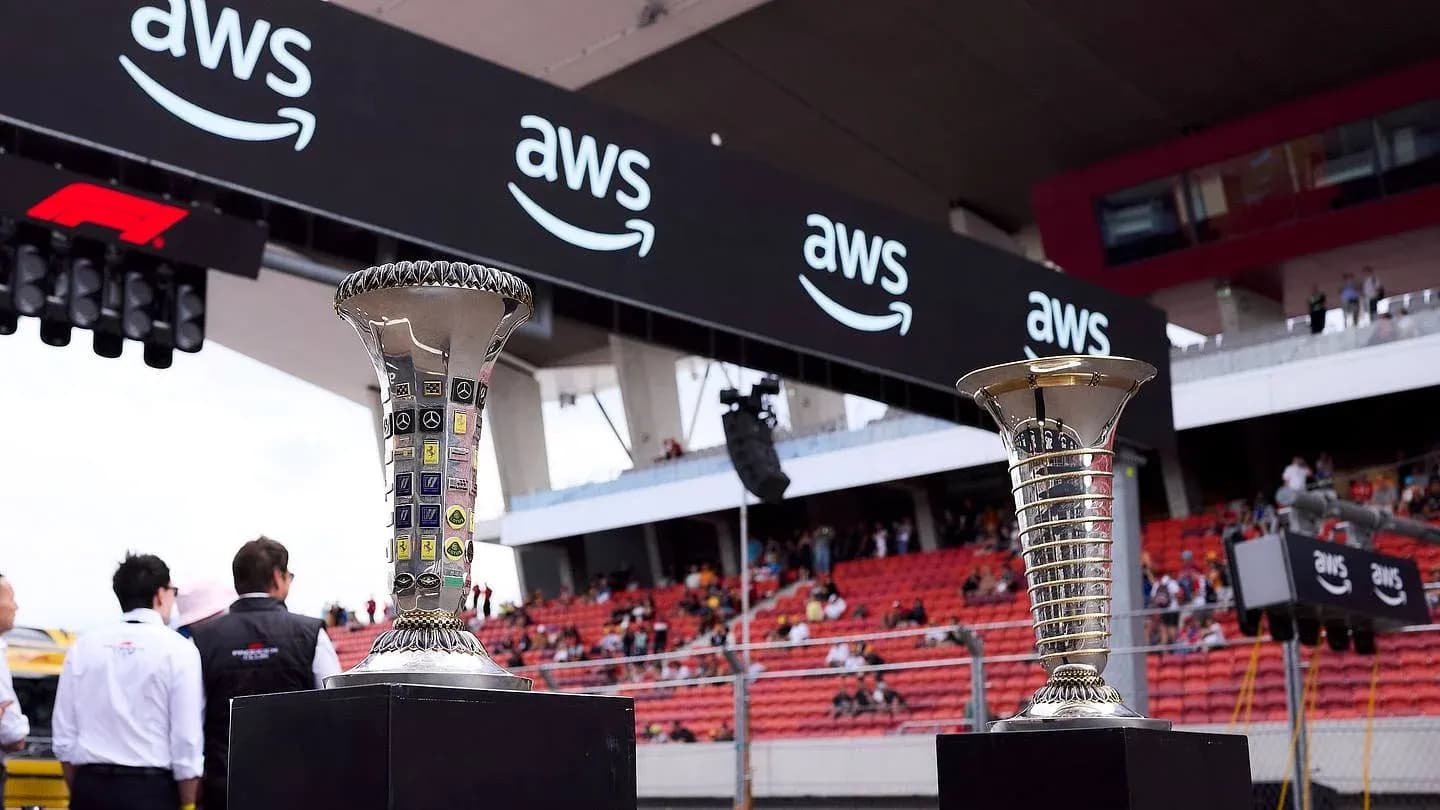
At Circuit of the Americas, the story starts long before the lights go out.
On a quiet Austin morning, in a corner of Soho House with a coffee cooling on the table, Ruth Buscombe is already talking about Sunday as if it has happened. No car has turned a wheel. No engine has fired. Kimi Antonelli is not yet World Champion. But the narrative that millions will consume around the world is already being stitched together.
A week later, Antonelli will clinch the title in Mexico. In Texas, he wins from pole on a one-stop strategy, falling just two points short of wrapping it up early. The race looks simple on television. It never is. And that gap between what is happening and what fans can see is where Amazon Web Services has planted itself at the heart of modern Formula 1.
COTA, Casual Fans and a New Kind of Audience
Buscombe has been coming to Austin since F1 first rolled into COTA in 2012. Back then, Liberty Media hadn’t yet transformed the sport’s U.S. footprint. Apple TV wasn’t in the F1 business. AWS wasn’t a broadcast staple. The race was an event, not yet a cultural touchstone.
Now, the United States Grand Prix is something else entirely. It’s a magnet for casual viewers, a weekend that pulls in millions of Americans who might not watch another race all year. This season, many of them didn’t even arrive via F1’s own platforms, but through Apple TV.
For Buscombe, that audience is not a side note. It is the point.
The numbers underline the shift. F1’s global fanbase is young and increasingly female: 43% under the age of 35, 42% female, with the fastest-growing demographic being women aged 11 to 25. A huge slice of the people tuning in have never known an F1 without Netflix, social media cutdowns or mid-race tyre graphics. They haven’t been around for the last 30 years of strategy lore. Many weren’t even born.
That is the gap AWS is trying to fill.
On the F1 app, AWS powers personalization. On the global broadcast, its F1 Insights graphics act as a trackside strategist for the living room: why one car is flying and another is stuck in traffic; why a team gambles on soft tyres instead of hards; why a pit stop comes now and not three laps later.
The philosophy is simple: if you can understand the story, you can fall in love with the sport. The job is to make a first-time viewer feel like they’re not just watching the race, but reading it.
At COTA, AWS put that idea on display with something that hints at where all of this is heading: Insight Track.
It’s essentially a strategy sandbox. A fan can say, “Show me what would have happened if Charles had gone to hards instead of mediums,” or, “What if Lando Norris had stopped two laps earlier?” and watch an alternate race unfold. It’s the fantasy of every armchair strategist made tangible: not just second-guessing a team, but running the counterfactuals.
It’s not yet in the hands of the public. But it is a clear sign of intent. This is about more than explaining F1. It is about letting fans inhabit it.
From 300 Sensors to a Single Graphic
The path from car to couch is brutal, fast and utterly unforgiving.
Every modern F1 car is a rolling data factory. As Michael Aghataher, who heads the F1 partnership for AWS, outlines, each machine carries around 300 sensors, generating 1.1 million data points per second, per car, per race. Layer on top more than 20 weather stations monitoring temperature, humidity and wind. Add timing loops every 150 metres, tracking exactly where each car is on track at any moment.
All of that firehose of information streams into F1’s Event Technology Center. From there, it splits: to Biggin Hill, to AWS for processing, and then back again. The entire round trip has to happen in less than 1.5 seconds so that a director can decide whether a piece of insight earns its place on screen.
Out of this flow come the Track Pulse systems and the F1 Insights graphics – tyre wear estimates, pit window projections, overtake probabilities, pace comparisons. They’re not just numbers; they are editorial tools, used by the production team to answer the questions fans are yelling at their televisions.
The system was stress-tested at Sepang, when F1 returned to a circuit that pre-dated AWS’s involvement in the sport. There was almost no historical data for teams, for F1, or for Buscombe herself.
She prepared like a fan at home would: leaning entirely on the AWS tools available across the weekend. No private test days. No legacy models. No secret stash of team telemetry. Just the same backbone of information that underpins what viewers see on screen.
You wouldn’t have known that watching the broadcast. That’s the point. The tech is supposed to disappear into the storytelling.
The Fight for Screen Real Estate
At the other end of the pipeline sits Dean Locke, F1’s director of broadcast and media. His team decides what actually reaches fans, whether that’s through F1TV, Sky Sports or the feeds pumped around the circuit to half a million spectators trackside every weekend.
The more content F1 creates, the fiercer the battle for every inch of the screen.
Locke treats each graphic like a player trying to earn a spot in the starting XI. If it’s on the broadcast, it has to justify its place.
He talks about watching other sports and seeing graphics that feel like clutter – information with no clear purpose. F1, he insists, cannot afford that. Every piece of data that appears must tell a story, be instantly understandable and add something to the viewer’s grasp of the race.
Strategy Insights, rolled out only a few races ago, is the clearest example of that principle. It was built to answer the exact questions that erupt in Locke’s production gallery mid-race.
The moment someone in the room says, “Why haven’t they stopped?” or “Why on earth have they pitted now?” he knows millions at home are thinking the same thing. That’s when the data has to step in, not as decoration, but as explanation.
F1’s broadcast team is not just looking inward. Locke and his group are raiding film, gaming and other sports for ideas, asking how techniques used in a meticulously crafted movie can be adapted to the chaos of live television. The upcoming F1 movie has already sparked conversations: if they can make that look and feel work on a film set, what can be salvaged for a real-time broadcast?
Again, the common thread is AWS – the engine room that turns ambition into something that can survive the brutal 1.5-second decision window.
The Intelligence Layer Spreads
When AWS first signed on with F1 in 2018, the remit was relatively narrow: modernize the broadcast, bring a data-driven edge to the coverage, give the “racing purists” more depth.
Then 2020 happened. Drive to Survive exploded. F1 stopped being just a sport and became a cultural product – part drama, part lifestyle, part fashion. The audience swelled, and with it the expectations placed on the partnership.
Track Pulse arrived in 2021, born from the realization that storytelling needed more than radio snippets and lap charts. As the boom carried on through 2023 and beyond, casual fans flooded in, and F1 Strategy Insights emerged in 2026 to meet them where they were: curious, engaged, but not yet fluent in the sport’s tactical language.
Aghataher now describes AWS as the “intelligence layer” of F1, a phrase that neatly captures how deeply embedded the technology has become. It’s no longer just a broadcast bolt-on. It sits across the sport.
The FIA has now formalized that reality, naming AWS its Official AI, Cloud, Computing, Machine Learning and Cloud Infrastructure Partner across all its properties. The same systems that help fans understand tyre strategy can also help stewards analyze track limits, speed violations and other regulatory flashpoints with more precision.
The tech that once simply explained the race is now influencing how it is governed.
Writing Tomorrow’s Story, Today
Which brings us back to that coffee at Soho House in Austin.
Before a single car had turned a lap at COTA, Buscombe was already building the narrative that would carry Antonelli from pole to victory and on towards his title in Mexico. The same infrastructure that allowed her to simulate strategies and decode Sepang now underpins almost every aspect of how F1 is experienced.
It reaches into the paddock, the stewards’ room, the director’s gallery, the fan’s living room. It is constantly being refined, challenged and pushed into new shapes.
To learn a sport is to love it. That line, repeated so often by Buscombe, has quietly become the unofficial motto of this entire project.
The question now is not whether AWS can help fans understand what they’re seeing. It’s how far this intelligence layer will go in reshaping what Formula 1 is – and who, exactly, gets to feel like they are part of the race.