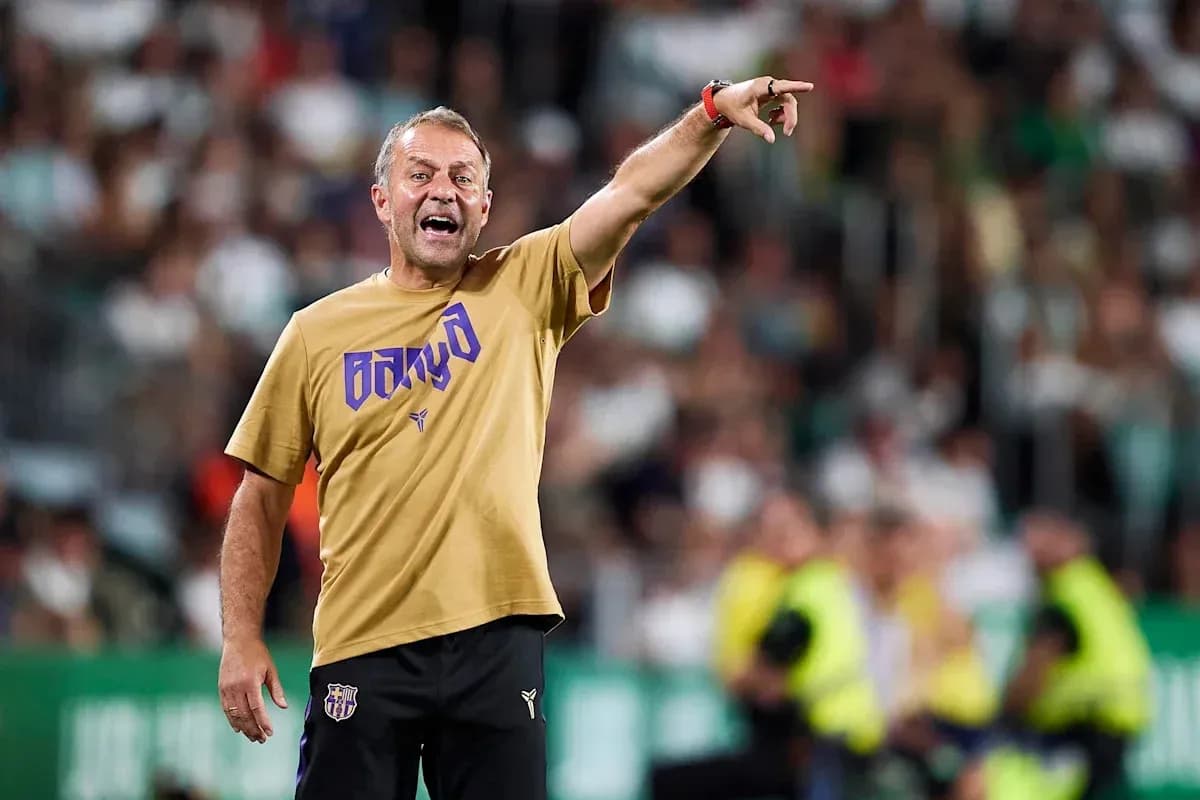
The clock is ticking in Barcelona, and for all the noise of this transfer window, one problem still sits in plain sight at the heart of the pitch.
Hansi Flick has his forwards. He has his midfield variety. He has fresh legs in wide areas. But at center-back, with only hours left before the window shuts, Barça are still walking a tightrope.
A free-flowing attack, a fragile core
The 5-2 win over Rayo Vallecano summed up this Barcelona side in one wild, breathless snapshot. Going forward, they can overwhelm almost anyone. They can turn games into track meets and back themselves to win the race.
But Rayo also showed what every analyst and every opponent already knows: this team can still be got at. The spaces between the lines, the gaps behind the back line, the moments when a simple ball in behind causes panic. For a club aiming to compete deep into every competition, that is a dangerous way to live.
With Álvaro Cortés gone, the margin for error at center-back has shrunk even further. The depth chart is brutally simple: Pau Cubarsí, Gerard Martín, Andreas Christensen. That’s it in terms of natural, senior central defenders.
Eric García and Jules Koundé can step inside when needed, of course. They’ve both done it, and done it well. But right now they are being used at right-back, and Flick’s structure leans heavily on them out wide. On paper they are options. In reality, they’re already spoken for.
Flick’s trusted pair – and the looming risk
Cubarsí and Martín have raced through the trust barrier at breakneck speed. They are Flick’s pairing for the big nights, and they’ve justified that faith. Against Athletic Club they looked like they’d been playing together for years: calm on the ball, aggressive in duels, unflustered under pressure.
Christensen sits just behind them in the hierarchy, a classy, composed defender who can slot in without fuss. The issue is not his quality. It’s his body. His injury record forces any sporting director to plan with a wince. You can’t build a season’s security on a player who might miss chunks of it.
Strip it back and the picture is stark. One injury to Cubarsí or Martín, and Barcelona’s central defensive plan starts to look like a house built on matchsticks. Two injuries, and you’re into improvisation territory, shuffling full-backs and youngsters and hoping it holds.
For a mid-table side, maybe you roll that dice. For Barcelona, chasing titles on multiple fronts, it’s a needless gamble.
What kind of defender do Barça really need?
This is not about finding the next generational star to push Cubarsí or Martín out of the team. Flick’s starters are clear, and the club has invested heavily in their development and status.
What Barcelona need is something more pragmatic: a reliable, low-cost center-back who understands his role. Someone who can step in when a regular is injured. Someone who can start away to a lower-table side on a Sunday night so that Cubarsí or Martín can breathe for 90 minutes.
A squad player, not a headline act.
That profile matters. The dressing room dynamics, the wage bill, the expectations – all of it points towards a defender who accepts rotation and embraces it. Deco’s task is to find that piece without distorting the long-term plan or the financial structure.
A loan would make obvious sense. Short-term cover, minimal risk, and no obligation to block the pathway of the club’s young defenders if everyone stays fit.
Enter Ruud Nijstad
Into this context steps the name turning heads: Ruud Nijstad.
The 18-year-old left-footed center-back from FC Twente fits a very modern template. At 195 cm (6'5"), he brings a dominant physical presence, the kind of frame that instantly changes how opponents think about aerial duels and set pieces. Those who have watched him closely praise not only his defensive instincts but also his comfort carrying the ball out from the back – a non-negotiable trait in Barcelona’s system.
On paper, he ticks a lot of boxes. Left-footed. Tall. Confident in possession. Young enough to grow with Cubarsí and Martín. He has even spoken before about his desire to play alongside Cubarsí at Barça, a small but telling detail about his ambition and how he sees his own game.
The problem? He’s not on the bargain shelf.
Nijstad only recently signed a contract with FC Twente that runs until 2029. Twente see him as a prized asset, not a player to move on late in a window to help a European giant patch a hole. Any negotiation starts from a position of resistance, not opportunity.
For Barcelona, already walking a financial tightrope, this turns a smart idea into a complicated operation.
Deadline-day dilemma
So the question is brutally simple: do Barcelona need a center-back before the window closes?
On the evidence of their squad structure, their injury histories, and the demands of a season that will stretch into late spring, the answer leans heavily towards yes. The risk of going into the campaign with three natural center-backs – one of them with recurring fitness issues – is obvious.
Is Nijstad the answer? He might be the right profile, and he might even be the right long-term bet, but the timing and cost look awkward. Twente’s reluctance, his long contract, and Barça’s financial reality all pull in the opposite direction.
That leaves Deco with a familiar Barcelona puzzle: secure the future or protect the present? Invest heavily in a teenager who could anchor the defense for a decade, or find a cheaper, more temporary solution who simply keeps the season on the rails?
The window is closing. The attack is ready. The midfield is stacked. The project is taking shape.
The only question now is whether Barcelona dare to chase glory with one center-back too few.