Barcelona have nailed their colours to the mast for the 2026-27 season – and the armband tells its own story.
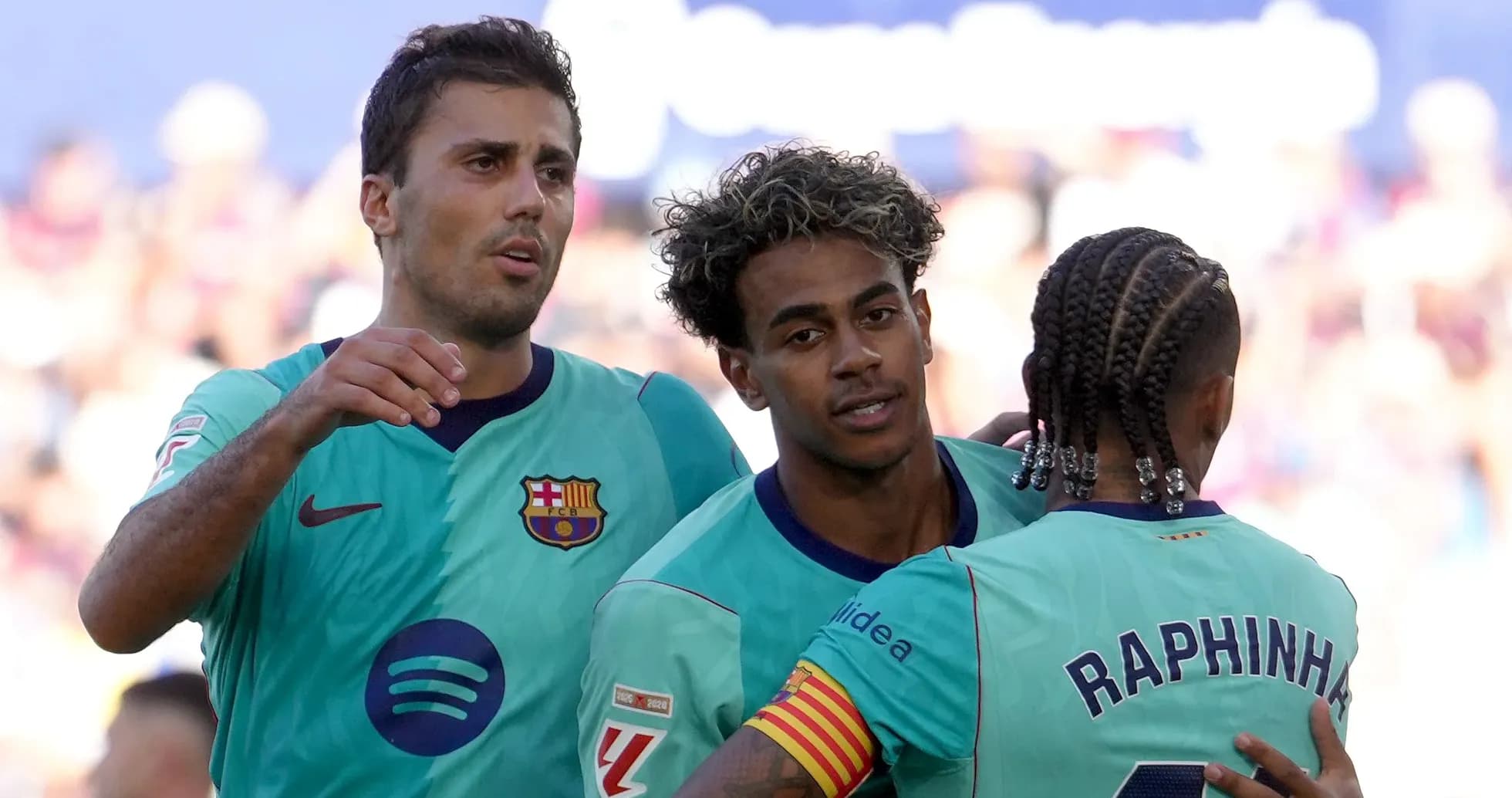
Hansi Flick has ripped up a long-standing tradition at Camp Nou by personally naming his two primary captains: Raphinha and Pedri. No seniority ladder, no slow climb through the ranks. The coach pointed at his leaders.
The dressing room handled the rest. In a vote shaped more by time served at the club than medals won elsewhere, Eric Garcia, Frenkie de Jong and Lamine Yamal completed the five-man leadership group.
Yamal’s inclusion, at just 19, turned heads. Rodri’s absence turned the volume up.
Here is a player who arrived from Manchester City for €76.5m (£65.3m), fresh from lifting the World Cup as Spain’s captain. A midfielder who has spent the last few years dictating the tempo of club and country, walking into a young Barcelona side that cries out for exactly that kind of authority. On paper, he looks like a captain-in-waiting.
But this is Barcelona. The armband is not a CV reward; it is a reflection of roots.
According to The Athletic, the internal vote leans heavily on club seniority. Yamal, a prodigy but already three seasons deep with the first team, carries more institutional weight than the man who only walked through the door in mid-August. Rodri’s leadership career may be glittering, yet his Barcelona story is barely a chapter old.
That hasn’t stopped him from taking over the room.
Flick’s admiration surfaced quickly. After Rodri’s first start, against Valencia, the German did not bother to hide his satisfaction. He talked about structure, about clarity with and without the ball, about a player who gives a team a framework. It sounded less like praise for a new signing and more like a manager recognising his on-field extension.
Rodri’s voice has travelled beyond the pitch as well. During that 5-0 demolition of Valencia, television cameras picked up a blunt assessment directed at Pau Cubarsi on the bench: “They’re really weak, they haven’t got past the halfway line.”
It was the kind of raw, unfiltered dressing-room talk that usually stays behind closed doors. This time, it didn’t. The moment it escaped into public view, Rodri’s response underlined why coaches trust him.
He picked up the phone and called Valencia captain Jose Gaya to apologise personally. He then addressed the incident publicly after Barcelona’s Champions League win over Feyenoord. No PR gloss, no attempt to brush it aside. Just accountability from a player who understands how leadership really works in a modern dressing room.
Inside the club, the lack of an official title has not dulled his authority. Staff already see him as a key guide for 19-year-old Marc Bernal, the defensive midfielder tipped to anchor Barcelona’s future. The two have shared minutes in recent games, Bernal stepping into midfield alongside the former City star against Feyenoord and Levante, learning on the job next to one of the best in his position.
This is how influence spreads at a big club: not just through armbands and votes, but through small, constant touches. A word in a youngster’s ear. A passing lane pointed out. A line of pressure adjusted.
The captaincy list, then, tells one story – of hierarchy, of years logged at La Masia or under the Camp Nou lights. Rodri tells another, every time he steps onto the pitch or opens his mouth.
Barcelona will need both versions of leadership in the coming weeks.
Flick’s side are staring at a brutal 12-day stretch next month that will test every ounce of their resolve. A trip to Galatasaray, never a gentle assignment, awaits. Real Betis away, with all its tactical traps, follows. Paris Saint-Germain lurk on the horizon, a heavyweight clash that will stretch Barcelona’s composure and courage.
And then, the crescendo: El Clasico at Camp Nou on October 25.
Real Madrid. A title marker, a political statement, and for Rodri, something more personal. He turned down strong interest from Jose Mourinho’s Madrid this summer to wear the Blaugrana shirt instead. That decision will hang in the air when he walks out for the first Clasico in his new colours.
He may not have an armband strapped to his bicep when he does. He may never need one. For a young, talented, still-fragile Barcelona squad, the question is simple: when the season hits its hardest stretch, whose voice will they follow?