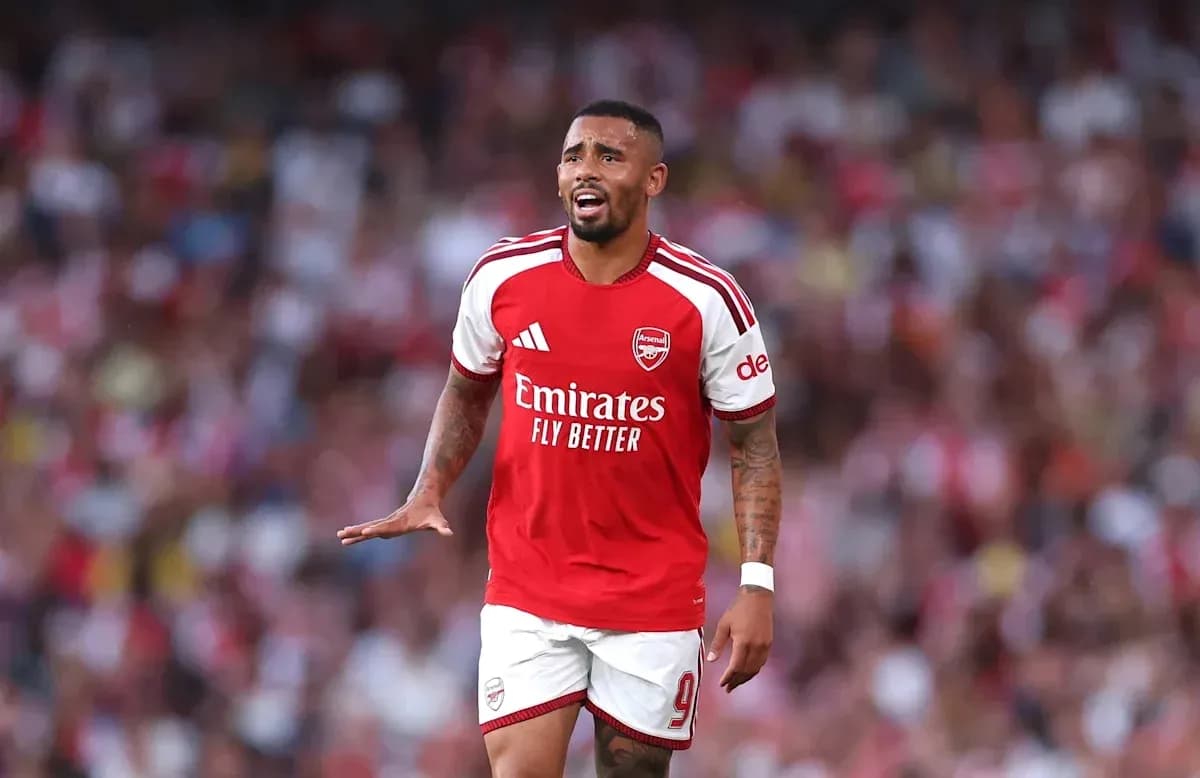
Barcelona finally have their No. 9 – and it’s Gabriel Jesus.
After a summer spent chasing Julian Alvarez without reward, the Catalan club pivoted sharply, moving for the Arsenal forward as a pragmatic solution to a problem that has lingered for years at Camp Nou. The deal moved quickly. The decision, less so.
A three-year bet on a fragile knee
Jesus landed in Catalonia on Monday, went through his medical, and did what every new Barcelona signing does: he faced the questions about his body before anyone talked about his football.
The Brazilian insisted his knee is “perfect” after the ACL injury he suffered in 2025, and the club’s doctors cleared him. That was the first hurdle. The second was the contract.
Early indications pointed to a two-year agreement with an option for a third. Barcelona have instead pushed their chips further into the middle. According to the latest information, Jesus will sign a fully guaranteed three-year deal, tying him to the club until the summer of 2029.
For a 29-year-old forward with a recent serious knee injury, that is not a timid commitment.
From directors’ box to Flick’s frontline
With the paperwork being finalised, Jesus spent Monday night watching his future from above. From the directors’ box at the Spotify Camp Nou, he saw his soon-to-be teammates dismantle Rayo Vallecano, a performance that underlined both the potential of this side and the challenge he faces breaking into it.
Raphinha has started the season in explosive form as a central striker, thriving as Hansi Flick’s surprise solution at No. 9. On current evidence, the Brazilian winger-turned-forward will remain the preferred starter, with Jesus arriving as competition, cover and, in time, perhaps the long-term reference point through the middle.
Once the contract is signed and La Liga registration is complete, Jesus will be available for selection against Valencia. Flick gains another weapon. How often he dares to use him is another matter.
The numbers behind the risk
Barcelona’s financial reality leaves little room for vanity projects. Every euro has to work. In that context, the structure of this deal matters as much as the name on the shirt.
The club will pay Arsenal a €10 million fixed fee, with a further €4 million in add-ons. The London side also retain a 20% sell-on clause, a reminder that this is not a cut-price fire sale but a carefully calibrated exit for a player who never quite became indispensable at the Emirates.
For Barcelona, the outlay is modest for a forward with Jesus’ résumé: Premier League titles, Champions League experience, years at the top level with Manchester City and Arsenal, and a significant role with the Brazil national team. On paper, it looks like value. On grass, it depends on that knee, that rhythm, that confidence.
Style, fit and Flick’s gamble
Concerns around Jesus are clear and justified. His injury record, his difficulty stringing together long, uninterrupted runs of games, and the loss of sharpness that comes with that stop-start pattern all hang over this transfer.
Yet he is not a blind roll of the dice.
Jesus’ profile dovetails neatly with Flick’s attacking demands. He presses aggressively, drifts wide to create overloads, links play with quick touches and combinations, and works tirelessly without the ball. He is not a classic penalty-box poacher, but he can drag defenders out of shape and open lanes for runners from midfield and the wings.
In a team that already boasts pace and creativity in wide areas, his movement between the lines and into the channels can give Barcelona a different dimension when the more direct, vertical threat of Raphinha is either unavailable or blunted.
The key will be management. Minutes, training load, expectations. If Barcelona can control those variables and keep his body from rebelling, the fee and the salary suddenly look like smart business rather than reckless optimism.
The club have not signed the superstar they once dreamed of for the No. 9 role. They have signed a proven, if fragile, forward on a three-year ticket.
Now the question is simple: will Gabriel Jesus be remembered as a stop-gap who bought Barcelona time, or as the unlikely cornerstone of Flick’s new-era attack?