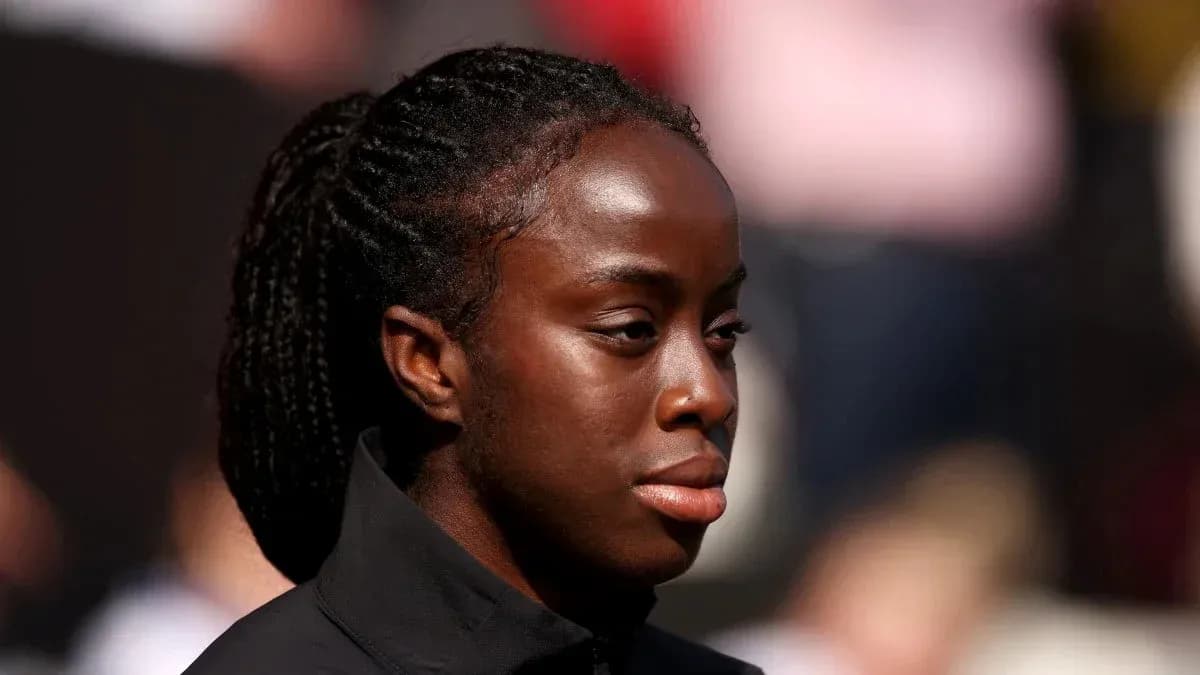
Barcelona have smashed the transfer ceiling to land Brazilian forward Kerolin Nicoli from Manchester City in a deal that underlines just how quickly the women’s game – and her own career – is accelerating.
The 26-year-old joins the European champions for a reported £1.25m, according to Sky Sports, the highest fee ever received for a Women’s Super League player. No one has ever left the English top flight for more. Not in this era of rising numbers, not in any.
Eighteen months. That is all it took.
Kerolin arrived in England from the NWSL in January 2025, a shrewd Manchester City signing who looked, at the time, like a calculated gamble. She leaves as the league’s most expensive export after 26 WSL appearances, 12 goals and a central role in City’s first title in a decade during the 2025-26 season.
City knew they were getting a talent. They may not have expected a market-maker.
From barefoot in São Paulo to a record-breaking move
Kerolin’s story does not begin in academies or pristine training centres. It starts on the streets of São Paulo, barefoot, playing with boys, learning to ride tackles and hit back harder. That environment forged the relentlessness that has since travelled from Brazil to North America, then to England, and now to the Camp Nou.
Her rise has not followed a neat, linear path. Arsenal tracked her before her move to Manchester City, only to see her choose the blue side of Manchester instead. With hindsight, that decision simply delayed the inevitable. A player of this profile, this output, was always going to be courted by Europe’s elite. Barcelona have merely moved first – and decisively.
Barcelona change the rules of their own game
The fee is not just a record; it is a statement of intent from a club that usually prefers evolution to extravagance.
Kerolin’s £1.25m transfer surpasses the mark set only last summer when Olivia Smith moved from Liverpool to Arsenal. More telling is what it means for Barcelona themselves. The four-time European champions had never previously paid more than £500k for a player. They have more than doubled that ceiling in one move.
Why now? Because this is a different Barcelona summer.
Alexia Putellas has gone. So have Ona Batlle and Mapi León. Salma Paralluelo’s departure ripped a hole in the forward line, removing a rare blend of power, pace and end product from the flanks. For a side built on control, they suddenly lacked a chaos agent, someone who could break a game open with a sprint, a dribble, a shot from nowhere.
Kerolin walks straight into that vacancy.
Her numbers in England tell the story. Only Khadija Shaw and Stina Blackstenius posted a better goals-per-90 ratio during her time in the WSL. No player attempted or completed more take-ons. She did not just score; she dragged defences out of shape, beat full-backs repeatedly, and forced teams to change how they defended City’s left and right channels.
At Barcelona, that profile is gold. Aitana Bonmatí, the current Ballon d’Or holder, remains the creative heartbeat. Around her, Pere Romeu is reshaping rather than ripping up a squad that has supplied each of the last five Ballon d’Or winners. Kerolin arrives not as a luxury piece, but as a new reference point in the front line.
Explosive on either flank. Able to score, create, and carry the ball through pressure. Built for big spaces and big nights. That is exactly what Barcelona have paid for.
What it means for Manchester City
For City, this is not just a farewell; it is a windfall.
The deal delivers a significant financial return on a player signed only a season and a half ago and hands the club extra room to manoeuvre in a rapidly inflating market. It also clears a path in a crowded group of wide forwards.
Aoba Fujino, Mary Fowler, Iman Beney and new signing Beth Mead are all candidates to claim the space Kerolin leaves behind. Each offers a different interpretation of the role: Fujino with her sharp movement, Fowler’s versatility, Beney’s promise, Mead’s proven end product. One of them now has the chance to step out of the rotation and into the spotlight.
City lose a match-winner, but they keep the title they won with her and the record fee she generated. Barcelona gain a forward built for their biggest stages. The WSL, meanwhile, has just watched one of its leading lights leave for a price that would have sounded absurd only a few years ago.
The question now is simple: will Kerolin’s move be remembered as a one-off spike in a wild market, or the new going rate for the kind of player who can tilt European finals on her own?