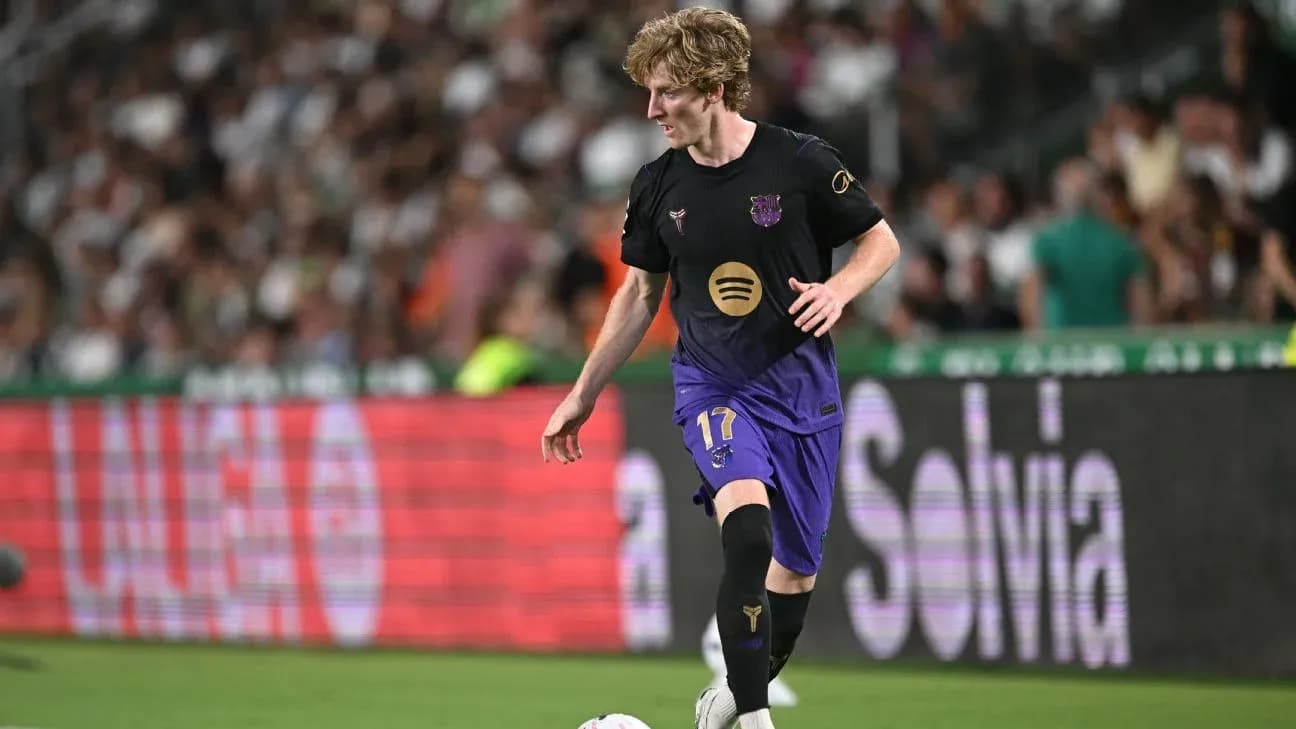
Barcelona did not just change wingers this summer. They changed emphasis.
Marcus Rashford left with 14 goals, two trophies and plenty of affection in the bank. Anthony Gordon arrived for almost double the money, without a goal to his name yet, but with the full weight of the club’s sporting project behind him.
For Deco, that trade-off makes perfect sense.
Style over sentiment
Speaking to RAC1, Barça’s sporting director laid it out with unusual clarity. Rashford delivered last season as Barça won LaLiga and the Spanish Supercopa, yet the club still walked away from a €30 million option to sign him permanently.
Instead, they wired €70m to Newcastle United for Gordon.
“We are extremely grateful to Rashford,” Deco said. “He contributed a lot last season, but our idea of play is much more linked to Anthony. His style fits with what the coach [Hansi Flick] is looking for.”
That is the crux of it. Rashford was productive. Gordon, Deco insists, is ideological.
The 25-year-old has yet to score in his first five games in blaugrana, but he has already stacked up five assists and, just as importantly for the people running the club, has injected life into the left flank. The Camp Nou crowd have responded quickly; his name rang around the stadium during a recent 5-2 win over Rayo Vallecano.
The numbers tell one story. The noise tells another.
Energy as a transfer principle
Deco framed Gordon’s arrival as a direct response to a problem that haunted Barça last season.
“We see every training session and analyse the team,” he explained. “We have a clear idea what we're looking for. One of the areas we struggled last season, without Raphinha, was that the team's energy dropped. It was lost.
“We needed more intensity. We analysed a lot of wingers. Signing someone from the Premier League is almost impossible, but [Flick] was clear with what he wanted and we worked on a deal from there.”
That word – energy – keeps coming back. In Deco’s mind, Gordon is not just a creator out wide. He is a tempo-setter, a runner who stretches games, a forward whose aggression out of possession locks in with Flick’s demands.
This was not a window built around one statement signing either. Gordon was one of six senior arrivals, joining Rodri, João Cancelo, Karim Adeyemi, Gabriel Jesus and Dominik Livaković in a squad remodel that leans heavily into mobility, pressing and vertical threat.
The message is obvious: Barcelona want to run as much as they want to pass.
Why Bernardo stayed a rival
Not every long-term target fit that picture. Bernardo Silva, a player Barça have admired for years, ended up signing for Real Madrid instead. Deco’s explanation was blunt and revealing.
“He wasn't what we were looking for in the end,” he said. “I love him. He's one of the best in the world in his position.
“He wanted to come to Barça, but things didn't move forward because we have certain parameters. It wasn't just a financial issue, it was also about playing time.
“It's not up to me to say if he is going to play or not, that's the coach's decision. But he had a different perception to us after playing [regularly] at City. He wanted to play.”
Barcelona, still navigating financial limits and a deep midfield, were not prepared to promise the role Bernardo expected after his Manchester City career. Talent alone was not enough. Fit, rotation, internal hierarchy – all of it mattered.
For a club often accused of chasing big names first and working out the rest later, it was a rare public admission of restraint.
The Julián Álvarez stance
Deco also lifted the lid on another high-profile pursuit that went nowhere: Julián Álvarez. He insisted Barça behaved correctly and rejected any suggestion they tried to push the Argentine into a public stand-off with Atlético Madrid.
According to Deco, Barcelona put €100m on the table, payable in three instalments. Atlético, he said, never showed the slightest willingness to negotiate.
In other words, the door was shut from the start. Barça walked away without the fireworks.
Lamine, Ballon d’Or and a “scandal”
If Deco sounded pragmatic on transfers, he turned emotional when the subject switched to awards.
Asked about the Ballon d’Or, he did not hesitate.
“I think [Lamine's the favourite], no doubt,” he said. “Not just for what he's done with Barcelona, but he's won a World Cup with Spain as an important player, too.
“Let's not forget he went into the World Cup with an injury as well. He was the best player in LaLiga last season. It's not because it's Lamine, our player, it's because I like football.”
Then came the sting. Raphinha and Pedri did not make the 30-man shortlist for the Ballon d’Or. Deco did not hide his anger.
“For me, it's a huge scandal [that Raphinha and Pedri aren't also nominated]. I don't understand these lists. Seeing that Pedri's not there, with the talent he has ... I don't get it.”
That sense of injustice will simmer inside the dressing room. Coaches look for edges; this one has been handed to Flick on a silver platter.
A new identity under scrutiny
Strip Deco’s words back and a clear pattern emerges. Barcelona are trying to hardwire intensity into their identity. Gordon over Rashford. Energy over elegance in certain zones. Measured caution with stars who expect guaranteed minutes. Aggression in the market, but on their terms.
It is a bold bet. It has to be. Real Madrid have just taken Bernardo Silva. Atlético Madrid refused to even talk about Julián Álvarez. The margin for error at the top of LaLiga is shrinking.
Gordon has five assists and the crowd on his side. Lamine Yamal carries Ballon d’Or expectations before his career has even settled. Raphinha and Pedri have a point to prove.
If Deco and Flick are right, this version of Barcelona will run harder, press higher and cut deeper than the one that just won the league.
If they are wrong, the decision to let a 14-goal Rashford walk away for €30m while paying €70m for a winger still chasing his first Barça goal will be thrown back at them all season.