
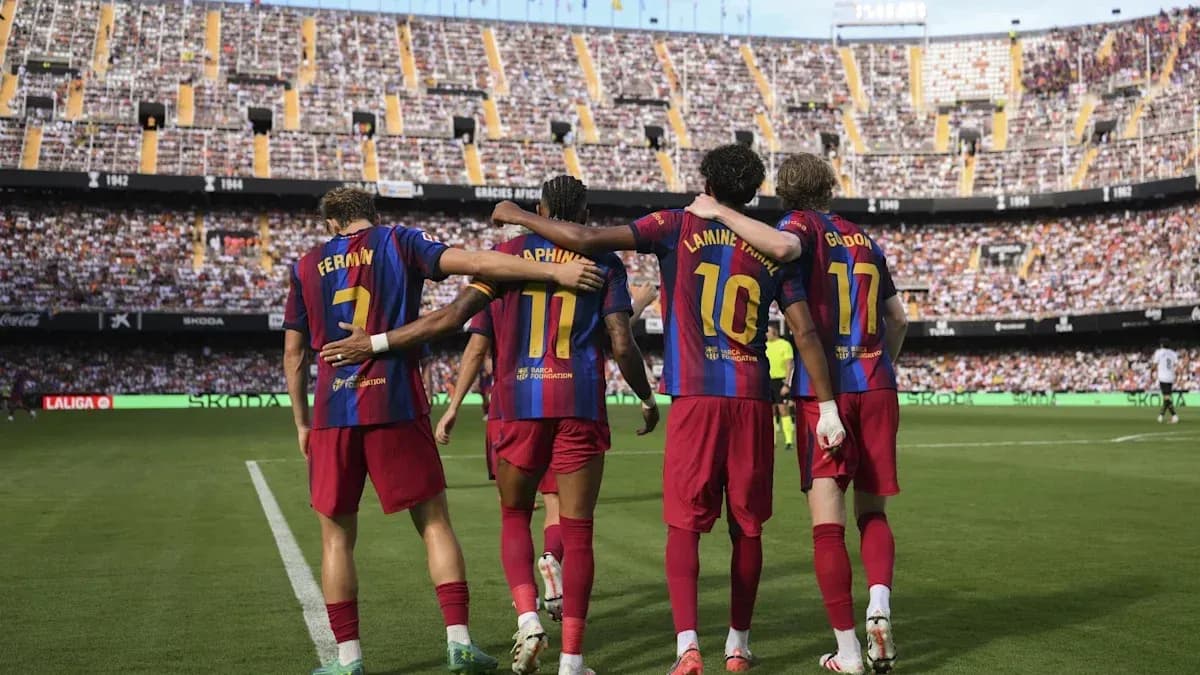
Barcelona’s new trident is tearing Europe apart.
Hansi Flick has walked into a club obsessed with attacking football and, 16 games into the 2026/27 season, his Barcelona side are producing numbers that belong to the most ruthless eras of the Camp Nou. Sixty-two goals already. Forty-eight in LaLiga, 14 in the Champions League. Close to four per game. This is not a gentle evolution. It is an explosion.
At the heart of it: Raphinha, Lamine Yamal and Fermin Lopez. Three players, three very different profiles, one devastating outcome.
A barrage that outstrips even Guardiola’s machine
To understand the scale of what Barcelona are doing, you have to go back to the Pep Guardiola vintage of 2011/12, the season that ended with a club-record 190 goals in 64 matches. After 16 games that year, Barça were already relentless.
This version is 14 goals better.
The current tally of 62 after 16 outings leaves even that historic side in the rear-view mirror. It is not just nostalgia they are challenging, but statistical history. Flick’s team are scoring more, earlier, and with a ruthlessness that feels closer to a Bundesliga title charge than a cautious rebuild in Spain.
Three players, 50 goal contributions
Strip away the badge, the history and the narratives, and the numbers from this trio are brutal.
Raphinha, Lamine Yamal and Fermin Lopez have directly contributed to 50 of Barcelona’s 62 goals in all competitions, either by scoring or assisting. That is not a supporting role. That is the system.
Their combined scoring output tells its own story:
- 32 goals in LaLiga
- 40 goals across all competitions
Raphinha sits at the top of the pile with 19 goals in all competitions, 15 of them in the league. Beside him, Yamal has 13 in total, 10 in LaLiga, a staggering return for a player still at the dawn of his career. Just behind them, Fermin has eight overall, seven in the league, numbers that would be headline material in most midfields across Europe.
This is not a front three padded by penalties and late tap-ins from 5–0 wins. It is a group that decides matches, that shapes game plans, that forces opponents to rip up their defensive structures by the half-hour mark.
Outgunning Europe’s elite
The dominance becomes even clearer when you look beyond Spain.
In LaLiga, the Barcelona trio’s 32 league goals stand well clear of their rivals. Real Madrid’s leading attacking contributors cannot keep pace. Kylian Mbappe has 13 league goals, Jude Bellingham has four, Yan Diomande has three. Together, that core group does not come close to matching Barcelona’s three-man surge.
Across the continent, the pattern repeats. Bayern Munich’s attacking arsenal, featuring Michael Olise, Harry Kane and Luis Diaz, also trails the combined output of Raphinha, Yamal and Fermin in all competitions. These are not minor clubs being left behind. These are superclubs, with superstar forwards, being overshadowed by a trio that, a year ago, few would have predicted as Europe’s most productive unit.
Right now, Barcelona do not just have one of the best attacks in Europe. They have one of the most efficient.
Flick’s blueprint: a false nine and a fearless right flank
This is not chaos. Flick has drawn clear lines on the pitch and his players are colouring inside them with precision.
Lamine Yamal owns the right flank. He stretches defences, attacks full-backs, and forces back lines to tilt towards him, opening gaps elsewhere. Raphinha, once seen primarily as a winger, now thrives as a false nine, drifting between the lines, arriving in the box at the right moments, finishing like a centre-forward but moving like a playmaker.
Behind and around them, Fermin Lopez has muscled his way into the conversation as an automatic starter. Operating from attacking midfield, he times his runs, links play and, crucially, scores. His emergence has not been a footnote; it has been a structural shift.
Dani Olmo’s injury could have been a major problem. Instead, it has become Fermin’s opening. With a run of games, he has turned opportunity into authority. Every performance strengthens his claim to that attacking midfield role, every goal makes the selection debate sharper.
When everything clicks in attack
For now, Barcelona’s attack is the least of Flick’s worries. The numbers say it clearly: this is a frontline that does not need fixing. It needs preserving, protecting, and feeding the ball as often as possible.
There will be questions later in the season about balance, about how this relentless attacking output holds up in the pressure of knockout ties and title run-ins. But in mid-season form, with the goals flowing and Europe’s biggest names looking up at their numbers, one thing is certain.
Barcelona have found an attacking trio that can define a season. The only real question now is how far this surge can carry them.





