Cricket Australia dangles a billion-dollar bait. The Indian Premier League’s power brokers are circling. But nobody is quite ready to bite.
That, in essence, is where the Big Bash League’s privatisation push stands: intriguing on paper, awkward in practice.
A billion-dollar promise, a complicated pitch
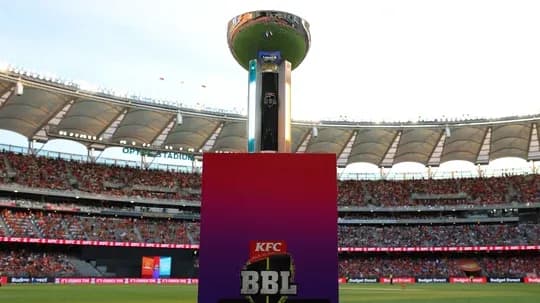
Cricket Australia (CA) has formally opened the door to private investment in selected BBL franchises and has hired US merchant bank Raine Group to run the process. Raine is the same group that engineered the eye-watering franchise sales for The Hundred in England last year, and CA chief executive Todd Greenberg has been quick to label this a “billion-dollar opportunity” for the sport in Australia.
The interest is real. CA has confirmed expressions of interest from IPL franchise owners and other Indian investors. The usual heavyweight names in the IPL ecosystem are believed to be running the numbers.
Yet when approached, none of those owners has been willing to publicly confirm their intent. Curiosity, yes. Commitment, not yet.
Renegades on the block, but with a catch
For now, only one BBL team is fully on the market: Melbourne Renegades, available for 100 per cent acquisition. CA, not Cricket Victoria, is handling the sale, and the expectation is that a deal will be done by Christmas.
On the surface, that sounds like a clean, attractive entry point. Own a team outright in a major cricket market, in a league with decent crowds and strong visibility.
Then the fine print kicks in.
Any new owner of the Renegades must essentially start from scratch. No guaranteed inheritance of an entrenched fan base, no long-nurtured identity to lean on. It is a full reset: same name, same competition, but a brand that needs rebuilding in a crowded sports landscape.
For the rest of the league, the offer is even less straightforward. Hobart Hurricanes and Perth Scorchers are understood to be next in line for investment, but only up to 49 per cent stakes. WACA has not yet even convened its general body to settle its position on divestment. That is an internal debate, but the outcome is clear enough for would-be buyers: minority shares, limited control.
And that is where the IPL model collides with the Australian one.
Control versus caution
IPL franchises are used to calling the shots. In SA20, ILT20, CPL and MLC, Indian owners enjoy full control of their teams. The Hundred is more nuanced, but even there, IPL-linked investors wield serious influence.
Sun Group’s SRH owns 100 per cent of Sunrisers Leeds. RPSG Group, which owns LSG, holds 70 per cent of Manchester Super Giants. Reliance (MI) and GMR (DC) each own 49 per cent of MI London and Southern Brave, but they still run operations.
That template – financial stake plus operational control – is what IPL teams prefer. CA is offering something different.
Chairman Mike Baird has been explicit: CA and its members will retain control over the “most significant aspects” of Australian cricket. That includes international scheduling, player availability, BBL salary caps, branding proposals, licence reserve prices and investor approvals.
In other words, money is welcome. Power, less so.
For investors used to building global multi-club empires on their own terms, that is a serious brake. They can buy in, but they cannot fully steer.
NSW resistance and a split vision
The internal politics add another layer. GMR, co-owners of Delhi Capitals, have already explored the Australian market more deeply than most. They own Hampshire County in England and had examined a potential investment in Sydney and Cricket New South Wales (NSW), talks that surfaced during the fifth and final BGT Test earlier this year.
Those conversations have run into a wall.
Cricket NSW is now understood to be firmly against private investment and may even withhold Baird’s nomination to CA for the chairmanship in future. The state and the chairman are pulling in different directions on the question of private money in the BBL.
For IPL owners, those disagreements are background noise. What matters to them is the framework: media rights, player availability, travel, tax, and the influence of the players’ union. On each of those fronts, the BBL project is throwing up hard questions.
Stars missing, windows clashing
The biggest red flag is player availability.
Unlike the ECB, which cleared the decks for The Hundred by keeping that window free of international cricket, CA has given no such guarantees for the BBL. Traditionally, the BBL runs alongside Australia’s international summer. That means national stars are often locked into Test or ODI duty while the domestic league ticks along without its marquee names.
For investors, that is a structural problem, not a minor inconvenience.
Pat Cummins has played just seven BBL games since 2016. Over the same period, he has appeared in 76 IPL matches. The contrast with India is stark: the BCCI ring-fences the IPL window and ensures its contracted and marquee players are available.
MS Dhoni (149 matches), Virat Kohli (160), Rohit Sharma (153) and Jasprit Bumrah (141) have barely missed an IPL fixture in that time. That reliability is a cornerstone of the league’s commercial success.
In Australia, no such certainty exists. A privately owned BBL team could spend heavily on local stars only to see them vanish into the international schedule.
There is similar uncertainty around overseas players. IPL owners want clarity and commitment. What they see instead is a crowded global calendar and a tax regime that works against Australia.
Tax, travel and the pull of rival leagues
Australian taxation is significantly higher than in South Africa, UAE or Bangladesh – all countries whose T20 leagues overlap with the BBL. If a player can earn comparable money in leagues with lighter tax burdens, shorter travel times and more predictable windows, the BBL becomes a tougher sell.
Logistics do not help. A trip to Perth can mean five to six hours of flying for a BBL side. In South Africa’s SA20, where IPL owners control all six franchises, the longest journey between host cities barely stretches beyond two hours. Travel is similarly manageable in England, the UAE and the Caribbean.
For players and owners alike, that matters. Less time in the air, more time training, recovering, and performing.
Media rights and union muscle
Then there is the question of media rights. CA is only three years into a seven-year broadcast deal. Any new investor would be entering a market where the largest revenue stream is already locked in for the medium term.
That limits upside in the short run and complicates valuations. The “billion-dollar” tag rests heavily on what the next rights cycle might deliver, not on what is currently on the table.
Another powerful stakeholder sits in the middle of all this: the Australian Cricketers Association (ACA). The players’ union carries significant weight in negotiations over pay, scheduling and conditions. For IPL owners used to operating in environments where they enjoy broad latitude, that is another layer of complexity and constraint.
Profits, promise – and a hard negotiator
Yet the BBL is not a distressed asset. Quite the opposite.
Feedback to prospective investors suggests that most BBL teams are already profitable. That financial health is one reason there is no unanimous push within CA for privatisation. The league is not on life support; it is a going concern.
For IPL owners, that is both reassuring and limiting. They are not being asked to rescue a failing competition. They are being invited into a stable, carefully guarded ecosystem where upside exists, but only within boundaries set by CA and its members.
There is one more pull factor. The major IPL groups have planted their flags in almost every significant franchise league on the planet: SA20, ILT20, CPL, MLC, The Hundred. The notable gaps are the Pakistan Super League and, for now, the BBL.
Filling that Australian hole in their global map has obvious strategic appeal. It offers access to a mature cricket market, a different time zone, and a rich talent pool.
The stumbling block is the deal itself.
An IPL insider, assessing CA’s stance, distilled the mood with one pointed line: “The ECB was difficult; CA is five times tougher to negotiate with.”
That is the reality facing Greenberg and Baird. If CA wants its “billion-dollar opportunity” to turn from slogan into signatures, it may have to loosen its grip, shift on control, and reshape the BBL window.
The money is there. The interest is there. The question is whether CA is ready to move far enough, fast enough, to actually land it.