Steve Smith is back in South Africa, back where the story curdled, still talking about the scars. He says he was “traumatised” by the reaction to his cheating in a Test match. The word hangs in the air. Not because the fallout wasn’t brutal, but because of what it reveals about where his gaze has been fixed all along.
This is Australia’s first Test series in South Africa since ‘sandpapergate’, the 2018 scandal that detonated their leadership group and shook the game. Smith was captain then, the man at the top when sandpaper was used to rough up the ball, a blatant breach of cricket’s laws. David Warner, his vice-captain, was banned too. Cameron Bancroft, the junior in the scheme, carried the sandpaper and the shame.
The years since have spawned a neat narrative arc, at least for some. Smith served his time, came back, and batted as if fuelled by every jeer.
At Edgbaston in 2019, his return to the Ashes was a theatre of hostility. English crowds booed, taunted, and revelled in his discomfort. Smith responded with 144 and 142 in the same Test. He finished that series with 774 runs, an astonishing tally stitched together amid relentless abuse. It was gutsy, defiant, unforgettable. Was it redemption? Or just a great batsman doing what great batsmen do?
Warner’s story from that series could not have been more different. Ten innings, 95 runs, seven dismissals to Stuart Broad. A walking wicket, a pantomime villain, an easy target. Then, in a different series, a different script: an unbeaten 335 against Pakistan, the highest score by an Australian in those contests. The numbers soared again, but the public mood did not.
As Geoff Lemon, who chronicled the scandal in book form, observed, opinion settled into a simple divide: Warner the criminal, Smith the innocent bystander. One mastermind, one tragic hero. It was a convenient framing, but not an accurate one.
Smith is a modern great, statistically undeniable. Among players with over 10,000 Test runs, he owns the best average, for a long time hovering above 60, second only to Don Bradman in that rarefied air. Yet the way the conversation keeps circling back to what the saga did to him – his pain, his trauma, his fall – rather than what it did to his team, his sport, or the basic trust of spectators, exposes a deeper issue. It shows the gap between self-obsession and self-awareness.
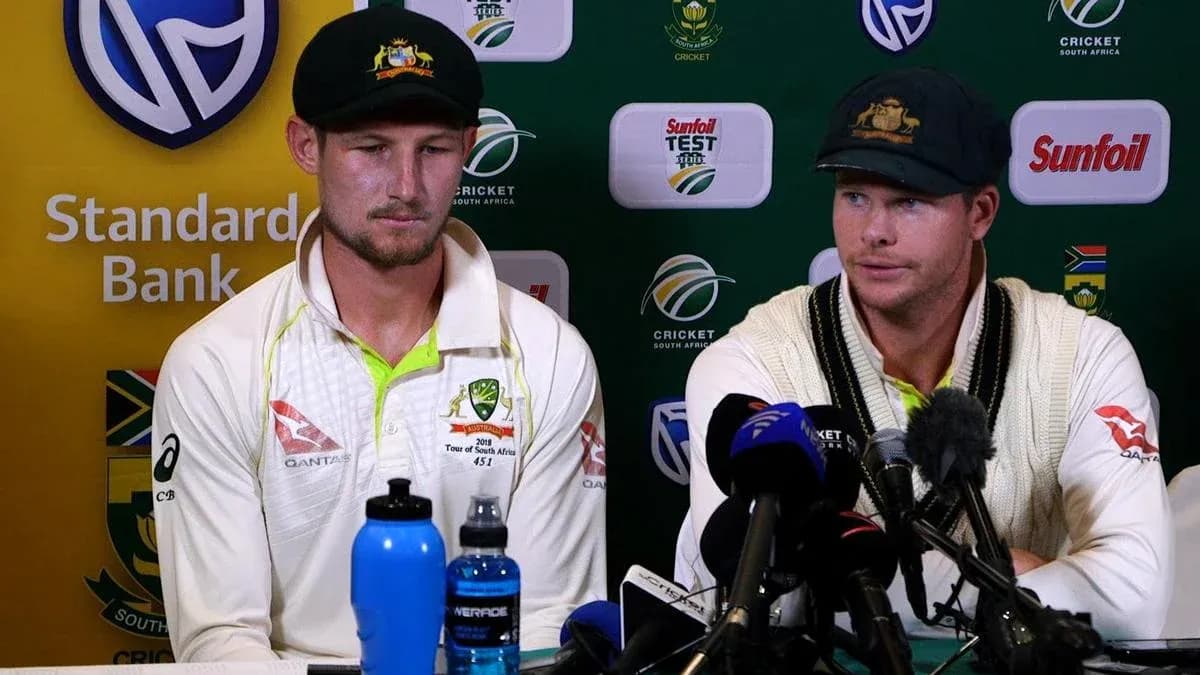
Cricket writer Gideon Haigh nailed that dissonance when he recalled the infamous press conference in Cape Town. What struck him was not just the act, but the ease with which it was agreed to, and the tone afterwards. Smith and Bancroft did not sound defiant, exactly, but they seemed oddly detached from the scale of what they had done, “sort of oblivious to the consequences.” That mindset was not a freak moment. It was the logical end-point of a culture.
For years, the Australian set-up had been steeped in entitlement and a “win-at-all-costs” creed. Winning meant ratings, ratings meant sponsors, sponsors meant money. Aggression was branded as identity. Lines were pushed, then blurred, then quietly erased. Everything was tolerated until the day something emerged that simply could not be waved away.
When the hammer finally fell, Smith would later say, “I was thrown to the wolves.” The phrase came at another press conference, this time in the language of personal suffering, the plea for sympathy. Yet there is something almost brazen in that complaint coming from a captain who had allowed a younger teammate, Bancroft, to do the actual tampering. The risk was outsourced. The responsibility was not.
None of this means Smith cannot grow from what happened. A cricketer as consumed by batting and winning as he is can be changed, even deepened, by public disgrace and private pain. And the principle remains: every person deserves a second chance once the debt is paid. In the heat of the scandal, even some seasoned observers called for life bans. With time, that absolutism looks misplaced.
Because cricket, for all the emotion it stirs, is still only a game. It is an artificial construct, a set of rules and rituals we load with meaning. We like to pretend it reflects the best of society – fairness, courage, respect – but its very artificiality allows us to demand higher standards than we manage in the real world. We can insist on ideals, even when we know they are fragile.
The sport itself is morally neutral. A bat, a ball, a strip of grass. The moral weight comes from what players choose to do. The fact that cricket felt the need to bolt on a “spirit of cricket” preamble to its laws says plenty. Those unwritten codes, once the quiet pride of the game, were being squeezed and exploited. Loopholes were hunted. Technicalities were weaponised. That erosion reflects less on cricket as a pastime and more on the players, and the era, that bent it to their purposes.
Not everyone agreed with the severity of the punishments. Many international cricketers felt the bans were harsh, that the so-called “Australian way” and the system that bred it should have shared more of the blame. Trevor Chappell, who has worn his own scarlet letter for decades after bowling under-arm to a New Zealand batter to prevent a last-ball six, understood the long tail of sporting infamy.
He pointed out that he has never escaped that moment. For 37 years, he has come up on search engines as the man at the heart of “Australian cricket’s darkest day”. Only now, with sandpapergate, has that unwanted title shifted. “It’s a relief I can finally drop that title,” he said. Which leaves an uneasy question: who will lift that burden from Smith and Warner, the current holders of cricket’s most infamous tag?
When Smith returned to South Africa on a white-ball tour, the reception was surprisingly muted. There were jeers, but not the full-throated hostility many expected. Time had done some work. Yet he knows the taunt is never far away, that in every corner of the cricketing world a crowd can summon the memory of Cape Town with a chant, a song, a hiss.
That, more than any suspension or fine, has become his true punishment: a career that will never be seen without that grain of sandpaper lodged in its story.