
A Christian players’ group at the centre of a growing row in German football says it wants to “demonstrate love and respect towards everyone” after Borussia Dortmund fans condemned Felix Nmecha’s latest goal celebration.
A celebration that lit the fuse
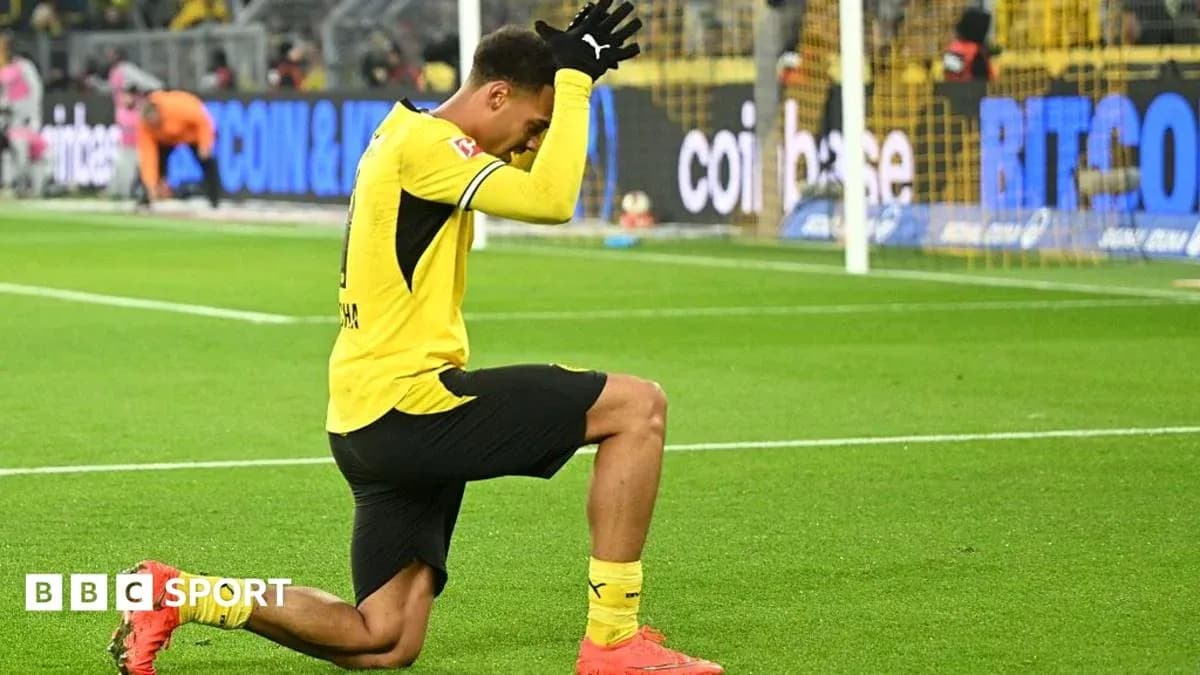
On the pitch, the moment looked routine enough. Nmecha scored twice in Dortmund’s 2-1 win over Elversberg on Saturday, pointed to the sky, then mimed lifting a crown from his own head and laying it on the ground.
For a section of the club’s support, it was anything but routine.
A prominent Dortmund supporters’ group objected to the gesture, arguing it referenced “The King’s Return” – a campaign promoted by Ballers in God, a Christian organisation for footballers. The group said the campaign stands in direct conflict with the club’s self-professed values of tolerance and diversity.
Citing a recent investigation by German broadcaster ARD, the fans’ group said the campaign advocates “extremely conservative positions against homosexuality and transgender identity”, portrays abortion as “Satan’s plan” and, in their view, discriminates against LGBTQ+ people.
Nmecha moved quickly to cool the storm. He insisted there had been “misunderstandings” around his celebration and stressed it was “not intended to promote myself or any organisation”. He added that his message “has never been about promoting intolerance, discrimination, or hate in any form.”
Ballers in God responds
Ballers in God, founded by former Crystal Palace and Tottenham midfielder John Bostock, suddenly found itself dragged from the fringes of the football faith community into a mainstream culture clash.
The organisation, which promotes Christian beliefs and counts high-profile followers such as England internationals Marc Guehi and Bukayo Saka and former Brazil forward Kaka, defended the player-led initiative.
“We are encouraged by player-led movements such as The King’s Return, where footballers themselves take the initiative to express their faith in Jesus,” the group said in a statement.
“Our desire is not only to share our hope, but to demonstrate love and respect towards everyone, including those who do not share our beliefs. Our focus has always been, and will always be, to point people to Jesus with grace and love.”
The wording was careful but firm: unapologetic about faith, insistent on respect.
For Dortmund’s critical fans, though, the concern lies less in the language of love and more in the underlying positions highlighted by ARD and echoed in their own statement. For them, this is not just about a goal celebration; it is about what, and who, their club stands for.
Football’s uneasy fault line
This is not an isolated flashpoint. It drops straight into a wider, increasingly tense conversation about how elite football balances visible support for LGBTQ+ communities with the religious convictions of some players.
Last year, the Premier League stepped back from the Rainbow Laces campaign and ended its formal partnership with LGBTQ+ charity Stonewall, a decision that quietly shifted the landscape around how clubs and leagues signal inclusion.
In 2024, then Ipswich captain Sam Morsy, a Muslim, said he did not wear a rainbow armband because of his “religious beliefs”. At Crystal Palace, Marc Guehi chose to write “I [heart] Jesus” on his rainbow armband when he captained the side, blending mandated symbolism with personal conviction.
At Manchester United, plans to wear a jacket supporting the LGBTQ+ community were abandoned after a player refused to take part.
Each incident lands differently. Each one, though, exposes the same fault line: where does personal faith end and institutional messaging begin?
Dortmund caught in the crossfire
For Borussia Dortmund, a club that has long projected itself as socially conscious and staunchly anti-discriminatory, the Nmecha episode cuts close to the bone.
Supporters are not challenging the idea that a player can be religious. They are challenging the association with a campaign they believe conflicts with the club’s core identity. In their eyes, “The King’s Return” is not just a slogan or a quiet nod to faith, but a vehicle for positions they regard as exclusionary.
Nmecha, who has already faced scrutiny from sections of the Dortmund fanbase over social media activity before, now finds himself again having to explain intent, gesture and belief in a highly charged arena.
Ballers in God, for its part, is adamant: its purpose is to share Christian hope, to point to Jesus, and to do so “with grace and love”. The supporters’ group, just as adamant, insists that some of the positions associated with the campaign have no place near a club that champions diversity.
The goals against Elversberg gave Dortmund a win. The celebration that followed opened a debate that will not be settled by a single statement, or a single matchday, and leaves a sharper question hanging over European football: how long can the game walk this tightrope between visible inclusion campaigns and the uncompromising edge of personal belief?





