“From -17 to Europe,” declared the banner in the away end at Anoeta, a strip of fabric that told Bournemouth’s story better than any glossy brochure ever could.
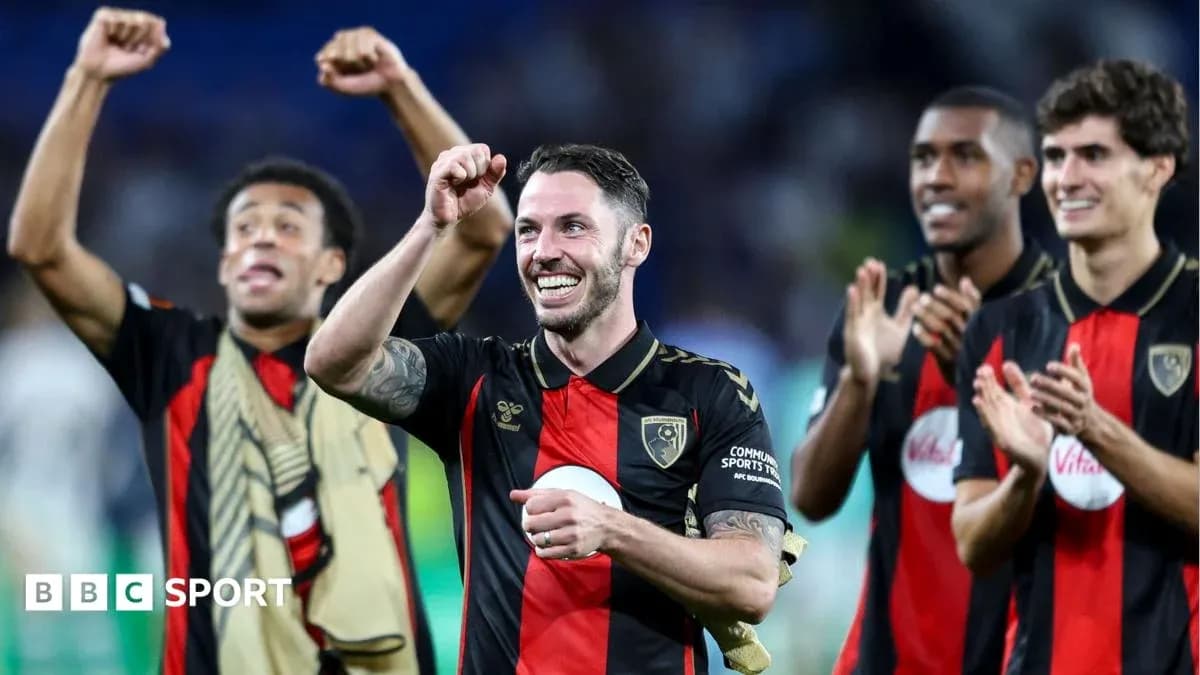
On a cool night in San Sebastián, the club that once started a season 17 points adrift of safety walked out for its first ever European tie. They didn’t just turn up. They beat Real Sociedad 2-1 in their Europa League opener and looked, for long stretches, like they belonged on this stage.
This is what the next step of a fairytale looks like when it hardens into reality.
A proper European away performance
For a younger generation of Bournemouth fans, the Premier League is all they’ve really known. Eleven years in the top flight will do that. Europe, then, might feel like the natural progression for a well-run, ambitious club.
For everyone else in that 2,000-strong travelling support, it still feels faintly ridiculous.
Just 18 years ago, Bournemouth were staring into the abyss. Administration, a 10-point deduction, relegation to League Two. Then the 2008-09 season began with a 17-point penalty and a simple condition: accept it and do not appeal, or risk falling out of the Football League altogether. Survival, not San Sebastián, was the obsession.
Back then, the idea of a £100m-rated midfielder sliding passes into a Brazil international to win a European tie would have sounded like delirium. Yet here was Alex Scott, striding around Anoeta with the swagger of a player fully aware of his value, and Rayan, the Brazilian winger, rising to meet his cross and reminding everyone why that reported £130m release clause is taken so seriously.
Against a Real Sociedad team led by World Cup winner Mikel Oyarzabal and fresh from a Copa del Rey triumph over Atletico Madrid, Bournemouth did not shrink. For 45 minutes, they smothered them.
They hunted in packs, pressed high, and repeatedly won the ball in advanced areas. This was not a plucky underdog clinging on. This was a Premier League side imposing itself, forcing errors, and then having the composure to turn those turnovers into chances even against a set defence.
“It’s a brilliant win in our first European game. It’s brilliant for the club and the 2,000 fans from Bournemouth,” manager Marco Rose told TNT Sports. He didn’t oversell it. He didn’t need to. The performance did that.
When the tide turned
Real Sociedad were never going to accept being toyed with in their own stadium. There is too much quality, too much Basque steel for that. The reaction came after the interval.
The first-half frenzy from Bournemouth had a cost. Legs started to tire, distances grew a little wider, and the home side finally found room to breathe. The atmosphere changed. The noise swelled. The pressure grew.
This is not a club historically associated with granite defending. Memories of leads slipping away in each of their first four Premier League matches this season were still raw. As Sociedad pushed and pushed, it was easy to fear a familiar script.
But this time, Bournemouth bent and did not break.
Rose’s side dug in. Tackles snapped in. Blocks arrived just in time. And when those lines were finally breached, Djordje Petrovic stood tall. The goalkeeper’s sharp reflexes underpinned the result as much as the slick attacking play that had built the lead.
“It was very intense and tough,” Rose said. “Brilliant first half in everything. The way we won balls and the possession high up. In the second half, we needed to suffer because we were not so sharp.”
They suffered, and they survived. That matters.
From Eddie Howe to Adam Smith, the thread that runs through it
Bournemouth’s rise can be traced neatly back to January 2009 and the appointment of Eddie Howe, a young manager handed a club on its knees.
He kept them up that season, finishing nine points clear of relegation despite the 17-point deduction. Six and a half years later, in his second spell, he had taken them to the Premier League. The journey from crisis club to top flight was not linear, but it was relentless.
So it felt fitting that on this latest landmark night, the team was led out by a player who has lived almost every chapter of that story.
Adam Smith first arrived on loan in 2010-11, returned permanently in 2014, and never really left. Close to 400 league appearances later, he walked Bournemouth out for their first European game as club captain, still driving up and down that right flank, still snarling into tackles, still carrying the badge like it means everything.
“Adam has been with the club for so long,” former Cherries full-back Charlie Daniels told BBC Radio Solent. “Dedicated himself to the club, and it’s such a proud moment, not only for him, but for his family, his team-mates and old team-mates to see how he’s grown – not only as a player but as a man as well.
“To lead out the Cherries on this historical night is fantastic.”
Smith added a little piece of history of his own. At 35 years and 141 days, he became the oldest English outfield player to make his debut in major European competition since Ipswich Town’s Reginald Pickett in 1962. A statistic, yes, but also a marker of how long and how hard Bournemouth have had to work to reach this point.
No one on that pitch understood the significance of the occasion more clearly than the captain.
The good times, with a warning label
Bournemouth’s recent years have not been smooth. Relegation in 2020. The battle to get back. The constant need to rebuild as key players are picked off by bigger, richer clubs across the continent.
Even this European breakthrough could not prevent another departure. Andoni Iraola, the coach who guided them into Europe, left in the summer and returns to the Vitality Stadium with Liverpool on Sunday. The churn at the top is almost annual now.
That is the reality of Bournemouth’s place in the modern game. Grow a star, lose a star. Build a team, watch it be circled. Repeat.
But nights like this change how those cycles feel.
When you can go to Anoeta, face a Copa del Rey winner, and win your first ever European match with authority, you don’t just bank three points. You bank belief. You bank memories. You bank a sense that this club, once docked 17 points just to stay alive, can live in these surroundings and not just visit them.
Daniels called it “a big occasion. A big moment for the club, and they should be applauded for it.” He’s right, but it also felt like something more: a marker that the story is still being written, not a neat ending.
The departures will continue. The bids for Scott and Rayan will come. Managers will move on. Bournemouth know that. They’ve lived it.
But in the away end at Anoeta, beneath that banner, nobody was worrying about the next sale or the next rebuild. They were watching their team win in Europe and realising, in real time, that these are the good days.
The question now is not whether Bournemouth belong here.
It’s how far this club, once buried under a 17-point penalty, can go now that Europe is no longer a dream but a fixture on the calendar.