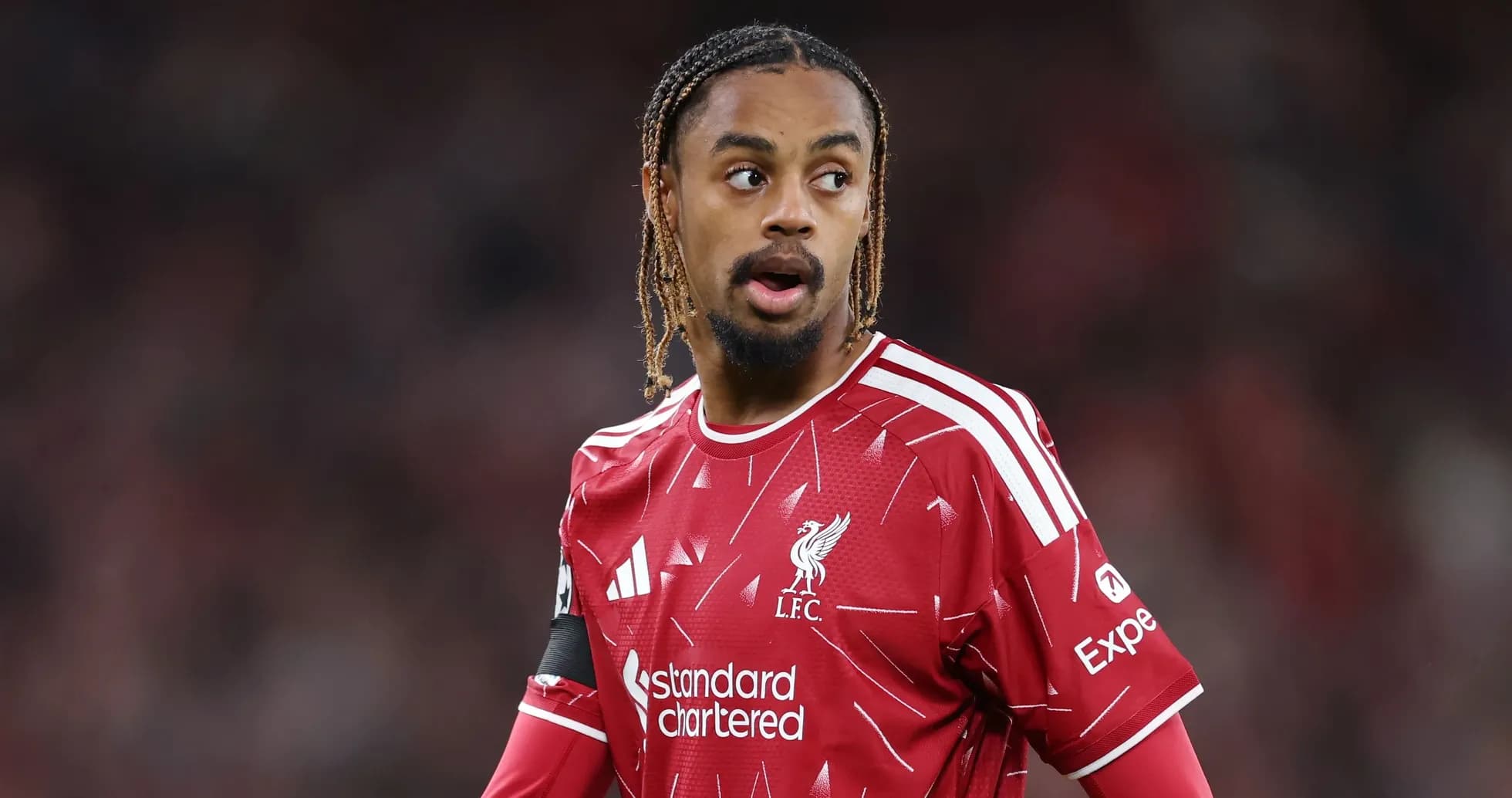
Bradley Barcola steps into Anfield carrying a price tag that bends the mind. Up to £123 million. Second only to the biggest signing in Liverpool’s history. That kind of number does not whisper; it roars. It follows you into every touch, every sprint, every misplaced pass.
Emmanuel Petit has seen that kind of pressure before. He does not sound remotely surprised that Barcola’s adaptation will be brutal.
“He needs to learn a different way”
For Petit, the issue is not talent. Barcola has that in abundance. The concern is transformation.
“Bradley Barcola needs to learn a different way of playing,” Petit told Boyle Sports, drawing a hard line between the life Barcola knew at Paris Saint-Germain and the one he has just signed up for at Liverpool.
PSG, Petit argues, is almost mechanical in its patterns.
“Paris Saint-Germain play a very specific type of football. It’s in their DNA, how they respond to the position of the ball, everything is like an automation.”
Barcola thrived in that environment. He knew the triggers, the movements, the rehearsed combinations. Now he walks into a club where the chaos is organised differently, where the tempo never really drops, and where the crowd demands verticality and aggression, not just pretty patterns.
“Liverpool are different,” Petit says, but he immediately points to why the move still makes sense.
Barcola, in his eyes, brings something Liverpool have been missing for two seasons: a winger who can carry the ball over distance, attack space behind defenders and live in the final third, constantly looking for one-on-ones. A player who can make the stadium lean forward every time he receives it.
“That kind of player can be dangerous every time they touch the ball.”
Talent is not the question
There were glimpses already. In the midweek Champions League win over Atletico Madrid, Barcola showed flashes of the winger Liverpool paid so heavily for: the glide with the ball, the willingness to commit defenders, the hint of unpredictability in the final third.
But the Champions League is one thing. The Premier League, as Petit sees it, is another world entirely.
The pace. The contact. The relentlessness of the schedule. The scrutiny that comes with a nine-figure fee in a league that devours narratives and spits them back out in headlines every three days. That is the real test.
“Is Barcola going to play the same way he played for Paris Saint-Germain? No, because Liverpool don’t play the same way, but he will play with that same ability,” Petit explains.
The technique will travel. The instincts, too. What may not travel so easily is the comfort.
“The only question is whether he has the mental strength to cope with the price tag of his transfer. We will have to see on that.”
It is a blunt assessment, but it goes to the heart of modern football. Talent gets you the move. Mentality decides whether you survive it.
No time for a slow burn
Petit is clear on one more thing: Liverpool cannot treat Barcola as a long-term project who slowly grows into his role across a couple of seasons.
“He now has the chance to do that for Liverpool, and he needs to make an impact straight away. They cannot wait on him like Florian Wirtz or Alexander Isak.”
Those names are not random. Both Wirtz and Isak have been allowed to mature at clubs where the spotlight, while bright, is not as suffocating as Anfield’s can be when results wobble. Barcola will not get that luxury.
Yet Petit is not writing him off. Far from it. He leans on recent history to suggest the winger might surprise people with the speed of his adjustment.
“I think Barcola is a player who will adapt very quickly to Liverpool. That’s what happened at Paris Saint-Germain when he left Lyon. It took him a couple of weeks but then he was showing his great ability.”
The pattern is there: a short bedding-in period, then a surge. Liverpool, under pressure already, will hope that curve repeats itself in England.
A bleak verdict on Liverpool’s season
Barcola’s story, though, is only one thread in a wider, more troubling picture for Liverpool. Petit does not sugar-coat his view of where the club stands.
They have already dropped points in three of their first four Premier League matches. For a team that finished fifth last season, that is not a blip; it looks like a continuation.
“Liverpool and Manchester United have no hope this season,” the World Cup winner says, cutting straight through the optimism that usually surrounds the early weeks of a campaign.
He puts them in the same bracket as Chelsea defensively: conceding too many, too often, and not convincing in the transfer market.
“They are conceding too many goals just like Chelsea but I was even less convinced about both clubs and what they did in the transfer market.”
In his eyes, both Liverpool and United enter the season incomplete. Holes in key areas. Unresolved issues. Squads that look a step behind the true contenders.
“They are both missing players and it’s hard to see how they can be favoured to finish in the top four, especially together. They may fight over that last place after Arsenal, Manchester City and Chelsea, but that place may go to another team.”
That is a harsh demotion for two of England’s most storied clubs: from title talk to scrapping over the final Champions League slot, and not even guaranteed that.
A star signing in an unbalanced squad
Barcola, then, arrives as both solution and symbol. He is supposed to unlock an attack that had started to look predictable, a forward line that too often ran out of ideas against deep, organised defences.
He offers a different profile: a runner, a dribbler, someone who forces defenders to turn and chase rather than simply hold their line and shuffle across. On paper, he gives Liverpool a new dimension.
But Petit's wider critique hangs over the transfer. An electric winger does not fix a side that cannot control games or keep the back door shut. The lack of balance elsewhere in the squad remains obvious, a structural problem that no single signing can erase.
So the burden on Barcola grows. He is not just expected to justify his fee; he is expected to tilt the mood, to inject unpredictability into a team that risks slipping behind the new pace-setters of the division.
For now, the spotlight stays fixed on his adaptation. Can he unlearn some of his PSG habits and embrace the ferocity and intensity that Liverpool demand from their wide forwards? Can he handle the noise that comes with being a £100 million-plus signing in a league that never looks away?
Petit is convinced of the raw tools. The feet, the speed, the capacity to hurt opponents every time he squares them up. What he questions is whether the head and the heart can carry that weight.
If Barcola answers that question the right way, he may yet drag Liverpool closer to where they believe they belong. If he cannot, that staggering fee will not just define his story; it will deepen the doubts about a club already fighting to keep pace with the new order.