Was the Brazilian Grand Prix the best race of 2026? If it wasn’t, it came very close – and it stripped this season bare.
Interlagos in the rain is never just a race. It’s an examination. Of drivers. Of teams. Of judgement. Of nerve. Brazil did all of that in one wild afternoon, while quietly signing off a constructors’ title and perhaps saving a few careers.
Verstappen’s damaged charge – and the one that got away
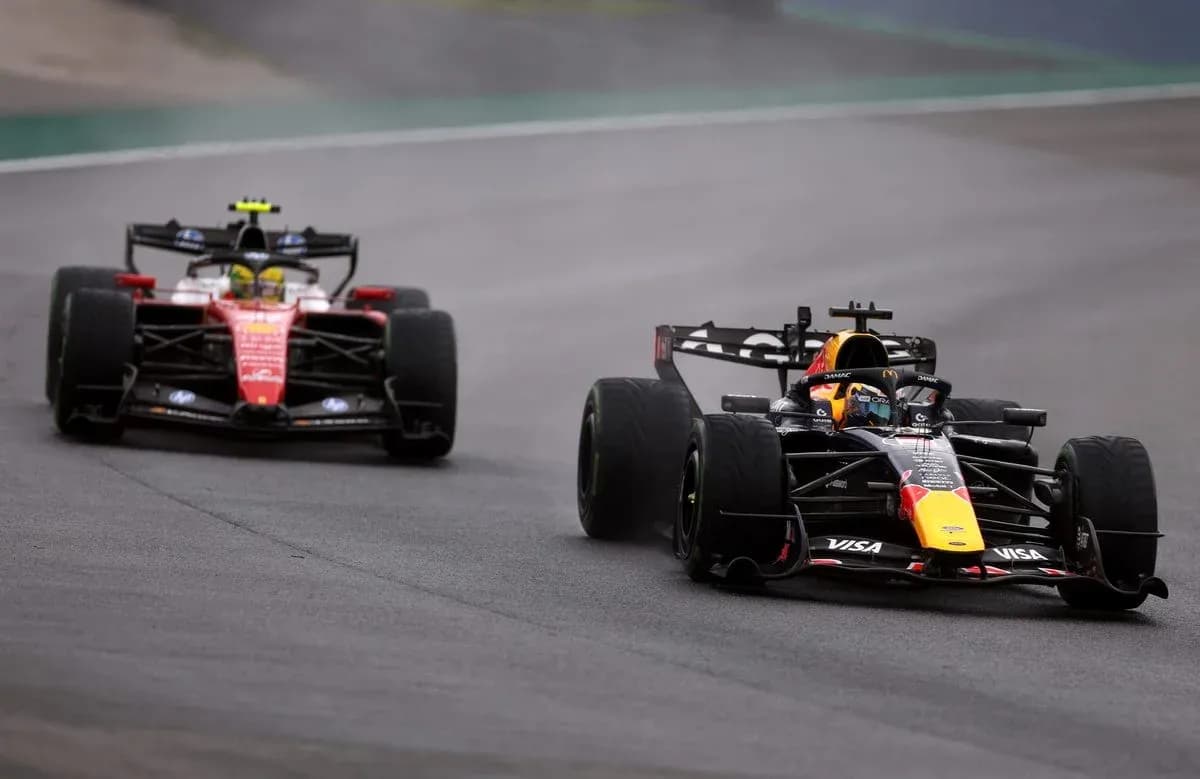
Max Verstappen left Brazil convinced something was wrong with his Red Bull. The lap chart backs up at least part of that feeling. The result – second from 21st on the grid, 14.6s behind Lando Norris – only underlined how much more might have been on the table.
The first warning sign came the moment he switched from intermediates to slicks. The car snapped into high-speed oversteer, a sudden, sharp imbalance that hadn’t been there earlier. When the rain returned and he bolted inters back on for the final stint, the transformation was stark. Night and day, in Verstappen’s words. Same car, same driver, completely different behaviour.
Red Bull now wants to know why.
The intriguing comparison sits on the other side of the garage. Isack Hadjar was electric for long stretches, especially on the softs. Across 38 directly comparable laps, Hadjar was quicker than Verstappen on 22 of them, on the same tyre and the same strategy. That is not the usual Red Bull hierarchy.
It doesn’t diminish Hadjar. If anything, it elevates him. This was his third podium for Red Bull and arguably his most convincing, enough for Laurent Mekies to call it “the best race he has done with us” and praise another “raised bar”.
But under normal circumstances you still expect Verstappen to have the upper hand. If the car really did lose aerodynamic performance mid-race, that missing chunk of grip and balance is exactly where a victory challenge might have evaporated. From 21st to second in a compromised car is brutal. From 21st to first would have been something else entirely.
We’ll never know. Norris did his job to perfection. Verstappen leaves Interlagos wondering if the car did his.
Mercedes seal the title – and wobble over the line
On paper, this was the day Mercedes completed the double: drivers’ and constructors’ world champions again, five years after its last teams’ crown. On track, it looked nothing like the ruthless operation that has bossed most of 2026.
Kimi Antonelli did everything right at first. He controlled the opening stint, led the first 19 laps, and looked exactly like what he is: a 20-year-old world champion with a car to match.
Then the track started to dry, and Mercedes blinked.
Antonelli stayed out on inters longer than Norris. The logic was obvious: protect the lead, avoid a gamble. The cost was brutal. Norris and McLaren nailed the crossover, pitted a lap earlier, and erased Antonelli’s advantage in a single, decisive move. Under pressure on slicks, Antonelli cracked. Mistakes crept in. The win slipped away. So did the podium.
He was furious with himself afterwards. He hinted at possible car issues, but the pattern is becoming familiar. In Montreal he lost his composure fighting George Russell. At Silverstone he didn’t adapt quickly enough to a damaged car. In Brazil, the combination of changing grip and a charging Norris unsettled him again.
This is what an unfinished champion looks like: already the best over a season, still raw in the margins.
For Mercedes, the other side of the garage wasn’t much tidier. Russell spun in the pitlane – an almost unheard-of error – as he tried to attack the exit on slicks in treacherous conditions. Interlagos’ twisting pit exit is probably the one place you’d expect such a mistake, but it was still ugly.
“I went quite high-risk because I smelt an opportunity and paid the price,” he said. His raw pace was strong, right there with Antonelli and Norris on the softs, and he recovered well enough to beat his team-mate. Yet when the rain returned and the field switched back to intermediates, both Mercedes faded badly.
They were losing upwards of half a second per lap to Norris. Russell reckoned his inters overheated on the outlap, when the track was at its driest, and never came back into the window. Whatever the cause, Mercedes ended the race looking oddly ordinary on a day it was officially crowned extraordinary.
Camara’s brutal debut – and the hints of something real
Rafael Camara could hardly have picked a tougher way to start a Formula 1 career.
Called up at the start of the week. No prior mileage in a Haas or any 2026 car. A wet, twitchy Interlagos. A forecast that screamed chaos. This was baptism by storm.
It wasn’t all struggle. Far from it. In qualifying he showed proper speed, flirting with a shock Q3 appearance in miserable conditions before it all unravelled. Two offs dented his confidence and his car. The first came on the Reta Oposta, a mix of aquaplaning and wheelspin that spat him into a fishtailing slide. The second was a lock-up at Juncao – where plenty of experienced names also got it wrong – and a heavy hit with the barrier.
You could see the after-effects at the start of the race. On inters, Camara was cautious, almost too respectful of the conditions. Haas will have encouraged that. No heroics, just get through the first phase. The price was a weak opening stint and another difficult final stint on intermediates, where the gap to Ollie Bearman ballooned.
Strip those away and the picture changes. In the slick running, across two stints on softs, Camara was only about a tenth of a second slower than Bearman on average. Given his lack of experience and Bearman’s compromised race in traffic, that’s not a bad first marker at all.
He finished 20th, two laps down. On paper, it’s forgettable. On track, there were enough flashes – the aggression in the dry, the way he grew into the race once the nerves settled – to suggest there is a proper driver here. His debut result will probably be one of the worst numbers on his F1 CV.
It might also be one of the most important weekends he has.
Lawson turns “maybe” into “how can you drop him?”
Liam Lawson left Brazil having won the midfield fight for the fifth race in a row. At one stage he ran as high as second. Yet, with three rounds to go, he still doesn’t officially have a 2027 seat.
Red Bull’s dilemma is simple and ruthless: two Racing Bulls seats, three names – Lawson, Arvid Lindblad, Nikola Tsolov. The performances are making the choice anything but simple.
Lawson is forcing the issue. The Race understands he is closing in on keeping his place, and the last three weekends – Austin, Mexico, Brazil – have been critical. If he had gone missing in that triple-header, his future might already look very different.
Instead, he has turned himself into something close to undroppable. Modern F1 rarely discards a midfielder performing at this level. The last comparable case was Sergio Perez losing his Racing Point seat for 2021, only to be picked up by Red Bull itself.
Earlier in the year, this would have been a different conversation. Lindblad, a rookie, was matching Lawson more often than not. Since Madrid and Baku, by Lindblad’s own admission, he has “lost [his] rhythm a little bit”, while Lawson has surged ahead.
Drop him now and Red Bull invites a storm. Keep him, and it rewards exactly the kind of relentless, opportunistic scoring that keeps midfield teams alive. An announcement before Las Vegas now looks less like a possibility and more like a formality.
Ferrari behave – when there’s nothing at stake
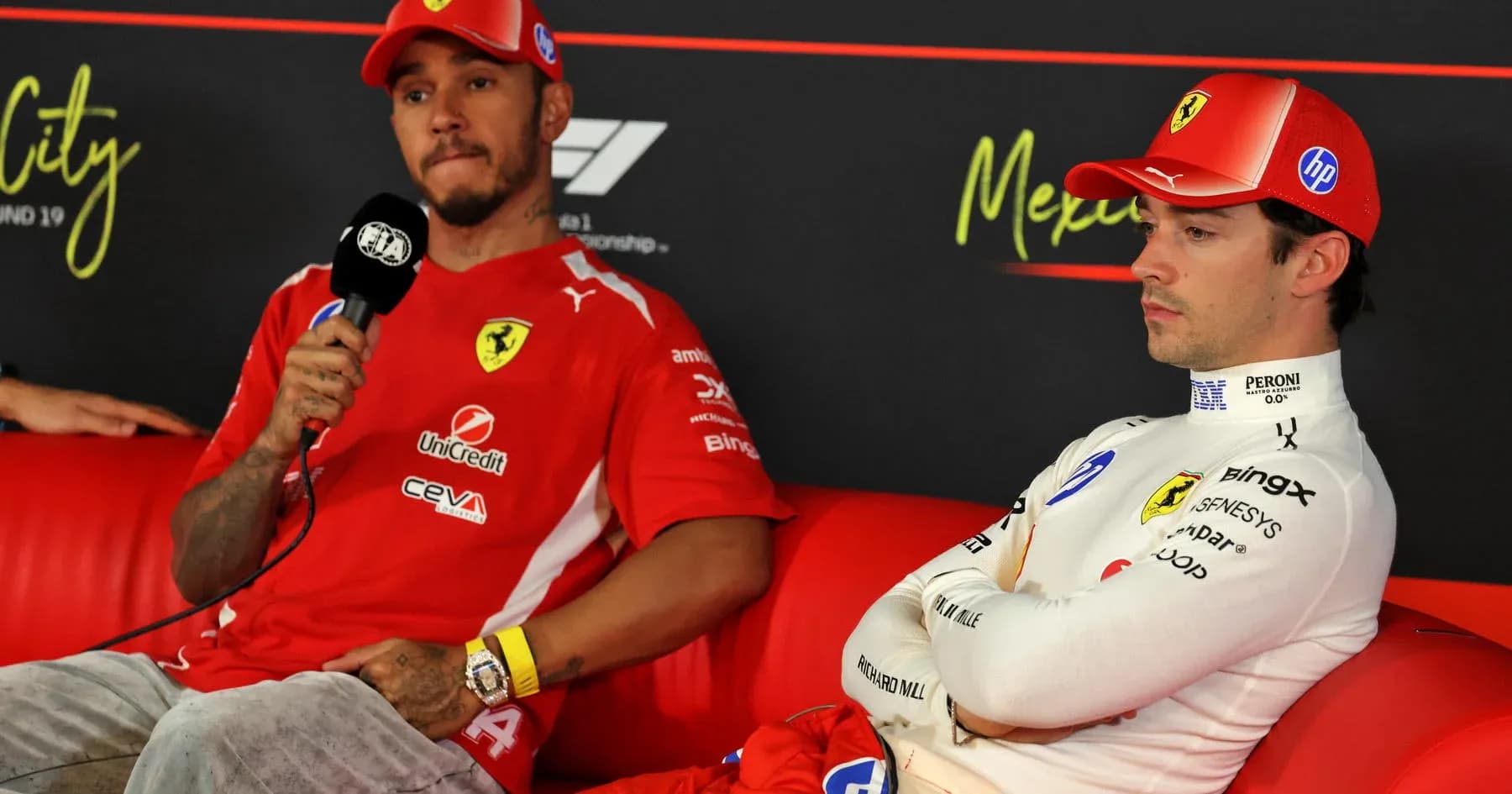
Ferrari arrived in Brazil still feeling the sting of Mexico, where Charles Leclerc and Lewis Hamilton tripped over each other and threw away a 1–2. That collision triggered a week of questions for Fred Vasseur about discipline, trust, and whether his drivers could be relied upon when it mattered most.
At Interlagos, the same pairing went wheel-to-wheel again – this time for scraps.
Vasseur, who loves to pivot from a joke to a hard truth, didn’t bother with the gag. There was no comparison to be made, he said. Mexico was a fight for the win. Brazil was a skirmish for nothing.
Leclerc saw the futility too. “Lewis was much faster than me, so at that time there was no point for me to fight,” he admitted. The duel passed without contact, which in these conditions was not guaranteed, and Ferrari at least avoided compounding a bad weekend with another self-inflicted wound.
The deeper issue was pace, or more accurately, inconsistency. Grid penalties meant Ferrari was never likely to fight for the victory, but Verstappen showed what was possible from the back with the right car. Ferrari didn’t have that level.
Leclerc climbed from 14th to seventh. Hamilton rose from 20th to ninth. Respectable, but flat. After a run of strong races, particularly in the dry, this felt like a step backwards. When the chaos came, Ferrari stayed largely out of trouble. It just didn’t have the speed to turn that discipline into anything more meaningful.
Alpine exposed in the rain
For Alpine, Brazil was less a race and more a diagnosis.
Pierre Gasly described the car as “broken” when it rains. Watching the weekend unfold, it was hard to argue. Both cars dropped out in Q1 – 17th and 18th – and at no stage on Sunday did they look like threatening the points. Franco Colapinto and Gasly finished 13th and 14th, a lap down.
This wasn’t one of those freak wet races where a midfield team misses a miracle podium. Alpine was nowhere near that kind of opportunity. The frustration lay in how completely the car fell apart as soon as water hit the track.
“It just feels like something is not right on the car, it’s broken whenever it starts raining,” Gasly said. Aerodynamically, the car behaved in “very odd” ways. That’s not set-up nuance. That’s a fundamental flaw, or a fundamental misstep.
Once the track dried, a different Alpine appeared. Colapinto, on fresh tyres before the final shower, was flying at points. The car suddenly had solid midfield pace, and both drivers could trust it again. The catch: it seemed to need a dry surface and soft tyres to show any of that potential.
Steve Nielsen had already warned on Friday about how wasteful Alpine has been this year. Interlagos offered another example, but with a twist. This looked less like operational waste and more like a specific, glaring weakness exposed by a rare fully wet weekend.
For a team that started the season strongly, this felt like a low. Not just in result, but in what it said about how far the project has drifted.
The 2026 wet-tyre compromise
One big question coming into 2026 was whether the new generation of cars and tyres could cope with proper rain. Interlagos delivered the first full examination – and a mixed verdict.
The positive side: Formula 1 actually ran. Qualifying went ahead in heavy rain, with the FIA willing to let the new cars loose rather than hiding behind the safety car. The grand prix itself, with its long spells on intermediates, passed without major chaos. Fears that the 2026 cars would be undriveable on inters never materialised.
But the drivers are far from happy. Carlos Sainz was blunt: the full wets are “not good enough” right now, and the intermediates are harder to switch on and feel less grippy than last year.
The root of the problem lies in the 2026 regulations. Pirelli has been forced to stiffen the construction of the intermediates to withstand the extra forces generated by F1’s new straight-line mode. That stiffness is the opposite of what a rain tyre wants. The result is less compliance, less grip, and trickier warm-up.
The only comfort is that change is already in motion. Pirelli has a revised intermediate design in the works for 2027, aimed at fixing the warm-up issues and clawing back some of the lost feel. Until then, weekends like Brazil will keep exposing the compromise baked into this rule set.
Aston Martin shine in the wet – Honda doesn’t
Fernando Alonso has made a career out of dragging cars to places they don’t belong. At Interlagos, he tried to do it again. This time, the engine wouldn’t let him.
His race was effectively ruined on lap one. Following Ollie Bearman through Turn 3, Alonso twitched, understeered and aquaplaned onto the runoff. In a few seconds he tumbled from eighth on the grid to 12th.
From there, he fought. He managed the conditions, picked his battles and clung to the edge of the top 10 for as long as he could. He still finished only 12th.
“Obviously I'm still missing a lot of straightline speed and that's difficult to compensate,” he said. And yet: “At one point we had some kind of fight with the Ferraris at the beginning and even at the end with the Mercedes. So, taking into account that we lose a lot on straights, that means that the car was phenomenal.”
This is not a new story. The Aston Martin chassis has often looked better than its Honda power unit, and the wet weather in Brazil masked some of that deficit. On a day when grip and bravery mattered more than horsepower, Alonso felt he had a car capable of bullying its way into the points.
The engine stopped that from happening. Worse, Honda’s reliability gremlins resurfaced. Lance Stroll suffered battery problems on both Saturday and Sunday, and Honda still doesn’t know why.
So Aston Martin leaves Brazil with praise for its car, frustration with its power, and fresh questions about reliability. On a day when the midfield shuffled wildly in the rain, this might have been its best remaining chance to let Alonso do something outrageous.
The window is closing. How many more of those chances will this partnership get before 2026 is in the rear-view mirror?