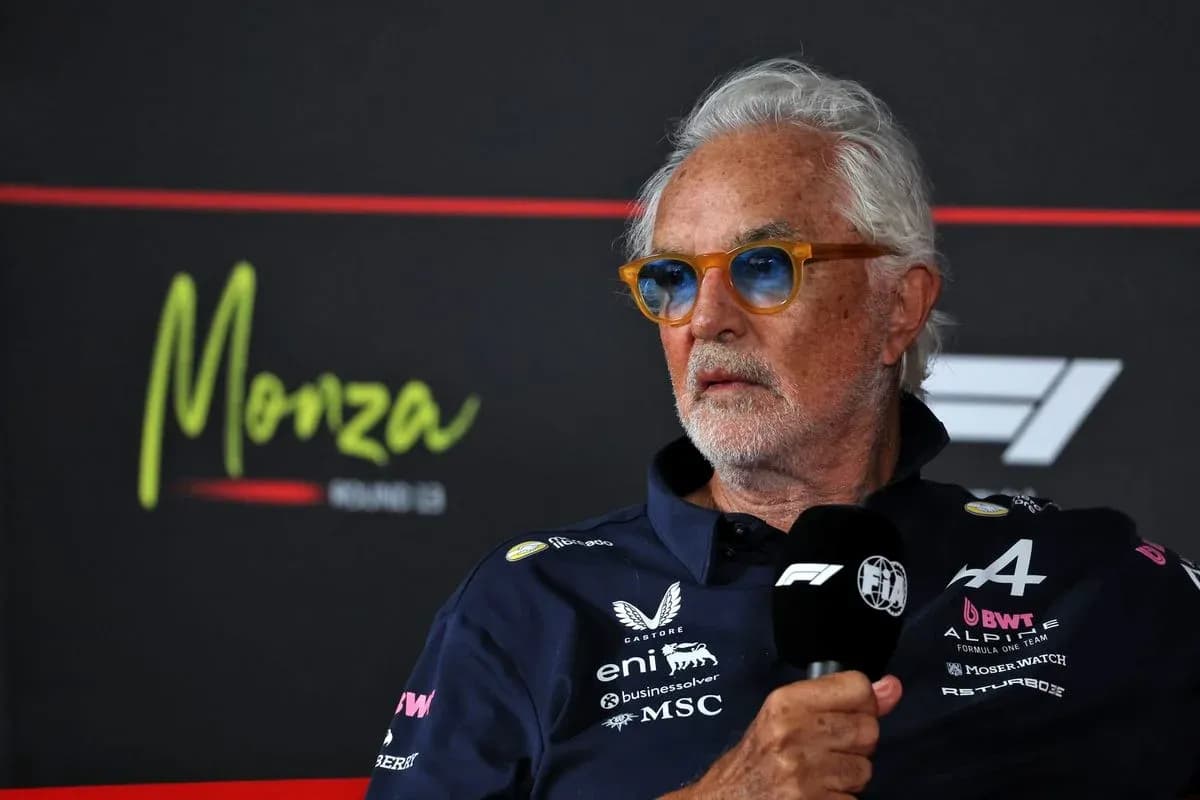
Flavio Briatore lit the fuse.
On a Friday that was supposed to close the book on the Monaco Grand Prix controversy, the Alpine executive advisor instead turned an FIA press conference into a political battleground, throwing pointed accusations at one of the sport’s own court judges and dragging McLaren into the storm.
Hours earlier, the FIA’s International Court of Appeal had confirmed that McLaren and Red Bull had successfully overturned Pierre Gasly’s Monaco podium. Alpine’s brief taste of Monte Carlo glory was gone. The verdict landed, the legal dust should have settled.
Briatore had no intention of letting it settle.
Briatore goes on the attack
Reading from a piece of paper, the former Benetton and Renault boss went straight for Filippo Marchino, one of the judges who sat on the appeal panel.
“Filippo Marchino is a judge, he was very nasty during the hearing, was acting as a prosecutor,” Briatore said, his words measured but loaded.
Then came the allegation that detonated the room.
“And after, we found out what is the reason why so nasty, this guy. He is very linked with McLaren.”
Briatore called the situation “very unfair”. He claimed Alpine had discovered, only after the hearing, that Marchino had connections to McLaren, and referenced what he described as a “nice picture” of Marchino speaking at a McLaren event in 2018 at MSO in Beverly Hills.
He went further. Marchino, he said, sits on the board of the One Drop Foundation, and McLaren had “gave two, three McLaren cars” to the charity.
“This was quite unfair,” Briatore concluded.
The cars in question relate to a 2019 charity auction held by One Drop, the foundation created by Cirque du Soleil co-founder Guy Laliberte. Laliberte has long-standing ties to McLaren as a friend of former team boss Ron Dennis, so the appearance of McLaren items at a One Drop auction follows a clear line of association.
Briatore’s point was not about the auction itself. It was about perception: that a judge with any visible link to a team involved in the case should not have been sitting in judgement on it.
McLaren fury at ‘insulting’ claims
If Briatore intended to provoke a reaction, he got one.
Andrea Stella, McLaren’s team principal, bristled at the suggestion that anything improper had influenced the appeal verdict. Calm on the pit wall, he was anything but relaxed in front of the microphones.
“I find that this conference going in this direction is quite insulting for McLaren, for the reputation of a team that deserves a lot of respect,” Stella said.
He made it clear the team would not let such accusations just hang in the air.
“If anybody makes these kind of allegations – which seem quite serious – they are going to have to take the responsibility for what they are saying in a public forum.
“The hearing, the whole International Court of Appeal, was conducted to the highest standards and we should not question this phase like it’s been done.”
The message was blunt: McLaren see this as an attack not just on a judge, but on the integrity of the process and the team itself.
Alpine weighs its options
Briatore, though, hinted Alpine are not ready to walk away.
“We’ve been thinking about it,” he said when asked if Alpine might pursue the matter. “Just pass the weekend and after that we think about it. For the moment, I don’t know.”
The problem for Alpine is structural. The International Court of Appeal is the FIA’s highest judicial body. Its decisions cannot be appealed in the conventional sense. Once the ICA rules, the case is, in principle, closed.
There is, however, a narrow escape route: a right of review. As with stewards’ decisions, a case can be reopened if “important new evidence is discovered which was unknown at the outset of the case before the ICA”.
Briatore’s contention is that Alpine only learned of Marchino’s alleged links with McLaren after the hearing. That, in his view, makes it fresh information.
Whether that is enough to trigger a review is another matter entirely.
How the FIA defends its court
The FIA, anticipating questions, laid out on Friday just how carefully it says the ICA panel is constructed.
The court has a roster of 36 senior legal figures. For each case, at least eight are shortlisted into a pool. That shortlist is then sent to the parties involved, who are given the chance to raise any “serious and objective reasons” why a judge should be recused – conflict of interest, or any other legitimate concern.
Alpine did not object to any of the shortlisted names. With no challenge raised, ICA president Laurent Anselmi, from Monaco, proceeded to select four judges for the hearing.
Formula 1’s own regulations also add a political twist. For any ICA hearing connected to the world championship, at least one judge on the panel must be someone elected to the pool at the FIA General Assembly after being proposed by at least five teams or three manufacturers.
In 2023, Filippo Marchino and Luigi Fumagalli – who also sat on the Monaco appeal – were both nominated at the FIA General Assembly following proposals from teams. Before anyone reaches that stage, they pass through a due diligence process by the FIA compliance officer, and then an ad hoc panel, before going to an eligibility assessment committee.
On top of that, when a judge is called for a specific case, they must confirm to the FIA’s secretary general that they are free of any conflict of interest. Only once all these checks are completed is the final panel locked in, and its composition kept secret from the parties until the day of the hearing.
That is the system Alpine are now implicitly challenging.
A row that won’t die
What began as a sporting dispute over a Monaco podium has drifted into something more corrosive: a public questioning of judicial impartiality and team reputation at the highest level of the sport.
Gasly’s third place in Monte Carlo has already been won, lost, and now definitively taken away. The verdict is written. Yet the fallout refuses to fade.
If Alpine decide to push for a right of review, the saga will drag on into a fourth month, with the spotlight shifting from racecraft and regulations to governance and trust.
For a championship that sells itself on precision and fairness, the real question now is stark: how many more blows can the system absorb before someone demands the rules of the courtroom be rewritten?