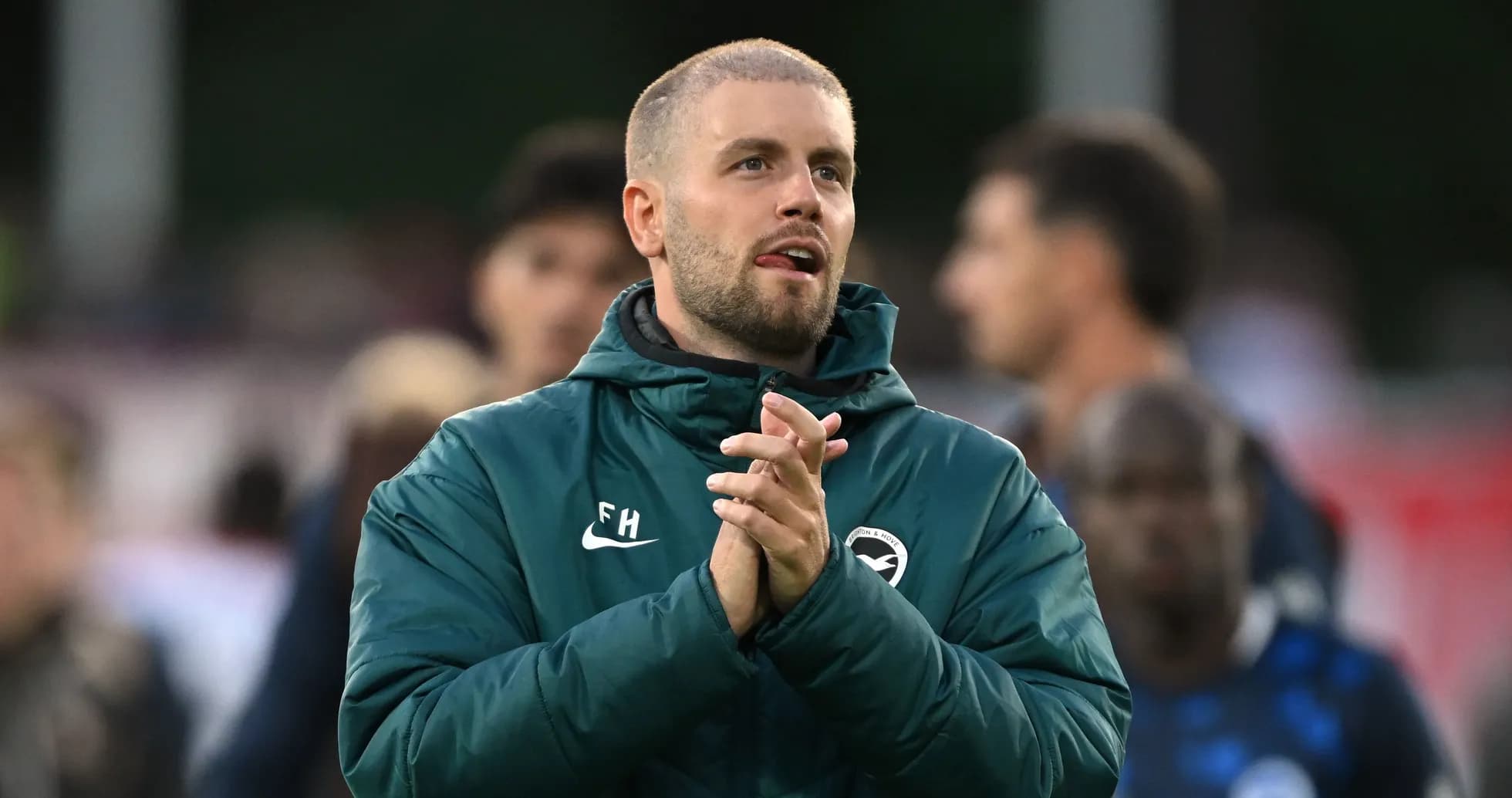
Back in March, Fabian Hürzeler walked into a press room and lit a fuse.
"There was only one team today that tried to play football," he snapped after Brighton’s 1-0 defeat to Arsenal. His side had outplayed the league leaders almost everywhere except on the scoreboard. Arsenal escaped with a Bukayo Saka moment of brilliance, aided by a Bart Verbruggen error, and Hürzeler left north London feeling his footballing ideals had been trampled by a more pragmatic, more cynical machine.
He didn’t just say it. He meant it. "I will never be a coach who tries to win like that," he told the room, questioning whether anyone had actually enjoyed what they’d watched.
Six months on, the same fixture told a very different story. This time, Brighton didn’t just try to play football. They imposed it, suffocated Arsenal with it, and walked away from the Falmer Stadium with a 3-0 win that felt like a manifesto.
This was Hürzeler’s football, fully formed and utterly ruthless.
Brighton’s Pressing Clinic
From the opening whistle, Brighton hunted.
They didn’t allow Arsenal a moment to breathe, never mind settle into their familiar possession patterns. The Seagulls’ front line chased all the way to the edge of the Gunners’ penalty area, locking onto defenders, shutting off simple options, and turning every touch into a test.
David Raya felt it first. In the opening 15 minutes, the Arsenal goalkeeper misplaced three of his seven passes, squeezed by Brighton’s press and forced into awkward decisions. Central passing lanes vanished. The ball drifted wide to Jurrien Timber and Riccardo Calafiori, both immediately swallowed up. When Raya went long, Brighton were already set, bodies in the right zones, ready to win the second ball.
The pressure kept coming. Nine regains in the final third – the most any side has managed against Arsenal since Liverpool in December 2023. Across the season, Brighton now sit on 35 high regains, eight more than Everton, the next-best pressing side in that metric. These are not isolated bursts of energy. This is structure. This is design.
"What was decisive was that every player, when he went into a duel, always had the feeling that one of his team-mates was behind him," Hürzeler said afterwards. One beaten man, the next stepping in. One press broken, another triggered.
Trust, roles, alertness – the words he kept coming back to were not glamorous, but they framed a performance in which his players carried out the plan with almost mechanical precision and very human intensity.
From Soft Underbelly to Steel Spine
When Hürzeler arrived in the summer of 2024, Brighton were brave on the ball but brittle without it. The back line looked like an open invitation to technically superior opponents. Heavy defeats followed. The idea was clear; the execution wasn’t.
The club backed him anyway. A five-year contract, a long runway, and a belief that the turbulence was part of the journey.
Now the balance is shifting. Brighton have the best attack in the league – 16 goals in five matches. In Premier League history, only Manchester City’s 2022/23 juggernaut has started faster, with 19. The numbers at the other end are just as striking: five clean sheets in eight competitive games. Last season, it took them twice as long to reach that mark.
"The most important thing is not to concede any goals at the back," Hürzeler insisted. His football might look wild in the press, but underneath it sits a clear defensive obsession.
Arsenal felt that steel. For long stretches, they were simply pinned back. Mikel Arteta admitted as much. From the very first throw-in, he said, he could see Brighton’s extreme pressing, see his own players abandoning the principles needed to escape man-to-man pressure. "We were constantly defending," he conceded.
The roles had reversed. The side once accused of winning without entertaining now found themselves unable to play at all.
The Right Players for the Right Idea
This Brighton is not just a tactical system. It’s a squad built piece by piece to serve it.
Chema Andres, brought in late from VfB Stuttgart, is the archetype of a Hürzeler player. Just under two metres tall, strong in the challenge, but quick enough across the turf to protect space behind the press. When opponents go long under pressure, Chema is the one waiting to hoover up the clearances and immediately restart the attack.
Luka Vuskovic, signed from Tottenham Hotspur for €55 million, has wasted no time becoming a fixture in the starting XI. His composure and physical presence have stiffened that once-fragile back line.
Then there is Pascal Groß, the veteran who has become the heartbeat of this side.
Frozen out at Borussia Dortmund, Groß arrived on the south coast last winter looking like a player edging towards the twilight. Under Hürzeler, he has caught fire. At 35, he leads the Premier League scoring charts after five matchdays with three goals and four assists, sitting ahead of names like Erling Haaland and Florian Wirtz.
Against Arsenal, he struck the opener on 31 minutes and later delivered the assist for Chema’s goal to make it 3-0 on 57. His numbers tell one story. His influence tells another.
"I feel very good, very comfortable," Groß told kicker, crediting a mix of fitness, experience and the way Hürzeler uses him. The freedom in the final third, the licence to drift into dangerous pockets, has unlocked a more attacking version of a player long admired for his intelligence.
"We had our pressing and the resulting high regains to thank for some of the goals," he said. "Overall, we create a lot of chances." He is both the beneficiary and the architect of Brighton’s new edge.
Hürzeler’s description of Groß was simple and vivid: "He is like good wine. The older he gets, the better he becomes." The coach talked about the unmeasurable things – the way Groß knits together a dressing room full of nationalities, the way he reads social dynamics as well as passing angles. On the pitch and at the training ground, he has become the conduit for the manager’s demands.
Respect Replaces Needle
When the final whistle went at the Falmer, there was no repeat of Hürzeler’s earlier outburst. He didn’t need to rail against Arsenal’s style this time. His team had done the talking, and the scoreboard had finally matched the performance.
Brighton’s third win of the league campaign lifted them to third in the table. The project that was supposed to take time is accelerating.
This time, it was Arteta’s turn to extend a hand.
The Arsenal manager, who had previously brushed off Hürzeler’s criticism with sarcasm, arrived in front of the cameras with a different tone. No digs. No defensiveness.
"I am here to give my opinion, to stand up for my club and to get the best out of my players. What happened is over. That is in the past," he said, before offering what sounded very much like a public endorsement. He spoke of "enormous respect" for Hürzeler and called Brighton’s work under him "simply remarkable."
The feud, such as it was, ended not with a clash, but with a nod of recognition.
The question now is no longer whether Hürzeler’s football can stand up to the Premier League’s elite. It’s how far this fearless, relentlessly drilled Brighton side can push those elite – and how long they can keep dictating the terms of the conversation.