
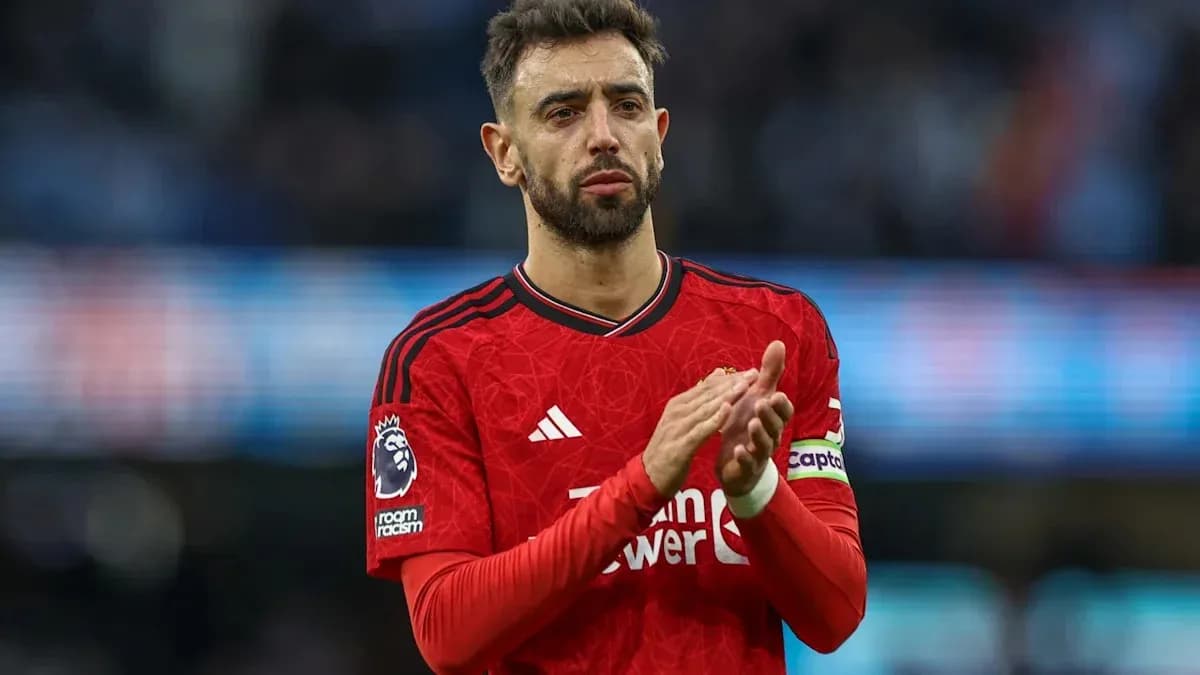
Manchester United wanted a lift during a bleak international break. Instead, their captain has handed them a headache.
Bruno Fernandes has rejected a second contract offer from the club, leaving United’s hierarchy and incoming manager Mauricio Pochettino facing a stand-off with the most influential player in the dressing room before a ball has even been kicked under the new regime.
His current deal runs until June 2027, with the club holding an option to extend it by a further year to 2028. They are almost certain to trigger that clause before 1 January if no agreement is reached. For now, though, the captain is saying no.
And Pochettino’s first game? Anfield. Liverpool away. On 22 November. Welcome to Manchester United.
Contract Talks Stalled at the Worst Possible Time
This was supposed to be straightforward. Discussions began in the summer, after a season in which Fernandes swept the awards circuit, including being named Men's PFA Player of the Year and breaking the Premier League assists record.
United tabled an initial proposal. Fernandes turned it down. They came back with improved terms. He rejected that as well.
The club want him to stay. Talks are expected to continue over salary and contract length, but with the club in turmoil after their worst domestic start in 40 years and Michael Carrick’s sacking on Thursday, no one expects a swift resolution. United are in the relegation zone. The captain is unconvinced. The new manager is still on a different continent.
If United do not exercise their option by the turn of the year, they run the risk of Fernandes entering the final six months of his deal in 2027 and being able to sign a pre-contract with foreign clubs. They will not let that happen. The power play is about the terms, not the timeline.
There is another layer to the caution. Liverpool’s heavy financial commitment to Mohamed Salah’s last contract has been a warning to every big club. United are reluctant to hand a huge, long-term deal to a 32-year-old whose form has dipped from last season’s extraordinary levels. Six goals in 13 games this season is respectable, not spectacular.
Both sides are wary. Both are watching each other.
Como, the Outburst and a Dressing Room on Edge
The mood around Fernandes changed in one night on the shores of Lake Como.
After United’s Champions League defeat there last month, the captain did what he rarely does: he tore into the game plan in public.
"It's a decision from the staff to not press man-to-man and sometimes leave a little space in behind and try to get the ball in the first moment, to wait for them, to give them the ball," he said.
"But sometimes when you give too much the ball to these teams they get confident, they have so many bodies behind the ball that make you run a lot, make people get frustrated, and then obviously when you recover the ball the legs are, and the brain, much more difficult to make it work."
The words landed with a thud. Gary Neville’s reaction was scathing.
"If that's your captain saying that, imagine what they're saying in the dressing room behind closed doors when no one's listening. That's horrific," he said, accusing Fernandes of failing to "read the room" and branding him an "excuse merchant".
The fallout was immediate. Fernandes was left on the bench for the Premier League defeat to Bournemouth, only to be restored to the starting XI against Chelsea in the following league game. Carrick, under intense pressure, refused to rule out dropping his captain in an emotional address before his dismissal.
The sense was clear: the relationship between manager and captain had frayed at the edges, just as results nosedived.
Defiance After Roma and a Captain Under Scrutiny
Then came Roma. Then came the comeback.
After United’s much-needed win, Fernandes fronted up again, this time determined to put out fires rather than start new ones.
"The club needed that win. The players needed that win. It is something we needed as a group of players and staff," he said. "We have been working so hard to get out of this situation together. It has been tough. There has been a lot of speculation in the media."
"A lot of lies around many things that have happened at this club, between me and the manager, like that we have cleared the air. Nothing like that happened."
He did not dodge his own responsibility.
"The manager took a decision of making myself on the bench because I wasn't performing. And that's fair."
"Everyone felt like that was a punishment for the words that I had [after Como]. And if it was, it was right."
"The manager makes the decisions. I have to accept it. I have to go forward with that. It doesn't change the belief I have in the manager, the staff and every player at this club."
"And it doesn't change my aim to win every f***ing game that I have ahead of me."
The message was raw, unapologetic and unmistakably Fernandes: emotional, combative, unwilling to step away from the spotlight.
Pochettino’s Dilemma
All of this is the backdrop to Pochettino’s arrival.
The Argentine, whose appointment has been ratified by the Glazer ownership after talks between chief executive Omar Berrada, director of football Jason Wilcox and Ineos chief Sir Jim Ratcliffe in Monaco, steps into a club under strain. Carrick, who took two days of training at Carrington while his fate was decided, has gone. The executives who oversaw his exit are under fire from supporters and from voices within the club.
And waiting for Pochettino is a captain who has turned down two new deals and publicly questioned his previous coaching staff’s approach.
There is history here. Fernandes came close to joining Pochettino’s Tottenham in 2019 before eventually signing for United six months later. That near-miss now feeds into the intrigue. The midfielder wants to compete for the biggest prizes. He will want to see, up close, what Pochettino can build before committing the final prime years of his career.
From the club’s side, the calculation is brutal. Do you lock in huge money for a player whose output has dipped and who turns 33 before his current deal expires? Or do you risk your captain running down his contract in an era when elite clubs circle for opportunities?
Pochettino will not be able to duck that question for long. His first test is Anfield, under the lights, with United in the relegation zone and their captain’s future unresolved.
A new era begins with a familiar United theme: a superstar at a crossroads, a club under pressure, and a manager walking into the middle of it.





