
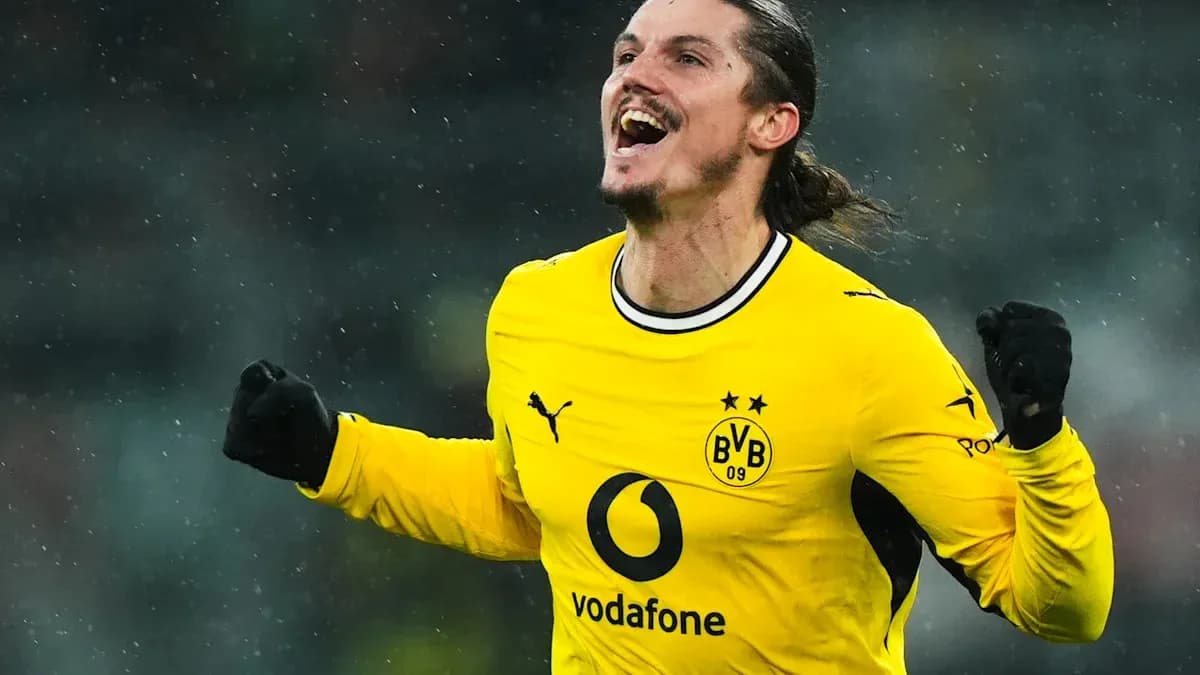
The Bundesliga has been crying out for a title race that actually deserves the name. Niko Kovac thinks this weekend might just light the fuse.
"At last, an exciting clash," the coach said before his side’s trip to Bayern Munich. Two teams level on points, a packed Allianz Arena, and first place on the line. Germany has been waiting for this. The last three titles – two for Bayern, one for Leverkusen – were wrapped up with barely a tremor of tension. Nobody wants a procession again.
To find the last truly gripping duel, you have to rewind more than three years, back to Dortmund’s infamous collapse against Mainz on the final day. The Westfalenstadion was ready for a coronation. Instead, it watched a meltdown. That summer, Borussia Dortmund went shopping for mentality.
They went to Munich and came back with Marcel Sabitzer.
Dortmund paid €19 million for the Austrian in 2023, lured not only by his quality but by the medals in his luggage. Two league titles with Bayern, a reputation as a fierce competitor, and the promise of a harder edge in decisive moments.
A ready-made leader, they hoped.
Big promises, uneven reality
Sabitzer said all the right things when he arrived.
"I want to do my part to help BVB achieve their goals and give them every reason to celebrate something special with their fans again as soon as possible," he declared at his unveiling. Then-sporting director Sebastian Kehl painted him as a cornerstone: "We're convinced that his personality will also make him a key pillar of the team and help us become more of a threat, especially in closely fought games."
Three years on, the verdict is complicated.
On one hand, Sabitzer was central to Dortmund’s run to the Champions League final, especially in the second half of the 2023/24 season. The quarter-final second leg against Atlético Madrid still glows in memory: a 4–2 win, three goal contributions from Sabitzer, and a stadium that shook under the noise.
On the other hand, his recent club reality has been more sobering. At 32, he has slipped into a role as impact substitute rather than automatic starter. Parts of the fanbase have grown increasingly critical, often in harsh terms. Reports have gathered pace that Dortmund are planning for a future without him once his contract expires in 2027. According to Sky, the club want to lean more heavily on younger players with greater development potential.
The narrative seemed to be writing him out of the story.
A last-second reminder
In the DFB-Pokal against Werder Bremen, Dortmund were on the brink of throwing away a 2–0 lead. The game drifted towards extra time, the tension rising, the groans getting louder. Sabitzer stood over a free-kick in the dying seconds.
He didn’t waste it.
With virtually the last kick, he whipped in a direct free-kick that sent BVB into the round of 16 and ripped the lid off Signal Iduna Park. A veteran, pushed to the fringes, had just dragged himself back into the spotlight.
"He has an incredible foot, an incredible shot," said defensive leader Nico Schlotterbeck afterwards. "I think Sabi really deserved that after the last few weeks and months, when he's often been unfairly criticised."
Sabitzer soaked it all in. The noise. The release. The reminder of what this stadium can do for a player who delivers.
"This stadium thrives on emotion. Quite a few stories have been written here," he said. On Tuesday night, he added another chapter of his own.
Back to Munich, back into the fire
Now the scenery changes. No yellow wall, no familiar roar. On Saturday, Dortmund walk into the Allianz Arena, into Sabitzer’s old home.
The script suggests he will start on the bench again. The hierarchy in midfield is clear, the competition fierce. But games like this rarely care for scripts.
"Somehow, he's the man for the big goals," Schlotterbeck summed up, thinking not only of Bremen but also of Atlético, when Sabitzer’s long-range strike sealed Dortmund’s place in the Champions League semi-finals. When the stage grows, his influence often does too.
Imagine the picture: Sabitzer, back in Munich, deciding Der Klassiker with another strike from distance or another dead ball bent beyond a helpless goalkeeper. Dortmund would go top. The title race would suddenly feel very real again.
And the conversation about his future would take a sharp turn.
Because that is the crux of it. If Sabitzer finally grows into the role Dortmund once imagined for him – a leader in the thick of a genuine title fight – then the idea of quietly letting his contract run down in 2027 will feel a lot less straightforward.
To change that trajectory, he needs nights like Tuesday to become a habit, not an exception. He needs important goals in important games, the kind that tilt seasons and silence doubts.
The Allianz Arena, under the lights, with first place on the line, is exactly that kind of stage.





