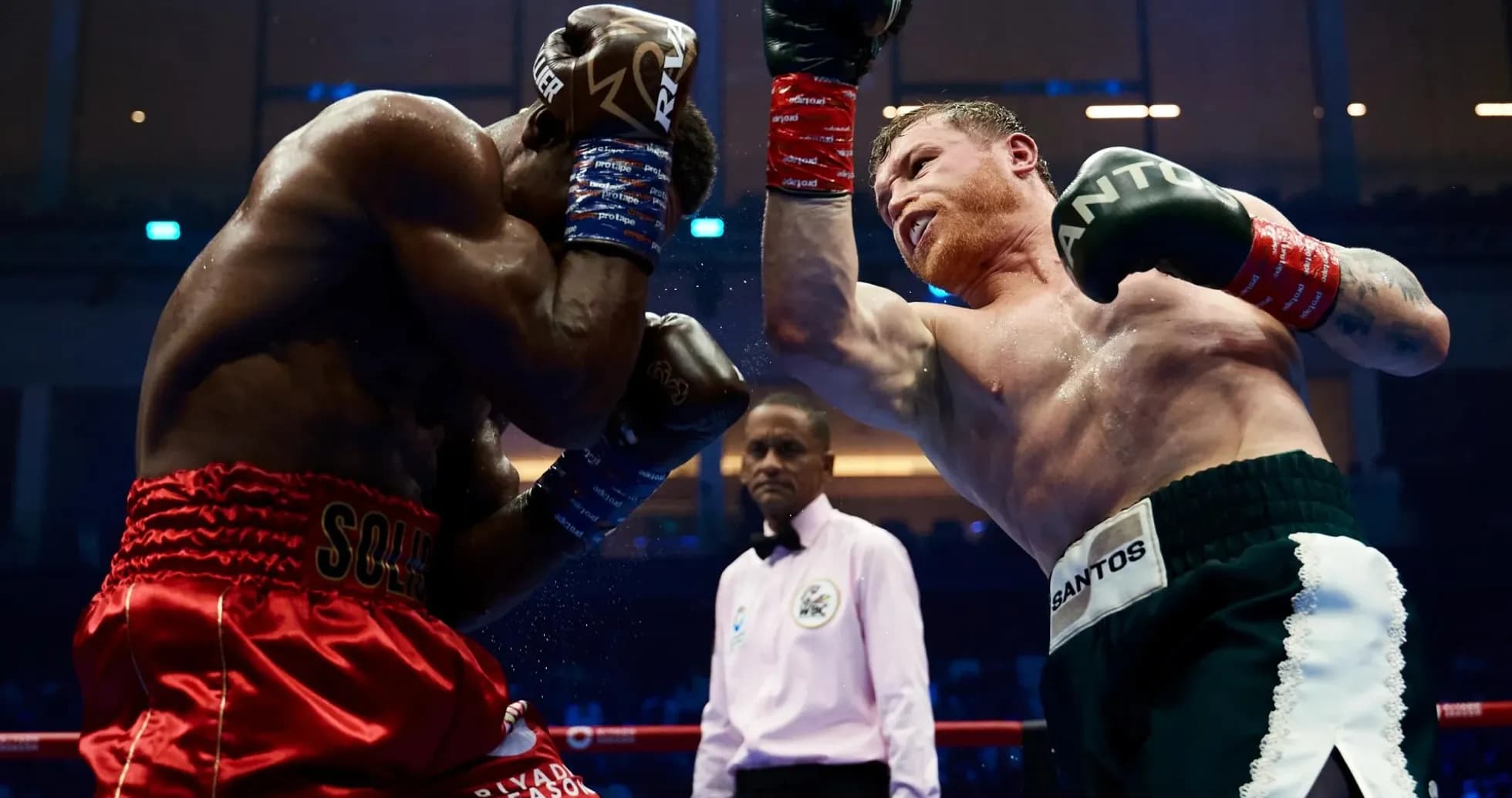
Under the bright lights of Riyadh, with questions swirling about his future and his aura, Canelo Alvarez quietly went back to work. Twelve rounds later, the old master had another belt around his waist and a new line on his legacy: three-time super-middleweight world champion at 168lbs.
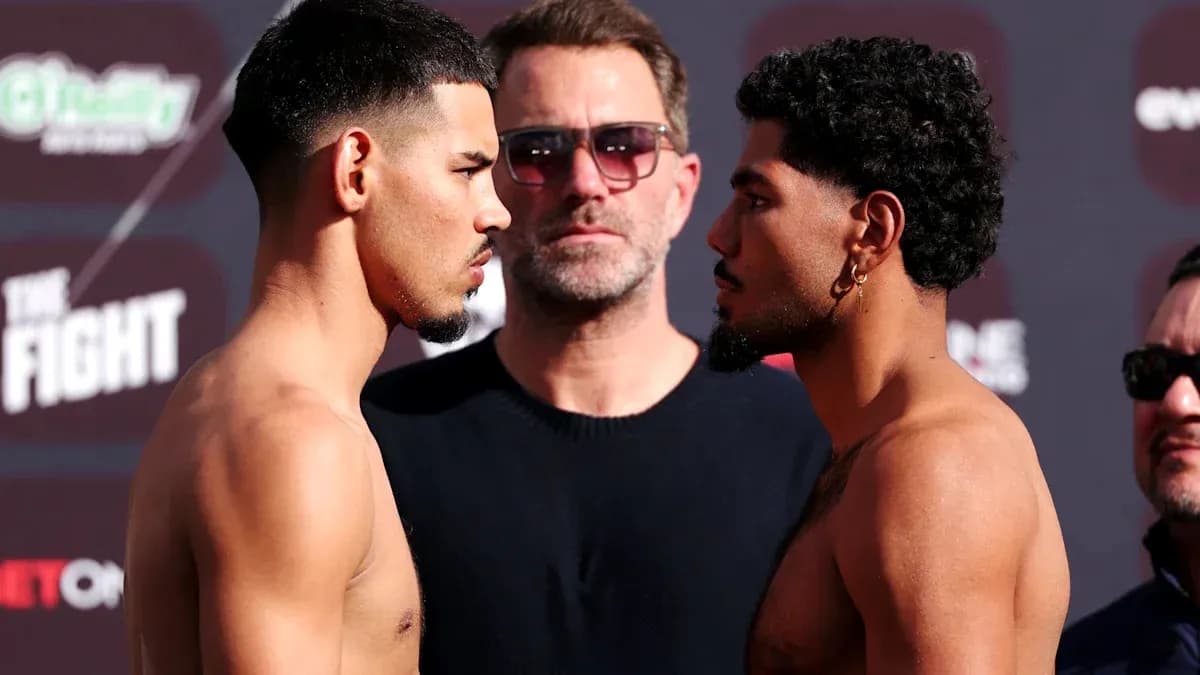
Christian Mbilli arrived with menace, power and a WBC title to protect. He left with his belt gone and his game plan stripped bare by a fighter who has spent a career solving nights like this.
The scorecards told the story of control and clarity: 115-112, 116-111, 117-110, all for Alvarez. No controversy. No debate. Just a great fighter doing what great fighters do when the noise gets too loud.
A legend resets his throne
This was Canelo’s first outing since losing to Terence Crawford, a defeat that had sparked talk of decline and doubt. Riyadh, again the global stage, offered him a chance to answer all of it in one disciplined, ruthless performance.
He did not charge out looking for redemption in one punch. He boxed. He thought. He set traps. He turned a supposed fire fight into a slow-burning chess match in the Middle East, and Mbilli never quite found the board, let alone the pieces.
When it was over, the emotion poured out.
"It is so difficult to explain, this is something unbelievable," Alvarez said in the ring. "It feels like my dream, now I've won the title again. I'm so proud of my team. Eddy Reynoso made me the champion that I am, thank you so much for everything."
The champion in him, though, never strays far from the next assignment.
"I'm going to have a rest, take a couple of weeks off and then we will come back again," he added. No grand declarations. Just the promise of more.
Early tension, quiet control
From the opening bell, the fight unfolded at Canelo’s tempo. The first round set the tone: Mbilli tried to pin him on the ropes, but Alvarez’s jab snapped out with authority, his feet held centre ring, and the Frenchman found only arms and gloves when he tried to let his hands go.
Round two brought Mbilli’s first real success. A straight shot down the middle caught Canelo’s attention, a reminder that the champion carried genuine danger. The response was instant. Alvarez dug a whipping left hand into the body, a trademark reply that signalled he was neither hurt nor intimidated. The tempo lifted, the tension sharpened.
The third was pure cat-and-mouse. Canelo stood his ground, baiting Mbilli forward, inviting him to overreach. Mbilli obliged with heavy swings but found himself swiping at air or colliding with a tight, disciplined guard. At one point, Alvarez waved him in, oozing confidence. Mbilli believed he was on top. The subtler story said otherwise.
By the end of the fourth, the pattern was clear. Mbilli was the busier man, marching forward, throwing in volume. Canelo was the more accurate, landing the cleaner, sharper punches. Judges were being asked a familiar question: do you prefer activity or quality?
Canelo’s rhythm, Mbilli’s frustration
The middle rounds belonged to Alvarez.
In the fifth, both men traded neatly, each going downstairs to invest in the body. Mbilli kept the output high, but Canelo’s shots carried more precision and authority. The Mexican also complained about a shot to the back of the head, a sign that the inside battle was getting rougher.
Round six saw Alvarez begin to open up. A combination ripped through Mbilli’s guard and drew a gasp from the crowd. The fight remained a tactical duel, but Canelo subtly turned the screw, upping his own work rate and drawing applause as he started to dictate not just where the fight was fought, but when.
By the seventh, he was in a groove. Dropping back, inviting Mbilli forward, then punishing him with straight shots and counters, Alvarez finally landed a textbook uppercut that snapped Mbilli’s head and drew a wry smile from the champion. Canelo had his best round of the fight, finding the target with growing regularity as the session closed.
Mbilli, for all his heart, found himself chasing shadows.
The pivotal moment
Round eight carried the flashpoint.
Canelo boxed smoothly off the back foot, picking angles, sliding away from Mbilli’s increasingly predictable rushes. The Frenchman continued to press, but his attacks grew one-dimensional, his feet plodding into positions Canelo had already mapped out.
Then came the controversy. As the pair tangled, Alvarez complained of punches to the back of the head. He gestured to the referee, indicating it had happened three times. The official agreed. A point came off Mbilli’s card.
The WBC champion shook his head in disbelief, but the damage was done. In a close fight, on a big night, that deduction loomed large. It also seemed to drain something from Mbilli, while sharpening Canelo’s focus.
The ninth underlined the shift. With the point gone, Mbilli now faced an uphill climb. Alvarez increased his work rate again, timing the Frenchman as he marched in, tagging him with shots that stopped him in his tracks. If Mbilli was to keep his belt, he needed urgency and invention. Instead, he met a wall of experience.
Mbilli fades, Canelo closes
By the tenth, the champion’s legs and belief looked heavy. He still came forward, but the conviction had dulled. Canelo slipped in and out of range, content to touch, move, and make Mbilli reset. The Frenchman tried to lift the pace late in the round, but his attacks fell straight in front of Alvarez, easy to parry, easy to read.
The eleventh was desperate territory. Mbilli needed a knockout. Nothing in the previous ten rounds suggested he would find one. Canelo kept boxing neatly, countering as Mbilli stumbled in, smothering his own work. For all the pre-fight talk of Mbilli’s power, Alvarez’s chin and composure remained untouched. He has never been dropped in his career, and this night never came close to changing that.
The final round offered one last chance at drama. Alvarez, firmly in command, continued to solve the puzzle in front of him, still a step ahead, still dictating the terms. Mbilli finally landed a big shot that drew a gasp from the crowd, a fleeting reminder of the threat he carried. Canelo’s response was to wave him in, demanding more, calling for a toe-to-toe finish.
Mbilli emptied what he had left, but it came too late and without the precision or surprise required to turn the fight. The bell sounded with Alvarez already looking like a man who knew the job was done.
The cards confirmed it. Champion again.
Oleksandr Usyk and Turki Alalshikh stepped through the ropes to congratulate him. The scene said it all: the sport’s powerbrokers and pound-for-pound royalty sharing the ring with a man who refuses to step aside quietly.
A Riyadh stage stacked with drama
The night in Saudi Arabia delivered more than just Canelo’s resurgence.
Jaime Munguia survived a thunderous scare to retain his WBA super-middleweight title against Nikita Zon. The Mexican, also guided by Eddy Reynoso, heard the final bell with scores of 116-112 twice and 117-111 in his favour. Those numbers hid the chaos that came before them.
The sixth round, in particular, will sit in any early shortlist for round of the year. Zon unleashed a brutal onslaught that looked certain to end the fight. Munguia somehow stayed upright, refused to fold, and then slowly wrestled back control as the minutes and rounds ticked away. By the championship frames, he was the one piling on pressure, using his experience to suffocate Zon's late hopes. The belt stayed in Mexico, but not without a brutal examination.
Elsewhere, Rafael Espinoza kept his WBO featherweight title with a third-round TKO over Ricardo Blandon, while Reito Tsutsumi blasted out Raymundo Rojas Garcia in two at super-featherweight. Carl Jammes Martin edged David Picasso by split decision in a tight featherweight contest, and Sultan Almohammed banked a unanimous decision over Erick Jahir Urvina Villegas at super-featherweight.
Bek Nurmaganbet made a statement with a first-round knockout of Marcos Vazquez Rodriguez at super-middleweight, Brayan Leon Salgado claimed a unanimous decision over Hector Octavio Aguirre Martinez in the same division, and Carlos Emilio Rojo Vazquez stopped Flavius Biea in four at middleweight.
But the night belonged to one man.
Canelo Alvarez came to Riyadh needing more than a win. He needed to prove that the old instincts still flicker, that the timing, the subtle defensive shifts, the quiet authority remain intact at the very top level.
He left with another world title, another name added to a long list of beaten champions, and another reminder sent to a division that had started to look beyond him.
At 168lbs, the king is not done yet.