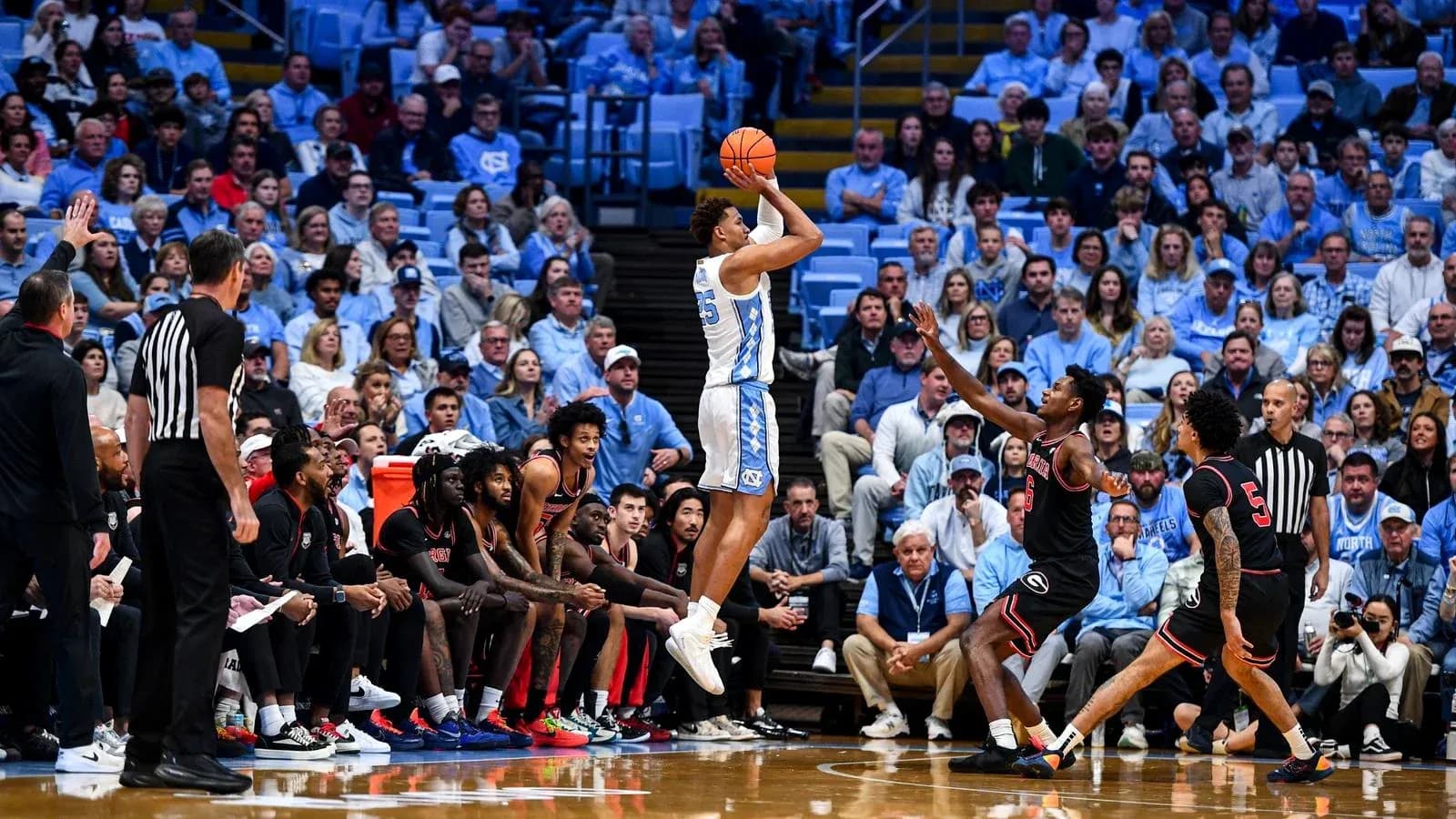
Carolina's Streak Ends as Georgia Dominates Rebounding and Three-Point Shooting
The Smith Center had grown used to exhaling late and walking out happy. Twenty-one straight times, Carolina had found a way at home.
Georgia didn’t blink.
The Bulldogs walked into Chapel Hill, absorbed Carolina’s best punch, then closed with a ruthless composure the Tar Heels never matched, handing UNC a 78–70 defeat that felt as much about habits as it did about one November night.
Carolina led by three with five minutes to play and had the shot it wanted. An open three on the left wing, the kind of look that usually sends the building into a roar and the opponent into a timeout. It rimmed out.
From there, the game flipped. Carolina went 3-for-11 from the field the rest of the way. Georgia either scored or snatched the offensive rebound on almost every trip. The Tar Heels never found another gear.
Beaten on the boards, beaten in the details
The closing minutes exposed a problem that had been simmering all evening. Carolina simply could not finish possessions.
Georgia grabbed 18 offensive rebounds and turned them into 15 second-chance points, 13 of those after halftime. In the final three minutes alone, the Bulldogs carved out a key field goal and two free throws off missed shots that Carolina failed to secure. The rebounding numbers told the story: Georgia 52, Carolina 43.
Freshman Maximo Adams, still searching for rhythm as a scorer, again looked like Carolina’s most instinctive rebounder. He went just 1-for-8 from the field and 0-for-3 from three, but he pulled down 11 boards in a game where every one of them mattered. Michael Malone trusted him in the closing stretch, using him in place of Jarin Stevenson, who finished 2-for-7 and 0-for-3 from deep but did grab seven rebounds.
Even with Adams battling, the Bulldogs controlled too many of the critical caroms. Second chances became the difference between a narrow home win and a sobering loss.
Living – and dying – by the three
Carolina’s shot chart read like a warning label.
They launched a school-record 38 three-pointers. Some of that came in late-game chase mode, but a large chunk arrived while the outcome still hung in the balance. They made only nine of them.
The numbers were stark: 9-for-38 from three (23.7 percent), 15-for-35 from two, and 32.9 percent overall. There was no safe haven on the floor.
The one area that did produce points was the free throw line, where Carolina went 13-for-19. That, too, faded when it mattered most. In the second half, the Tar Heels attempted just seven free throws and made five. Sayon Keita, Alex Samodurov and Stevenson combined to take a single free throw all night, a quiet statistic that underscored how little pressure Carolina applied at the rim.
Malone will stew over the missed finishes inside. The Heels had multiple chances at the basket, the kind that should be automatic at this level, and came away empty. When the threes weren’t falling, there was no reliable counterpunch.
Brown shines, then disappears
If there was a steady offensive pulse, it came from Terrence Brown.
The sophomore kept Carolina afloat in the second half, flashing the full offensive package that has made him one of the early bright spots of the season. He drilled four three-pointers, mixed in drives, and consistently put Georgia’s defense under duress. He finished with a team-high 21 points and drew a team-best five fouls.
Then, with the game hanging in the balance, he vanished from the box score. Brown did not attempt a single shot in the final 5:17.
Whether Georgia’s defense took him away or Carolina simply lost track of its hottest hand, the result was the same. The one player who looked capable of creating something out of nothing never got the chance to rescue them.
A brutal close to a brutal half
The ending echoed the first half, when Carolina’s offense sputtered and stalled.
Georgia closed the opening 20 minutes on a 9–0 run, turning what had been a manageable game into a frustrating deficit. The Tar Heels shot 9-for-36 in that half, including 5-for-20 from three. The 25 percent mark from the field tied the third-worst shooting half in Smith Center history, a building that has now hosted 601 games.
Early on, it looked different. Georgia entered at 3–0, having protected the ball well, but Carolina jumped them with defensive pressure, forcing turnovers on the Bulldogs’ first three possessions. Those miscues fueled some of Carolina’s best offense of the night. The Tar Heels turned eight first-half turnovers into seven points and eventually built a nine-point lead with 10:35 left before the break.
That pressure didn’t last. Carolina finished with 12 points off 12 Georgia turnovers, but the Bulldogs played cleanly when it mattered most. The Heels did not force a single turnover in the final 9:38, removing one of the few reliable ways they had been manufacturing points.
History, and what comes next
This was the first meeting between Carolina and Georgia since November 1998, a gap that feels almost impossible in modern scheduling. The next one won’t take nearly as long: the teams are already set to reunite in Athens in November or December of 2028.
By then, this night will be a line in a media guide. For now, it’s a jolt.
A 21-game Smith Center win streak is gone. So is the illusion that this team can simply shoot its way out of trouble when the threes stop falling and the glass goes unprotected.
Carolina has a week to sit with it before Marshall arrives next Friday, the start of a stretch that brings two home games in four days, with Monmouth and former Tar Heel King Rice following on Nov. 23.
The question isn’t whether this group can score when it’s humming. It’s whether it can learn to win on the nights when everything feels as hard as it did against Georgia.