
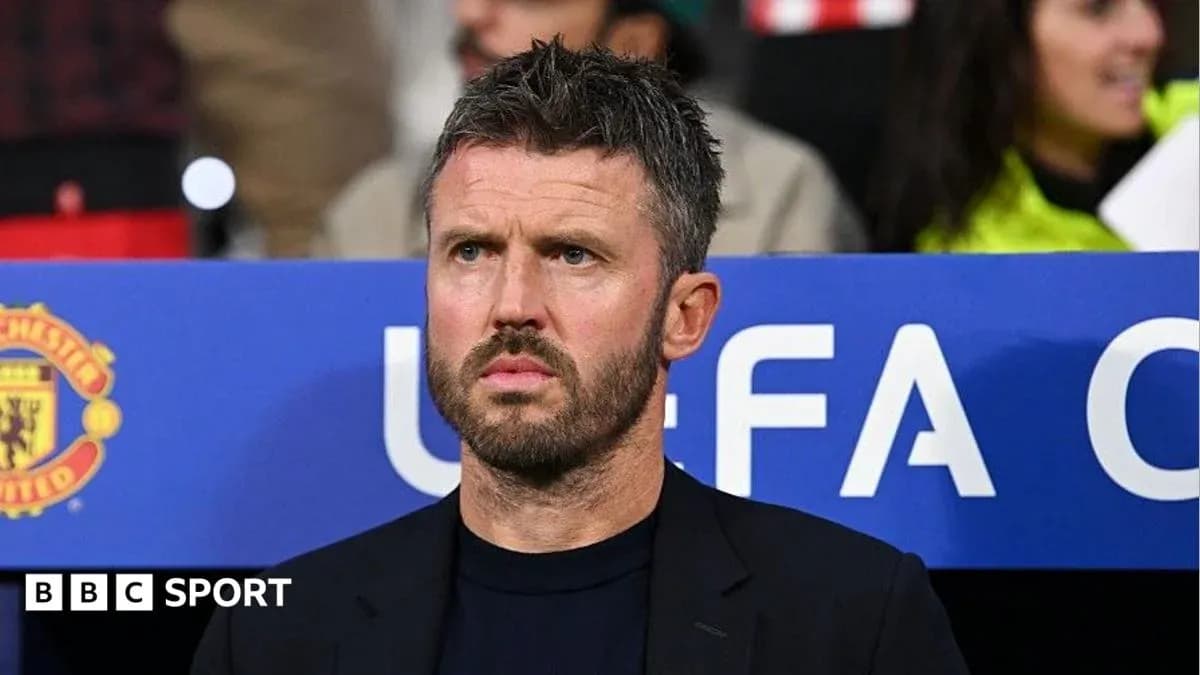
Michael Carrick walked into the press room at Carrington on Friday and made one thing instantly clear: this was going to be on his terms.
There were no opening questions, no gentle warm-up. The under-pressure Manchester United manager stood, took control of the room and spoke – for five minutes and 30 seconds – with a rawness and emotion that laid bare the scale of the crisis he is fighting to contain.
Carrick takes the mic – and the responsibility
“Recently we haven't had a good time, I think that's pretty obvious,” he began, before circling quickly to the night that has dragged United to the edge.
Wednesday’s 4-1 collapse against Como in the Champions League was not just another bad result. It followed a run of seven games without a win and arrived on the back of public criticism of the club’s hierarchy from Lisandro Martinez and a damning assessment of the team’s tactics in Italy from captain Bruno Fernandes.
Carrick knew he could not just sit down and trade soundbites. So he reached for the club’s soul instead.
“Wednesday was a bad night, and it hurt me to see us play like that. It was unacceptable.
“My responsibility is to get a team on the pitch that represents this football club, and the supporters, and they can be proud of in the identity we show. We have gone away from that recently. It's important we all recognise that.”
This was not the measured, distant language of a man detaching himself from the wreckage. It was a manager staking his reputation on the idea that United’s core values still matter – and that he understands them.
“The foundation and values of this football club have been etched for many years. I totally understand and get every single one of them.
“There's a resilience about this football club that runs very deep. I've seen it with my own eyes, I've felt it, I know some of the individuals closely who have been a big part of that history.
“Entitlement cannot be at this football club.
“It was based on being humble, having humility, and hard work. We can never lose that, and I won't let us lose that.”
The echoes of Sir Alex Ferguson were hard to ignore. The great Scot would occasionally seize control of a press conference in similar fashion, but rarely did he feel the need to speak at such length. Carrick, with his job on the line and his authority questioned, clearly felt he had no choice.
Fernandes under the spotlight
If Carrick wanted to talk about values, the questions that followed dragged him straight back into the harsh reality of his present.
Would he consider dropping Bruno Fernandes for Sunday’s Premier League game against Bournemouth at Old Trafford?
The captain, 32, has not just been struggling for form. His post-match comments in Italy have cut to the bone at a club still trading heavily on its past.
“At this club, there's too much focus on what's been done in the past,” Fernandes told Sky Italia after the Como defeat. “But we're not those people anymore. The club and the players need to understand that.
“Unfortunately for us – especially when it comes to the players – those who join expect to win trophies, win games, and reach the highest level, that's been very difficult at this club in recent years.”
Those words landed badly with some inside Old Trafford. Club sources insisted on Thursday that Fernandes would not be stripped of the captaincy or fined, but the sense of a fracture between dressing room and dugout has grown.
Carrick, asked directly whether he might leave his skipper out against Bournemouth, refused to offer any protection.
“The most important thing for me is the team, the squad and dynamics in the squad,” he said, his tone firm.
“It's about the football club. I'll always do what is best for the football club.”
The question came again, this time about the armband. Would he take the captaincy away from Fernandes?
The answer did not change.
“I will always do what is best for the football club.”
On whether he had spoken to Fernandes about his conduct, Carrick drew a line.
“I don't think this is the time to go into too much detail.”
If that was an attempt to close the subject down, it did not entirely succeed. The image of a captain questioning the club’s relationship with its own history, and a manager publicly wrestling with what that history means, will linger long after Sunday’s team sheet is revealed.
Dressing room unity – and a personal blow
With players speaking out and results collapsing, the inevitable question followed: is the dressing room divided?
“No, it's not,” Carrick replied. “We just need to get back to doing what we do best.”
Belief in that statement will only truly be tested on the pitch. Seven games without a win, a 4-1 humiliation in Europe, senior figures openly challenging decisions – these are the classic ingredients of a fractured squad. Carrick insists the group is still together. Bournemouth will offer the first piece of evidence either way.
Away from tactics and tension, there was a reminder of the human cost of life at this level. On Wednesday, while the fallout from Como dominated headlines, Fernandes’ Cheshire home was burgled.
Carrick made a point of stressing the club’s response.
He said United were “doing everything” to support the midfielder and his family.
“Thankfully they weren't directly affected even though it is an awful situation.”
A line in the sand
For all the talk of resilience and humility, Carrick knows what really counts now. Bournemouth at Old Trafford has become more than a routine league fixture. It feels like a test of whether his words carry any weight inside his own dressing room.
He has invoked the club’s values, challenged the notion of entitlement and refused to shield his captain from scrutiny. The rhetoric is strong. The emotion is real.
What happens next will decide if this was the start of a fightback – or the last stand of a manager running out of time at Manchester United.





