
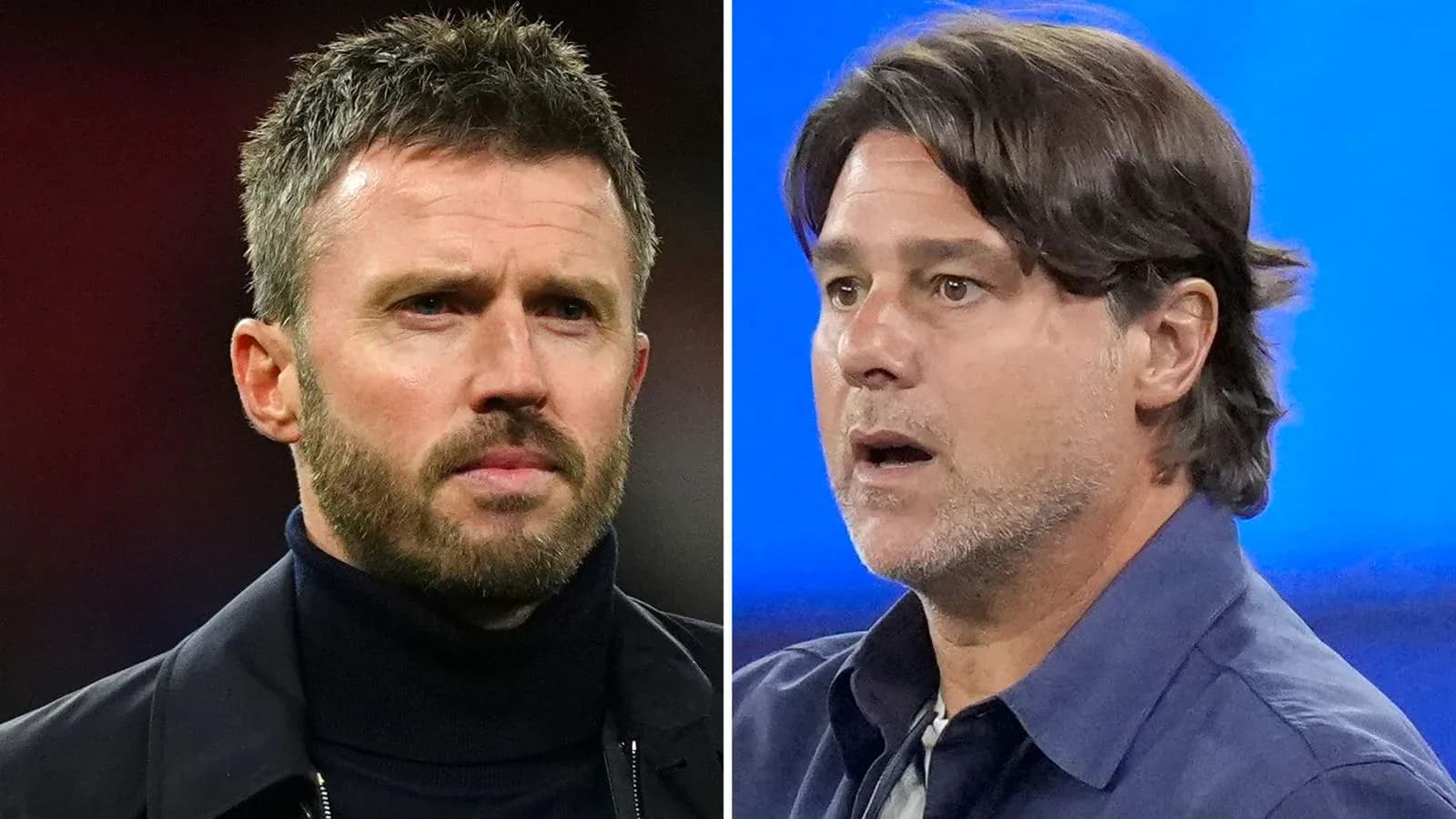
Michael Carrick’s grip on the Manchester United job is loosening by the day, and the club’s powerbrokers know it.
In Monaco on Wednesday, CEO Omar Berrada and director of football Jason Wilcox are due to sit down with minority owner Sir Jim Ratcliffe. On the table: the conclusions of their season review, the direction of the club – and whether Carrick survives it.
No final call has been made yet. But the tone around Old Trafford has shifted from patience to calculation.
Pochettino waits in the wings
Mauricio Pochettino is not pushing, not briefing, not agitating. He doesn’t need to. Those close to the situation say he is open to a conversation if United pick up the phone.
The cost of prising him away from his current role as USA head coach is thought to be around £7m. The former Argentina defender recently extended his contract with the USMNT until 2030 and is preparing for a Nations League quarter-final against Haiti. Any move would be complicated, not impossible.
United have been here before. They have spoken to Pochettino on at least two previous occasions about the manager’s job. His name never really leaves the Old Trafford orbit; it just drifts closer or further depending on the latest crisis.
Right now, it’s drifting closer.
A review, not yet an execution
Carrick arrived at the training ground on Tuesday with the club in full review mode. Wilcox is leading a deep dive into performances so far this season, and the numbers are damning.
One win in 11 games. Thirty goals conceded in all competitions – the worst defensive record of any side in Europe’s top five leagues. A worst-ever start to a Premier League season for Manchester United. The scale of the slump has drowned out the brief optimism from recent comebacks.
Carrick was already on the brink after a 3-0 home defeat to Bournemouth two weeks ago. He was granted a stay of execution: three more games to turn it around. The response? An eighth straight Premier League match without a win and a late salvage job against Villa that did little to calm boardroom nerves.
There is now genuine doubt that he will be in the dugout when United go to Anfield the weekend after next. That is the fixture looming over every conversation.
Boardroom caution, not conviction
Despite the pressure, United are not sprinting towards the trapdoor. The hierarchy intend to use the international break to take a breath, reassess the season and decide whether changing the head coach actually fixes anything.
If they were convinced a new man would transform results overnight, Carrick would likely already be gone. Julian Nagelsmann and Eddie Howe are both out of work, both believed to be open to talks if United come calling. The club has not moved. That hesitation is telling.
They want to avoid another interim. If Carrick goes, the preference is a clean handover to a long-term appointment. At this stage, there have been no substantive discussions with alternatives, beyond sounding out the landscape.
The club’s bosses are walking a tightrope: act too soon and they risk another reset with no clear plan; act too late and the season drifts beyond rescue.
Why Carrick is still in the job
Three factors, in particular, are keeping Carrick in place.
- First, the stands are not turning on him. Old Trafford is not singing for his head. Carrick is a club legend, a midfielder who won 11 major trophies in United colours, including the Champions League and five Premier League titles. The affection is deep, and it has bought him time others would never get.
- Second, the board believe the players are still with him. The last two matches have been chaotic, but they produced a Champions League win against Roma and a draw against a strong Villa side, both via late surges. The view inside the club is that the squad has not downed tools. They are still running, still chasing, still trying to haul games back from the brink.
- Third, there is a nagging suspicion in the corridors of power that the head coach is not the root of the problem. United’s hierarchy privately feel Carrick over-achieved last season, dragging a flawed side to third place and Champions League football. This year, they see a group of players who have badly under-performed, regardless of who stands in the technical area.
Those three strands – fan loyalty, dressing-room backing, and structural doubt – have combined to keep Carrick in the job longer than the results alone would justify.
A club at a crossroads
Carrick and his staff returned to Carrington on Tuesday after a scheduled day off on Monday. Most of the squad are away on international duty, no full first-team sessions are planned, and that lull has given the club rare breathing space to think rather than react.
The question now is not just whether Carrick survives the break. It’s what Manchester United want to be.
Sky Sports News chief reporter Kaveh Solhekol put it bluntly. He argued that it almost doesn’t matter who is in charge – Carlo Ancelotti, Pep Guardiola, Jurgen Klopp – because under the current ownership structure, the club will continue to drift away from the elite they once matched, clubs like Barcelona and Real Madrid, and towards a very different tier.
The fear, starkly expressed, is that if this slide continues unchecked, United will find themselves rubbing shoulders with clubs like Lincoln and QPR rather than Europe’s aristocracy.
That is the backdrop to every decision Ratcliffe, Berrada and Wilcox will make in Monaco. Carrick’s future is just one part of it, but it is the most immediate, the most visible, and the one that will define the mood when United next walk out at Anfield.





