
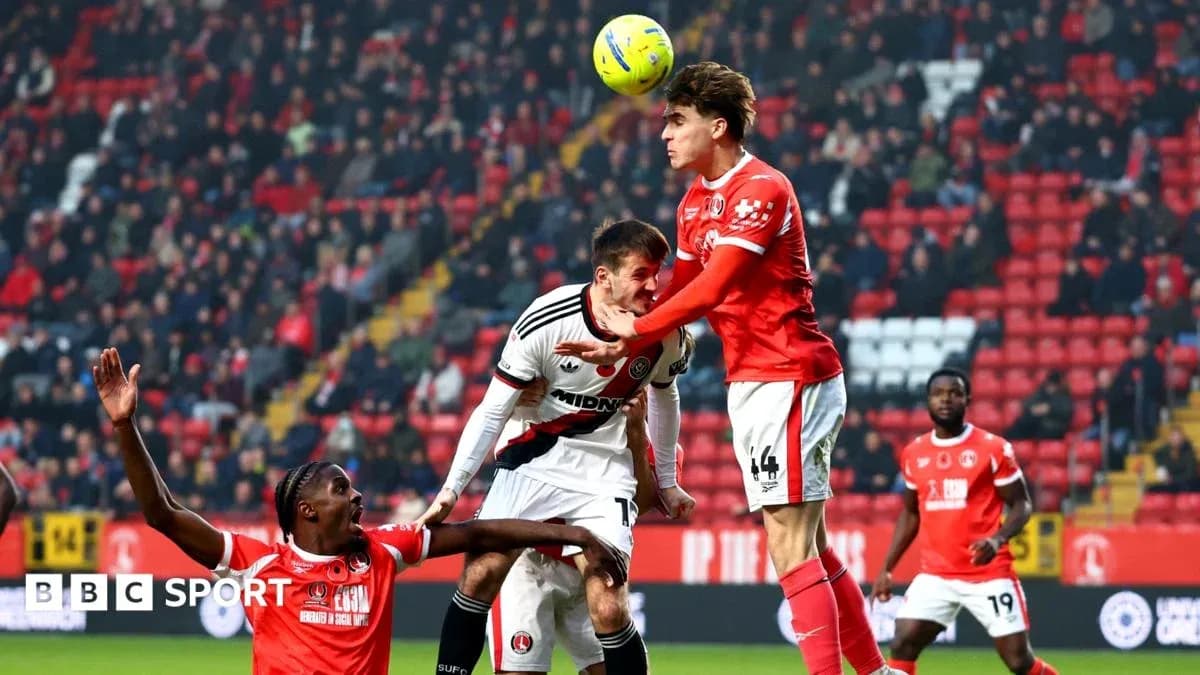
The tension inside The Valley finally snapped on Saturday afternoon. Not with anger this time, but with relief. After 11 winless games, Charlton Athletic at last found a way to stop the slide, and they did it the hard way – by beating a Sheffield United side drilled by Chris Wilder and stacked with top-level experience.
This was no soft landing. Wilder’s teams rarely offer that. Sheffield United arrived with a solid start to the season behind them and a spine built on know-how: former England midfielder Kalvin Phillips dictating from deep, Chile international Ben Brereton Diaz offering threat in the final third, Ghana forward Jordan Ayew adding nous and movement.
On paper, Charlton looked patched-up and vulnerable. A summer signing who hadn’t fired in Millenic Alli. A reserve goalkeeper in Will Mannion. Tyler Bindon, a young central defender still searching for consistency. Conor Coventry, short on form but suddenly carrying the weight of the captain’s armband. Around them, a side reshuffled by necessity, with Kayne Ramsay, Nathaniel Chalobah, Lloyd Jones, Miles Leaburn and Karlan Grant all sidelined.
This did not read like the blueprint for ending a crisis. It read like the prelude to a twelfth straight game without victory.
Then the script flipped.
Alli, so often a symbol of frustration since his arrival in the summer, tore into this game with a different edge. He was direct, decisive, and finally devastating. He scored, he created, and he carried himself like a player determined to rewrite the early chapters of his Charlton career. The forward who had been a problem suddenly became the solution.
Behind him, Mannion produced the moment that every escape act needs. Deep into the contest, with nerves shredded and legs heavy, Sheffield United carved out one last chance. Mannion’s response was not that of a reserve making up the numbers. It was a full-stretch, highlight-reel save – the kind that gets replayed all weekend and remembered all season. A world-class intervention, at the death, to protect what Charlton had fought so hard to build.
Bindon, facing the club he represented on loan last season, finally delivered the kind of performance Charlton had been waiting for. He read danger early, attacked crosses, and refused to be bullied by seasoned Championship operators. This was the afternoon he stopped looking like a prospect and started looking like a defender you can rely on.
Coventry, meanwhile, wore the captain’s armband like armour. Where recent weeks had brought hesitancy and loose touches, this time there was clarity. He snapped into tackles, used the ball with purpose and set the tone in midfield. It was, by any fair measure, his best display in a Charlton shirt.
Around that core, a makeshift XI played like a hardened unit. Players drafted in because of injuries became unlikely heroes, closing gaps, pressing in packs, and refusing to let the occasion overwhelm them. Every block, every recovery run, every second ball won felt like a small act of defiance against the slump that had dragged the club down.
At the centre of it all stood Nathan Jones.
Under intense pressure and, in reality, one more bad result away from a very serious conversation about his future, he found a way to marshal this group into something coherent, disciplined and dangerous. He didn’t just pick a team; he built a plan to unpick a renowned Championship side and convinced a fragile dressing room to believe in it.
The stakes for him were obvious. Reach 12 without a win, and the odds on his departure would have shortened by the hour. Instead, he leaves this game with something stronger than just three points. He leaves with proof that this squad will still run for him, still listen, still fight.
The international break now offers a rare pause. Time to heal the injured, reset the mood, and breathe. Jones has earned that quiet spell with his family, earned the chance to step back without the cloud of a winless run hanging over his head.
The question is no longer whether Charlton can stop the rot. They have. The question now is whether this afternoon at The Valley becomes a turning point – or just a welcome, isolated roar in a season that still has everything to decide.





