
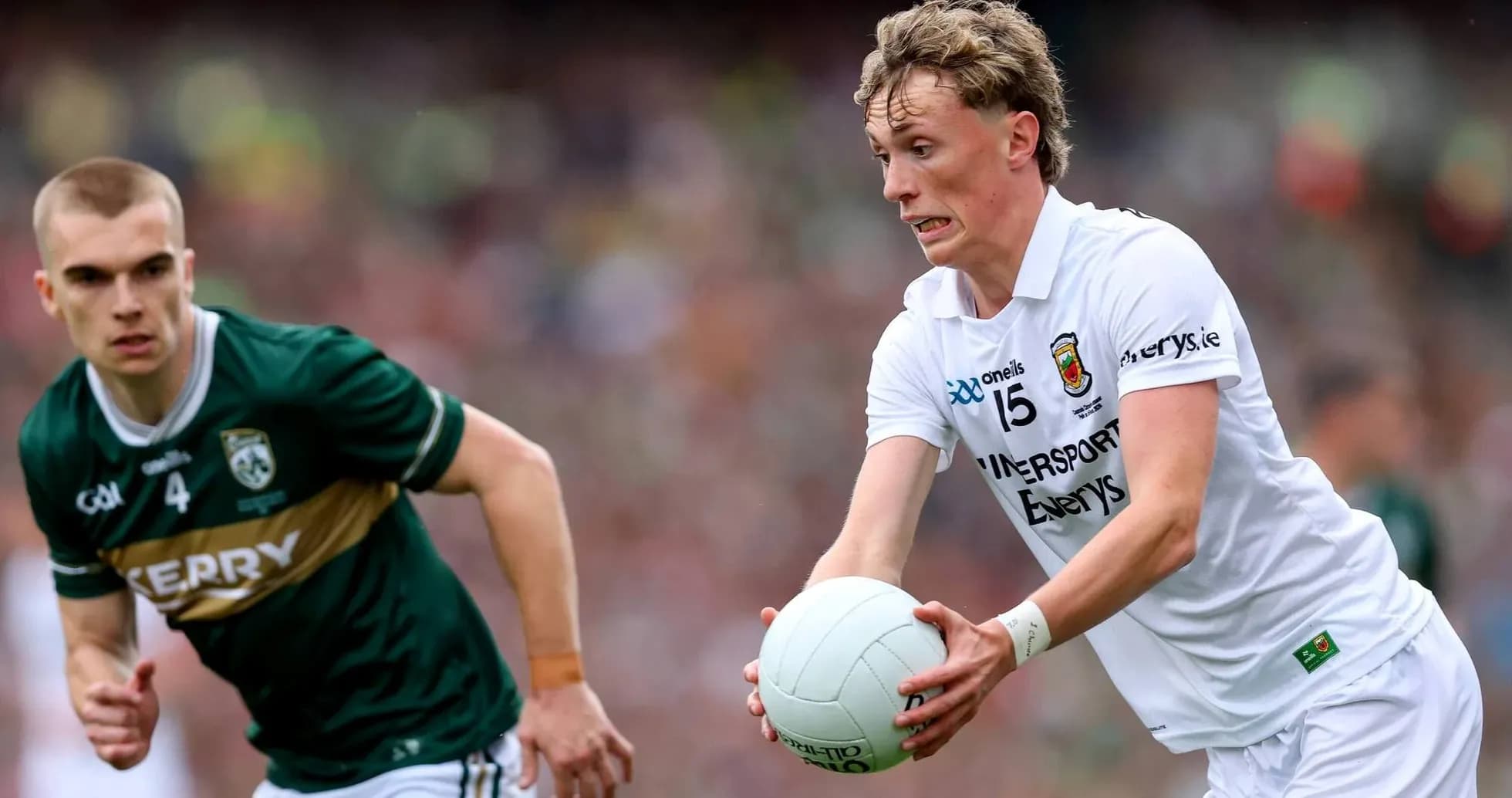
Whose point was that, really? Whose mistake?
Kobe McDonald had tracked Donal O’Sullivan Casey diligently, stride for stride, as he broke from deep. Then he hit the brakes at halfway, like Wile E Coyote at the cliff edge, because he couldn’t afford to breach the defensive line. Ahead of him, Eoin McGreal hovered in the right area but with his back to the ball, eyes glued to Paudie Clifford.
Jordan Flynn picked up Casey’s run. Casey laid off. Flynn went chasing leather. Casey kept going. Clifford, of course, saw everything and clipped the pass into him for the opening score.
So where do you pin that? Should another Mayo defender have pushed up to free McDonald to continue tracking Casey? Should one of the other man-markers have shuffled across to Clifford, trusting the structure to hold? Should Flynn have stayed with Casey once he took him on, even if the ball moved away?
And, in the cold light of winter, what does a moment like that mean for the All-Stars?
The myth of the single cause
These are the knife-edge calls that turn individual awards in a team game into an imperfect science. They are why any final All-Star selection feels, at some level, unsatisfactory. It is a judgement, not an equation.
Every year, the same prescriptions are floated. Bring current players and managers into the process. Lean more on data. Give extra weight to the league, or to the early rounds of the championship, or to Croke Park alone.
This is what happens when an entire sport goes hunting for the same thing: the one thing.
Players chase the one tweak that nudges them into the starting 15 or onto the shortlist. Managers obsess over the one adjustment that will make this season different from all the others. Journalists, too, look for the one clean explanation that says why one team climbed the steps and another trudged down the tunnel.
It is never one thing.
Games, seasons, careers: none of them bow to a single factor. A simple explanation makes for a neat story, but the reality is that a mind-melting number of components feed into performance, and all of them sit on the table when awards are discussed.
There is no perfect system.
What the numbers see – and what they miss
Part of the problem lies in what we actually count. GAA data is overwhelmingly tilted towards what happens in possession: kickout wins, shots, scores, assists. Everything that shines with the ball in hand.
Those numbers matter. They should shape the conversation. But they are only one side of it.
Take Mayo’s leading assisters in the 2026 championship. The honour is split three ways: Ryan O’Donoghue, Kobe McDonald and Jack Carney. Next on the list is Sam Callinan, credited with creating 13 points. He also scored with the only two shots he took.
How much weight do you put on that for a man nominally picked at corner-back?
There are defensive metrics, of course: tackles, turnovers won, pressure acts. Some inter-county setups go deeper again, tracking “breaches” – every time a defender is beaten by man or ball. Those numbers are time-consuming to log, harder to explain, rarely published and, bluntly, a lot less glamorous than scores and assists.
Then come the matchups. The stories we tell around them can be just as misleading as the stats.
How often have you heard it said that Jack Coyne held his direct marker scoreless from play in his last four games? It’s a powerful line. It sounds definitive.
Look a little closer.
Coyne started the All-Ireland final on Dylan Geaney, with McGreal minding Paudie Clifford. By midway through the second half, both McGreal and Geaney were off and Coyne was now tracking Clifford.
Kerry’s last point of the game tells its own tale. Clifford collected the ball outside the scoring arc and squared up Coyne. Two feints, a slip of the hips, and he glided past on the left to clip over. It doesn’t erase Coyne’s season. It doesn’t say he didn’t deserve an award. It does put that “scoreless from play” stat under a harsher light.
The modern game tilts heavily towards the attacker. Space, rules, conditioning – all of it favours the man with the ball. For defenders, the job description has changed. Sometimes the brief is to bend but not break, to funnel, to delay. Sometimes it’s to call a switch, to hold space rather than a man, to track a decoy runner so someone else can make the play.
Those decisions are rarely straightforward, and they almost never show up in a neat column on a spreadsheet.
Reconciling the contradictions
Look at David McBrien. He struggled at midfield against Roscommon. He had real issues with Bobby McCaul when Mayo faced Monaghan. Louth’s Ciaran Downey kicked 0-4 directly off him.
On paper, that’s a problem. On the pitch, the story is more tangled.
So much of McBrien’s role lives inside a collective shape: doubling up on danger men, providing sweeper cover, plugging gaps before they open. He was a legitimate Player of the Match contender in the All-Ireland decider. How do you reconcile that with the raw concession numbers from earlier rounds?
Or take Matthew Whittaker. How much allowance should be made for the fact that large chunks of his season were played through injury? You can’t see the painkillers or the restricted training load on a stat sheet.
What about Flynn’s sheer industry in a centrefield that, at times, looked under siege? His GPS numbers, his repeated efforts, the dirty work that lets others shine – they’re vital, but they don’t fit easily into a headline.
Then there’s Paudie Clifford. Eight championship games this year. Across the final three in Croke Park, he scored 0-13, with 0-9 from play. That’s elite output on the biggest stage. Yet his influence in earlier outings against Cork, Donegal and Armagh was curbed by various impediments.
So how do you weigh a storming finish against a quieter start? Do you privilege the defining days in Croke Park or the full body of work from May onwards?
These are not abstract debates. They are the arguments that shape careers, legacies, contract leverage, even how players are remembered in their own counties.
Tweaking a flawed machine
None of this means the All-Star process is beyond repair. It can be sharpened.
In the Tailteann Cup Team of the Year, players and management submit their own teams, feeding an extra layer of insight into the selectors’ room. Something similar could be explored for the All-Stars.
A mid-championship stock-take could also help, a formal check-in to ensure that early-season excellence isn’t washed away by the tidal pull of the All-Ireland series. Memory is fickle; Croke Park in August and September tends to drown out everything that came before.
There is scope, too, for a more rigorous data backbone. The All-Star sponsors could commission an independent analysis provider such as GAA Insights to compile a comprehensive report: possession data, defensive metrics, contextual breakdowns. That document could sit at the heart of deliberations and, when the dust settles, fuel the barstool rows that follow the team announcement.
It would not hand down a verdict. It would frame a conversation.
Because in the end, that’s all this is: a conversation. Individual tallies, collective roles, injury history, big-game moments, form, fitness, the intangibles you can see but never quite measure – they all jostle for space.
There is no clean answer. Pretending otherwise does a disservice to the players who live inside those grey areas, and to a game that long ago outgrew simple explanations.





