
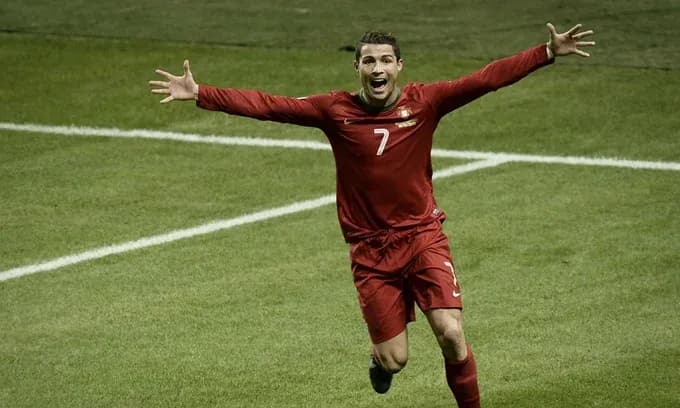
On 20 August 2003, an 18-year-old with bleached tips and fearless eyes walked into the Portugal dressing room and found Luís Figo lacing his boots. Cristiano Ronaldo had just swapped Sporting for Manchester United. That night, in a low-key 1-0 friendly win over Kazakhstan, Luiz Felipe Scolari handed him his first cap.
It was a quiet start. The noise came later.
Less than a year on, Portugal hosted Euro 2004 and Ronaldo was no longer just the kid. He was a weapon. In the opening game against Greece, he rose in stoppage time, met a cross with a thumping header and scored his first goal for the national team. The stadium roared. The scoreboard did not forgive: Greece still won 2-1.
Portugal grew into the tournament and so did Ronaldo. In the semi-final against the Netherlands, he struck first, igniting a 2-1 win and sending his country into their first major final. A new star, a new belief, a new Portugal.
Then came the crash.
In the final, Greece did it to them again, a 1-0 defeat that silenced Lisbon and left Ronaldo sobbing on the grass, inconsolable as the trophy slipped away on home soil. That image – the teenager in tears under confetti meant for someone else – became the first defining photograph of his international life.
Zlatan, Solna, and a one-man ticket to Brazil
A decade later, the stakes were different, the responsibility heavier. Portugal, misfiring in qualification for the 2014 World Cup, had stumbled into a playoff against Sweden. Ronaldo on one side. Zlatan Ibrahimovic on the other. Two egos, one plane ticket to Brazil.
In Lisbon, Ronaldo settled the first leg with a sharp finish in a 1-0 win. Advantage Portugal, but hardly security.
Solna turned the tie into a duel.
Ronaldo opened the scoring in the second leg, bursting clear to put Portugal ahead and seemingly out of reach. Ibrahimovic refused to accept it, thundering in two goals to flip the game to 2-1 Sweden and drag the tie to the edge of chaos.
Then Ronaldo took over.
First, a ruthless finish. Then another, a blur of pace and precision, to complete a devastating hat-trick and seal a 3-2 victory on the night, 4-2 on aggregate. He had scored all four of Portugal’s goals across the two legs. No debate, no sharing of the spotlight. He dragged his country to Brazil by sheer force of will.
From heartbreak to the summit of Europe
Euro 2016 did not begin like a coronation. Portugal drew all three group games, stumbling through the first phase without a single win. Against Hungary in the final group match, they trailed three times. Each time, Ronaldo refused to let the story end.
He scored twice in a wild 3-3 draw, keeping Portugal alive in a tournament they never truly controlled, but never quite left.
The campaign became a grind, a series of narrow escapes and controlled moments. In the semi-final against Wales, Ronaldo rose again – literally. A towering header opened the scoring in a 2-0 win, another landmark goal, another step towards redemption for 2004.
The final in Paris brought a cruel twist. After just 25 minutes against France, Ronaldo went down under a heavy challenge. He tried to continue, strapped and limping, but the knee gave way. He left the pitch in tears, the captain’s armband passed on, the dream seemingly snatched away again.
Portugal did not fold. They endured, they suffered, they held their nerve. In extra time, Eder – a squad player, not a superstar – drove a long-range shot into the corner and stunned the hosts. Portugal had their first major international trophy.
Ronaldo, now in a white training top, hobbled back onto the pitch at the final whistle, lifting the trophy he had chased since that night against Greece. The tears of 2004 were finally answered in 2016, the boy’s anguish replaced by the captain’s grin under the European crown.
Sochi, Spain, and a 33-year-old phenomenon
By June 2018, Ronaldo arrived at the World Cup in Russia as the reigning European champion and Portugal’s eternal reference point. Age 33, but still the storm around which everything swirled.
The opening match against Spain in Sochi turned into one of his great one-man shows.
Four minutes in, he won a penalty, then buried it with typical certainty. Just before the break, he struck again, his shot slipping through the hands of David de Gea. Portugal led, Spain responded, and by the second half the game had flipped to 3-2 in Spain’s favour.
Time bled away. Then came the free kick.
With two minutes left, Ronaldo stood over the ball, 25 yards out, the stadium holding its breath. The strike was pure theatre: over the wall, dipping and curling into the top corner. Hat-trick complete. A 3-3 draw salvaged. Another line in the record books as he became the oldest player to score a World Cup hat-trick at the time.
On the biggest stage, against one of the world’s elite, he still dictated the script.
Qatar, the bench, and a painful slide
The 2022 World Cup in Qatar began with history. Ronaldo scored in the group stage and became the first male player ever to find the net in five different World Cup tournaments. Another record. Another milestone. The sense of inevitability around him lingered.
Then it cracked.
Head coach Fernando Santos, angered by Ronaldo’s reaction to being substituted in the previous game, made a seismic call before the Round of 16 against Switzerland. He benched his captain for Goncalo Ramos.
Portugal exploded without him. Ramos scored a hat-trick in a 6-1 demolition, and Ronaldo came on late, a supporting figure in a team suddenly playing with a different rhythm.
Santos doubled down in the quarter-final against Morocco. Again, Ronaldo started on the bench. Again, he was summoned in the second half, this time to rescue a game slipping away. Morocco held firm, winning 1-0 and sending Portugal out.
Ronaldo walked off in tears once more, this time as a veteran, the image of a legend wrestling with the reality that his era at the summit of the international game was closing.
Nations League glory and the pursuit of records
Ronaldo’s story with Portugal did not end with Euro 2016. It grew richer.
In 2019, he added the inaugural UEFA Nations League title to his collection. In the semi-final against Switzerland, he delivered yet another hat-trick, ripping through the Swiss defence and setting up a 1-0 win over the Netherlands in the final. A new competition, another trophy, same protagonist.
Between those triumphs came a personal milestone that underlined his place in football history. In September 2021, against Ireland, Portugal trailed late. Ronaldo scored twice in the dying moments, not only turning defeat into victory but also surpassing Ali Daei’s long-standing record of 109 goals. With those strikes, he became the all-time leading scorer in men’s international football.
The numbers kept climbing. So did the years.
Six years after that first Nations League crown, at 40, he was still decisive. In the 2025 Nations League final against Spain, with Portugal trailing, Ronaldo struck in the 61st minute to level the match at 2-2. The game went to penalties, and Portugal emerged as champions again. Another title, another night with Ronaldo at the heart of it.
A sixth World Cup and an uneasy farewell
The 2026 World Cup offered one last shot at the only trophy that had eluded him. It was his sixth appearance at the tournament, another record, and he became the first player ever to score in six different World Cups. The numbers remained extraordinary. The ending did not change.
Portugal’s run stopped in the Round of 16 with a 1-0 defeat to Spain. The dream of lifting the World Cup never materialised, the one blank space on a crowded honours list.
What followed was not the graceful fade many had imagined. In the months after the tournament, Ronaldo’s relationship with new head coach Jorge Jesus fractured. He left a September training camp early, then publicly accused the coach of breaking promises. The tension spilled into the open, a stark contrast to the carefully curated image of unity that had surrounded much of his international career.
On 5 November, Ronaldo chose his own ending.
He posted a video announcing his retirement from the national team, speaking of the honour and responsibility of wearing Portugal’s number 7 for 23 years. He acknowledged that it was time to pass the torch, to let a new generation write their own story under the red and green flag.
He walked away with world records of 234 appearances and 146 goals, three major international trophies – Euro 2016 and two Nations League titles – and a catalogue of nights that reshaped what Portugal believed was possible.
The World Cup remained out of reach. The dream stayed unfinished. But for more than two decades, every time Portugal walked into a stadium, they did so knowing that as long as Cristiano Ronaldo was on the pitch, the impossible always felt one strike away.





