
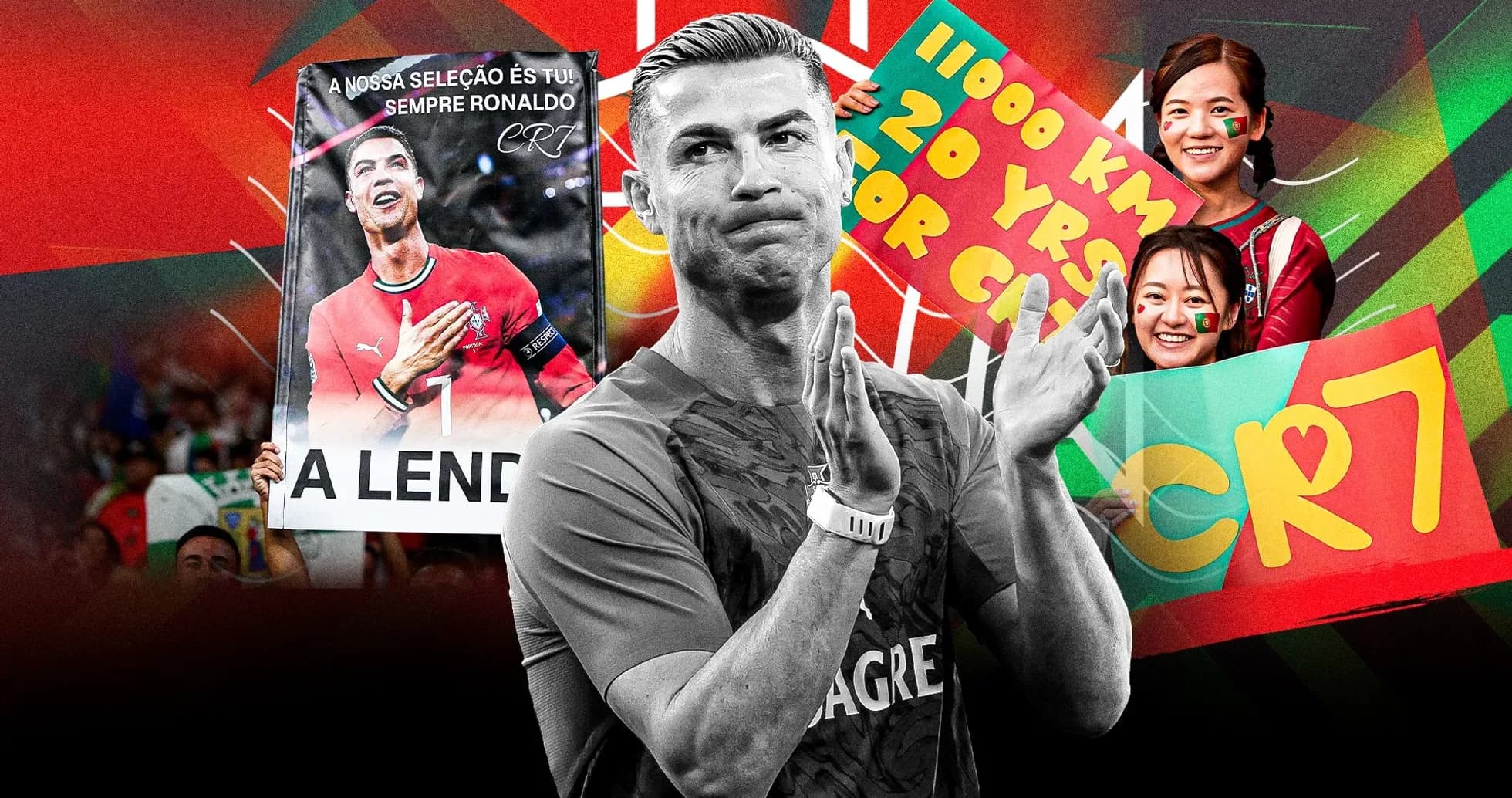
Cristiano Ronaldo always liked to control the ending. The script, the spotlight, the stage. This time, he almost walked off it for good.
On the flight home from the United States after this year’s World Cup, Ronaldo was, by his own account, ready to call time on his international career. One final act, then the curtain. It took the intervention of FPF president Pedro Proença, mid-air and mid-crisis, to pull him back from the brink. Not because Portugal still needed his goals. Because they still needed his gravity.
For years now, that has been the contradiction at the heart of the Seleção. On the pitch, Ronaldo had become a problem. Off it, he remained the solution.
The burden on the grass, the gold in the boardroom
Portugal’s players have spent three straight major tournaments trying to accommodate an immobile centre-forward. They bent their game around him, narrowed their options, dulled their own edge. The result was obvious: a team carrying a legend who no longer moved like one.
From a sporting perspective, Ronaldo had turned into an unbearable weight. He didn’t press, he didn’t stretch defences, he didn’t link play. He stood where the game used to come to him and waited for it to do so again.
Yet in the corridors of power, nobody was rushing to cut the cord.
Proença gave the game away last month at an FPF event. Publicly urging Ronaldo to continue, he described the Al-Nassr forward as “the greatest asset” Portuguese football had ever produced. It was a cold word for such a romantic figure, but a brutally accurate one. Asset. Not captain, not icon. Asset.
Because even as his starting place became impossible to justify, his value never dipped. Ronaldo was still Portugal’s most valuable player in the only language that federations, sponsors and broadcasters truly share: money.
A one-man industry
Ronaldo is not just a footballer; he is a one-man industry, a billion-dollar brand. Juventus did not sign him in 2018 primarily to complete a tactical puzzle. They signed him to supercharge their global relevance.
The numbers told the story. Within 24 hours of his transfer to Turin being confirmed, between July 10 and 11, Juventus gained 2.2 million new followers across their online platforms. That is not a fanbase; that is a market.
Football finance author Marco Bellinazzo summed it up neatly: “The Ronaldo Effect is very real. It’s there for all to see.” Clubs and federations looking to grow internationally need a global icon. Cristiano Ronaldo is exactly that – a walking, talking, posting sponsorship magnet, especially in North America and Asia.
Juventus felt the impact in hard cash. Six months after his arrival at the Allianz Stadium, they signed a new seven-year kit deal with adidas worth €357m – double the value of the previous agreement. By November 2019, they had extended their partnership with shirt sponsor JEEP to €42m a year, a jump of €25m on the old contract.
That is not coincidence. That is leverage.
In the age of influencers, there is no more powerful influencer in football than Ronaldo. Even players follow him. His move to Al-Nassr in 2022 was followed, within months, by Karim Benzema and Neymar heading to the Saudi Pro League. They did not blaze that trail; they walked one he had already lit.
Portugal’s greatest amplifier
For two decades, Portugal surfed that same wave. They did not just have a generational talent. They had, arguably, the most recognisable face on the planet fronting their national team.
Sports marketing expert Daniel Sá put it starkly after the World Cup. “From a brand perspective, Ronaldo is incomparably bigger than the entire Portuguese national team and countless others combined,” he told Lusa. That is not hyperbole; it is a reflection of how modern sport is packaged and sold.
His warning was equally blunt. “It will be a tragedy when he leaves, because people still don’t grasp the media attention that will be lost. We’ll be falling down a high-speed escalator. He’s the one who has enabled them to sign numerous contracts and earn a lot of money for over 20 years.”
Irreplaceable is an overused word in football. Here, it fits. Sá later told EFE that Ronaldo is “a global communications platform in himself”. Portugal, he argued, are not just losing an extraordinary player. They are losing “the greatest international amplifier of the Portugal brand.”
On the commercial front, there is no like-for-like replacement. There may never be.
Easier to replace the legend on the pitch
Strange as it sounds, the easier job for Portugal might be replacing Ronaldo the footballer, not Ronaldo the phenomenon.
This is, after all, the most prolific player in the history of international football. Yet the early signs without him are striking. The Seleção do not look starved of goals. They look liberated.
Gonçalo Ramos will never be Cristiano Ronaldo. That is not the point. What he offers is movement, energy, and the ability to knit together a front line instead of demanding that everything orbit around him.
The first real glimpse came in Qatar. When Ramos was thrown into the starting XI against Switzerland at the 2022 World Cup, in place of the former captain, he scored a hat-trick. It was not just the goals. It was the way Portugal suddenly looked like a modern attacking side again.
The irony is sharp. While Ronaldo was clinging to his status as first-choice No.9, Ramos was given just 34 minutes of World Cup football. Yet since then, every time he has been trusted to lead the line, he has repaid it.
The pressure will now be relentless, especially after the acrimonious nature of Ronaldo’s exit. All eyes were on the AC Milan striker in last month’s fixtures against Denmark and Norway. He scored in both, making it three goals in three consecutive starts and four in his last five appearances for Portugal.
Those numbers matter, but the manner matters more.
A team unchained
When readers of Portuguese daily A Bola were asked to choose their preferred XI for last month’s game against Wales, they picked Ramos ahead of Ronaldo. That was not ingratitude. It was recognition.
For too long, the interests of one man shaped the entire system. Talented wide players and gifted midfielders were forced to feed a centre-forward who no longer had the legs to press or the dynamism to stretch defences. Portugal’s attack became predictable, clogged, easy to contain at the elite level.
With a forward in his mid-20s, the team can finally play at the speed and intensity demanded by the modern game. Runners can run. Creators can create. The penalty area is no longer reserved for one man’s finishing angles.
There is no guarantee this so-called new golden generation will deliver a major trophy. International football is too volatile, too unforgiving, to promise anything. But their odds are better with a striker at his physical peak than with one in his early 40s.
The end of an era, not the end of the story
None of this diminishes what Ronaldo has done for Portugal. It cannot. They made history together. They climbed podiums together. They turned a small nation into a global reference point for excellence.
His goals will be missed. So will his magnetism. The Seleção will almost certainly never again be as popular or as profitable as they were with Ronaldo at the centre of everything.
The brand will shrink. The team, already, looks bigger.
That is the paradox of Cristiano Ronaldo’s international farewell: Portugal lose their greatest amplifier, and in the sudden quiet, their football finally has room to breathe.





