
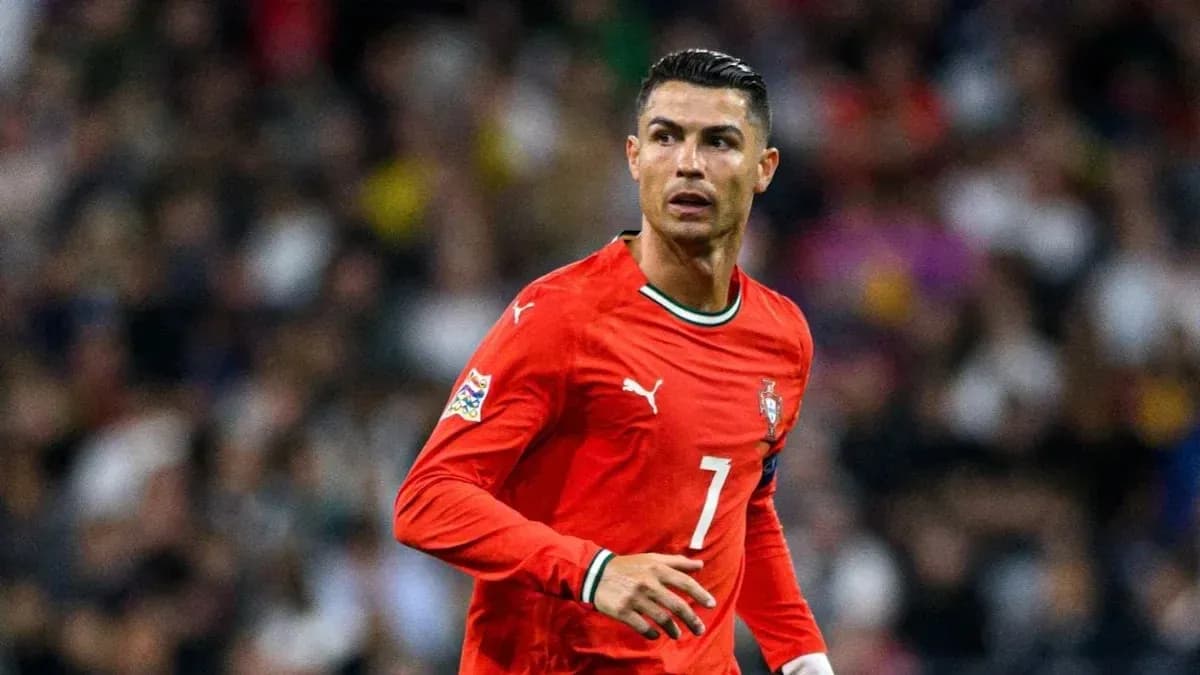
Cristiano Ronaldo has finally done what for two decades felt unthinkable: he has walked away from Portugal.
At 41, the country’s greatest footballer announced his retirement from the national team in a video message released on November 5, bringing an end to a 23-year international career that reshaped what was possible in the shirt of Portugal.
He did not step aside quietly in the night. He addressed the people who had travelled with him from teenage prodigy to enduring icon: the Portuguese supporters at home and across the world.
Ronaldo goes with numbers that may stand for generations. According to FIFA, he leaves with 234 senior caps and 146 goals, both men’s international records. No man has played more times for his country. No man has scored more.
His club career, though, is not finished. Not yet.
Still at Al Nassr in Saudi Arabia, Ronaldo is chasing another impossible landmark: 1,000 career goals across his professional journey. The international chapter closes; the personal pursuit of milestones continues.
The timing of the announcement was not accidental. It landed a day before Portugal coach Jorge Jesus was due to name his next squad, with Nations League fixtures against Denmark and Wales on the horizon. The message was clear: the next list would be written without the name that had been its constant for more than two decades.
Passing on the No. 7
In his farewell message, Ronaldo focused on the symbol that had become an extension of his identity: the No. 7 shirt.
“Today the time has come to pass it on to the future,” he said, in FIFA’s English translation of his words. A simple sentence, but the weight behind it was obvious.
He admitted the decision had been difficult, shaped by emotion as much as by the realities of age and competition. This was not a player pushed out; it was a player choosing his own exit point, even if the heart resisted.
Ronaldo took time to thank those who had lived in the shadow of his career. His family, who accepted the absences, the training camps, the tournaments that swallowed summers and winters alike. The teammates and coaches who shared dressing rooms and pressure. The medical staff and backroom workers who rarely appear in photographs but keep the machine running.
He also turned to the people in the stands.
Ronaldo spoke about Portuguese fans living abroad, for whom a Portugal match meant more than 90 minutes of football. It meant a flag in a foreign city, a national anthem sung thousands of miles from home. He recalled looking around during that anthem and seeing families in the crowd, those brief minutes when club rivalries and personal differences dissolved into a single, shared loyalty to Portugal.
For a player who built his legend on individual excellence, it was a reminder that his story with the national team always belonged to something larger.
A Rift with Jorge Jesus
This farewell did not arrive in a vacuum. The relationship between Ronaldo and Jorge Jesus had already been tested in public.
The tension burst into view during the September international break. On September 27, in a 2-1 win over Norway, Ronaldo remained an unused substitute, a detail confirmed by the Norwegian federation’s match record. He warmed up, waited, and never stepped onto the pitch.
Three days later, on September 30, he left Portugal’s camp, the day before the match against Denmark.
The storm followed quickly.
On October 6, Ronaldo released a statement accusing Jesus of breaking promises about his involvement, including an assurance that he would play against Norway. Jesus, as reported by Sky Sports, denied any agreement over playing time.
Ronaldo did something he has not often had to do in his career: he apologized. He said sorry to his teammates and to Portuguese supporters for walking out, admitting he should not have left the camp. At that point, he stressed he was still available for selection.
The Portuguese federation responded with punishment: a 30-day suspension and a €255 fine. By the time he announced his retirement, that suspension had already been served.
Jesus, speaking to Canal 11 on November 5 and cited by RTP, revealed he had asked Ronaldo to continue before naming his first Portugal squad. He wanted the veteran forward alongside him. The coach said he now had to accept the player’s decision.
He also disclosed a symbolic gesture: a large photograph of Ronaldo installed in the national team’s auditorium, a permanent reminder and a standard for younger players to measure themselves against.
Even in absence, Ronaldo’s presence will be unavoidable.
From Figo’s Heir to Portugal’s Standard-Bearer
The scale of what ends now becomes clearer when you rewind to the beginning.
Ronaldo’s senior debut came in August 2003, against Kazakhstan. He was 18. He replaced Luis Figo at halftime, a changing of the guard that at the time felt like a footnote. It became a turning point in the history of Portuguese football.
From there, he did not simply fill the gap left by Figo; he dragged the national team into new territory.
He captained Portugal to its first major international trophy at Euro 2016, the night in Paris when he was forced off injured yet still roared instructions from the technical area as if he had swapped boots for a suit. Three years later came the Nations League title in 2019, and another Nations League triumph followed in 2025.
Across six World Cups, he found the net in each tournament, finishing with 11 goals on the biggest stage. He scored three times at this year’s competition. His final World Cup ended not in glory but in a 1-0 defeat to Spain in the round of 16. Even giants exit on ordinary nights.
The Portuguese federation has already promised a farewell tribute to its former captain. It will be emotional, it will be grand, and it will still feel too small for the scale of the career it attempts to honor.
Now the No. 7 shirt waits for a new owner, the anthem will play without its most familiar face on the touchline, and Portugal must learn to chase trophies without the man who made that expectation normal.
The question is no longer what Ronaldo can still give his country. It is how a nation that grew up with him writes its next chapter without him.





