Dallas Mavericks' Clutch Games: The Impact of Kyrie Irving
There’s one number that cuts through all the noise of the Dallas Mavericks’ 26-win season.
Forty-five.
That’s how many clutch games they played in 2025-26 — tied for the most in the league. Forty-five nights where the score sat within five points in the final five minutes, where every possession felt like a coin flip. Dallas went 17-28 in those games. That’s the season, right there.
This wasn’t a team getting run off the floor. It was a team that kept walking into the fire and didn’t yet know how to get out.
A Young Team That Couldn’t Close
For a group that lost 56 games, the sheer volume of tight finishes tells its own story. The Mavericks were in the fight. They just didn’t know how to finish it.
They were young. Very young. One of the least experienced rosters in the NBA, trying to navigate the most unforgiving part of a game without the one thing that usually decides it: a proven closer.
Cooper Flagg was a teenager learning the league in real time, thrown straight into late-game decision-making most rookies only see on film. The players around him had never been primary options in those moments. They were feeling out coverages, timing, and spacing on the fly, with the scoreboard and the clock offering no mercy.
Experience matters most when the game shrinks. Last five minutes. One- or two-possession margin. Every mistake magnified. Dallas had talent, but almost no scar tissue.
That’s where everything changes with Kyrie Irving.
Kyrie, the Closer
Irving doesn’t just bring star power. He brings a résumé built for exactly the problem Dallas kept running into.
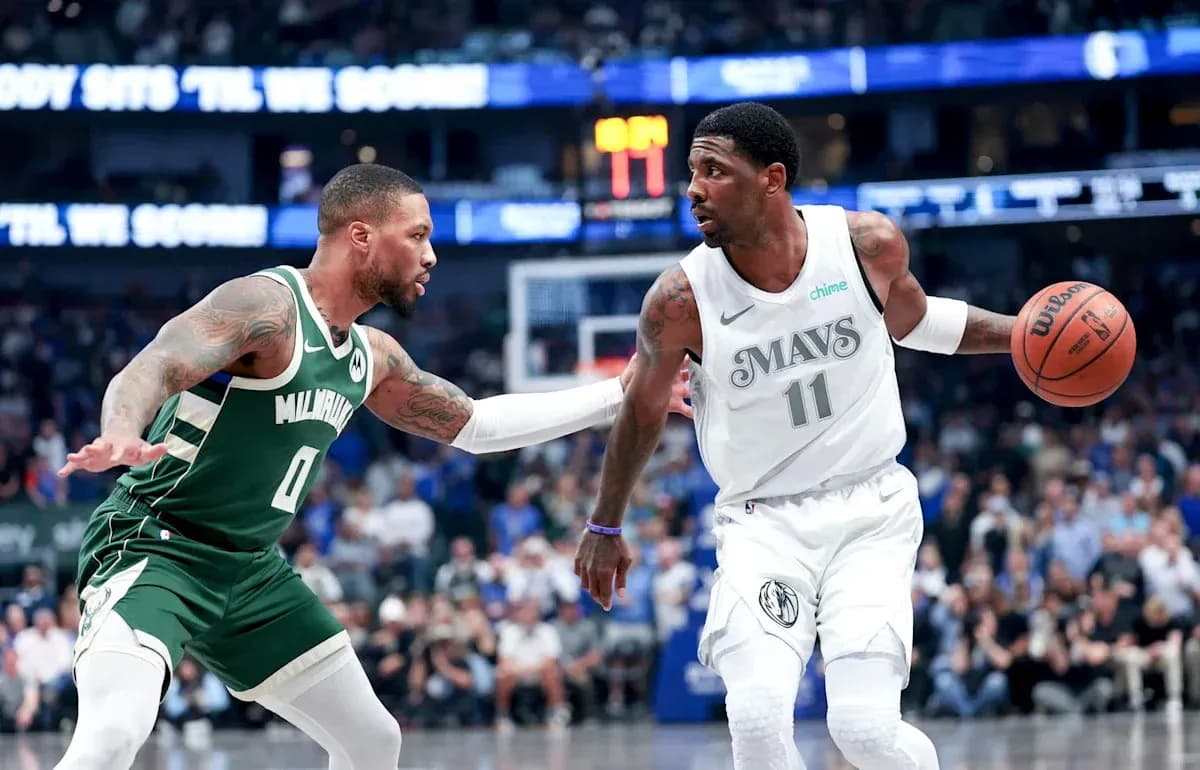
This is the guard who buried the Game 7 dagger over Stephen Curry to seal the 2016 Finals for Cleveland, a shot that will live forever in NBA montages. The same player who stunned Denver in 2024 with a left-handed floater from the free-throw line that defied logic as much as physics. A guard who owns a 15-1 record in postseason closeout games, averaging 23.5 points when a series hangs in the balance.
Pressure doesn’t rattle him. It sharpens him.
Dallas has already seen what that looks like with its own eyes. In 2023-24, with Irving on the floor, the Mavericks went 16-4 in clutch games, one of the best records in the league. He ranked among the NBA’s top 10 in clutch scoring, putting up 4.2 points per game in those situations while shooting 60% from the field and 42% from beyond the arc when it mattered most.
Same franchise. Same jersey. Completely different outcome once a closer enters the picture.
Late in games, offenses tend to strip down. Sets disappear. Matchups slow to a crawl. The ball finds the star, and the defense loads up. Only a handful of players can still manufacture clean looks against that kind of pressure. Irving is firmly in that group.
He can score at all three levels. He can get to his spots even when everyone in the arena knows what’s coming. And when defenses overcommit, he bends the floor enough to create simple reads for teammates who are still figuring out the league.
For a roster packed with youth, that matters. Instead of young players forcing something out of nothing, Irving’s gravity gives them clearer choices: open catch-and-shoot looks, straightforward drives against a scrambling defense, easier decisions in the tightest moments.
The Hidden Value of All Those Losses
There’s another layer to this, one that doesn’t show up in last year’s standings.
Those 28 clutch losses weren’t useless. They were reps.
Flagg and the rest of the young core spent an entire season living in high-pressure situations, even if the endings were brutal. They saw how quickly a good possession can turn bad. They felt how one misread can swing a game. They learned what it means to execute when every cut, screen, and pass gets scouted and squeezed.
Players grow from that, even when the record doesn’t show it.
Now those same players bring a year of late-game scars into a season with a veteran who has made a career out of closing the exact games they kept losing.
A Small Shift With Big Consequences
Dallas doesn’t need to transform overnight into a juggernaut. The blueprint is simpler than that.
This team already proved it can stay in games. The next step is converting a reasonable share of those coin flips. If last season’s pattern holds and the Mavericks again find themselves in a pile of one-possession finishes, even a modest swing in clutch performance changes everything.
Turn a handful of those 28 late-game losses into wins, and the standings look very different. Turn a few more, and the conversation around this franchise changes entirely.
The Mavericks have already shown they can get to the final five minutes with a chance. Now they have Kyrie Irving to decide what happens once they get there.