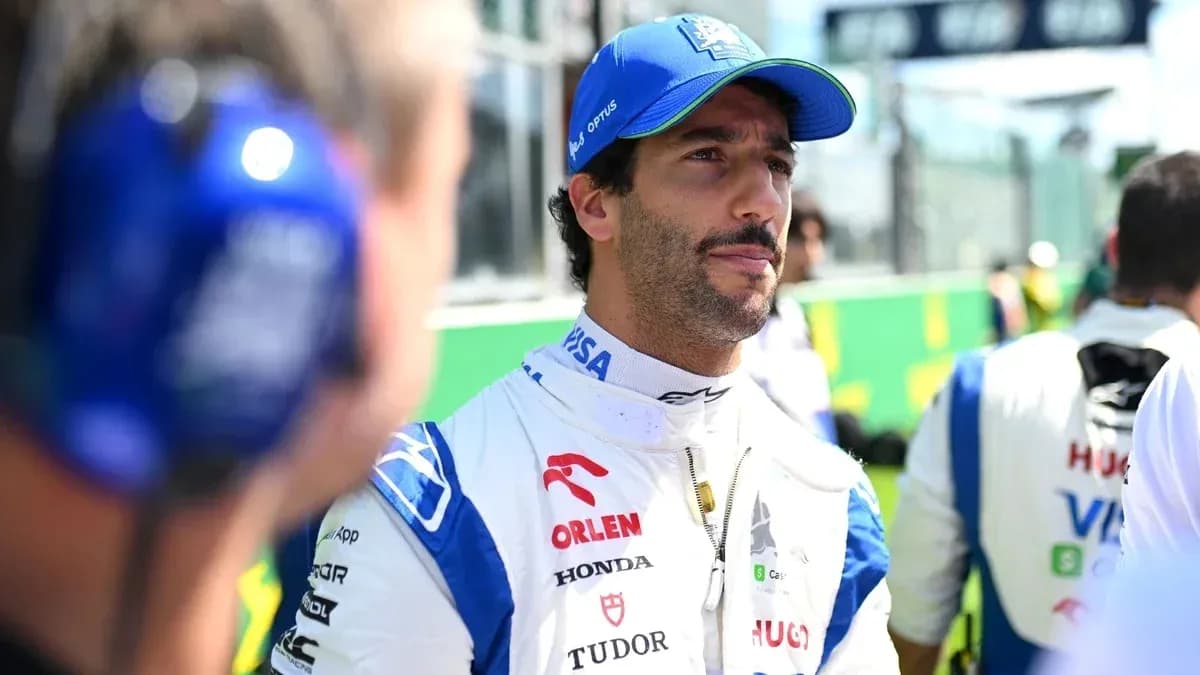
Daniel Ricciardo has always worn his heart on his sleeve. The grin, the jokes, the late-braking heroics – it all built a picture of a man born to live on the edge of a Formula 1 car. But when he sat down on the Beyond The Grid podcast last month, something had changed. The smile was still there. The tone was different.
He sounded like a man who’d finally had time to look in the mirror.
Two years away from the spotlight have given the Australian exactly what F1 never really allows: space. Space to replay those final, bruising seasons. Space to admit that what looked from the outside like a slow fade from the front was, on the inside, something far heavier.
Those closing chapters were hard. After losing his McLaren seat, Ricciardo went back to Faenza – back to the team where he’d first made his name – hoping it would be the road home to Red Bull. It wasn’t. The fairytale never arrived. The famous Monza win with McLaren sits there as a wild, glorious outlier; beyond that, he didn’t stand on a podium again in his last 70 starts.
The statistics only tell part of the story. The rest is written in the way he talks about Singapore 2024, his final race.
“By that point, I was done getting knocked down; I was, I guess, getting beat up,” he admitted. The hunger lingered, but it came wrapped in denial. He describes the internal monologue every elite athlete knows too well: the insistence that they’re strong enough, good enough, resilient enough to simply push through.
He tried. He told himself to “sleep it off” after the bad days, waiting for that one good weekend, that one sharp lap, to convince him the fire was back. Sometimes it came. It never stayed.
Ricciardo still wanted the storybook ending. A Red Bull return. A second shot alongside Max Verstappen. A late-career surge at the front. He can now admit what he already knew deep down: it was slipping away. The performances weren’t coming as easily. The mental toll was growing heavier. Other drivers older than him were still operating at a frighteningly high level. For him, it was different.
“There was just a lot of pain, process, a lot of things that just were happening and had happened over the years, that I think just built up,” he said. “It was just very hard for me to shut all that out and do it.”
In the end, Red Bull made the decision he could not. The team chose Liam Lawson for the second RB seat and closed the door on Ricciardo’s F1 career. The call hurt. It also may have saved him from himself.
He confessed to a fear that, if the contracts had kept coming, he might never have stopped. Monaco 2022 is burned into his memory: 14th on the grid, 13th at the flag in a place where, four years earlier, he had dominated and won. That night, sitting in his apartment, he told his team he didn’t want to do it anymore. He says he’d had that same conversation before – Silverstone 2015 among the low points – and yet he always carried on.
Around him, the chorus was reassuring. You’re great. You can still do it. People meant well, but their belief drowned out his own doubts. It became easier to listen to them than to the voice telling him he was exhausted.
“I still don’t like how it ended,” he said, but there’s a twist. “There’s also a part of me which is grateful they pulled the trigger, because I wouldn’t want to be doing it now.”
Gratitude isn’t the emotion most drivers feel when the sport spits them out. For Ricciardo, it came only after wrestling with something rawer: a sense of failure and humiliation.
He talks about the ruthlessness you develop when you start racing young. The standards you set. The way that steel hardens not only towards rivals, but towards yourself. When the results dried up and he couldn’t reach the level he once had, he saw it as failure, plain and simple. Not finishing seasons as he wanted. Not delivering when it mattered. Not being the driver he believed he was.
The cost was emotional as much as professional. In public, he played the part. Laughing, drinking, putting on the show. Inside, he was grieving a version of himself – the kid who thought he’d be fighting for world titles and stacking up wins. That dream, he realised, had gone.
So he did something that almost no Formula 1 driver ever does willingly: he stepped away from the paddock and stayed away. No constant media duties. No lingering in motorhomes. No half-in, half-out existence.
“In terms of driving, I was burned out, let alone emotions and all that, I was just tired,” he said. The solution was radical simplicity. He travelled alone. He hiked. He gave himself the silence he’d been missing for years. He just needed, as he put it, “to breathe on my own”.
Yet the story doesn’t end with him walking away from racing altogether. Last May, he went to the Indianapolis 500. Not as a driver. As a fan.
There, in the roar of 33 cars thundering into Turn 1, something stirred again. Watching from the outside, stripped of the pressure, he rediscovered something fundamental.
“Being a fan again reminded me that I do love motorsports,” he said.
It won’t rewrite his F1 ending. It won’t erase the years of doubt, the bruises to his pride, the nights in Monaco and Silverstone when he wondered if it was all over. But it does leave a different kind of question hanging over the next chapter.
If Daniel Ricciardo can finally separate the love of racing from the weight of Formula 1, where does that passion take him next?