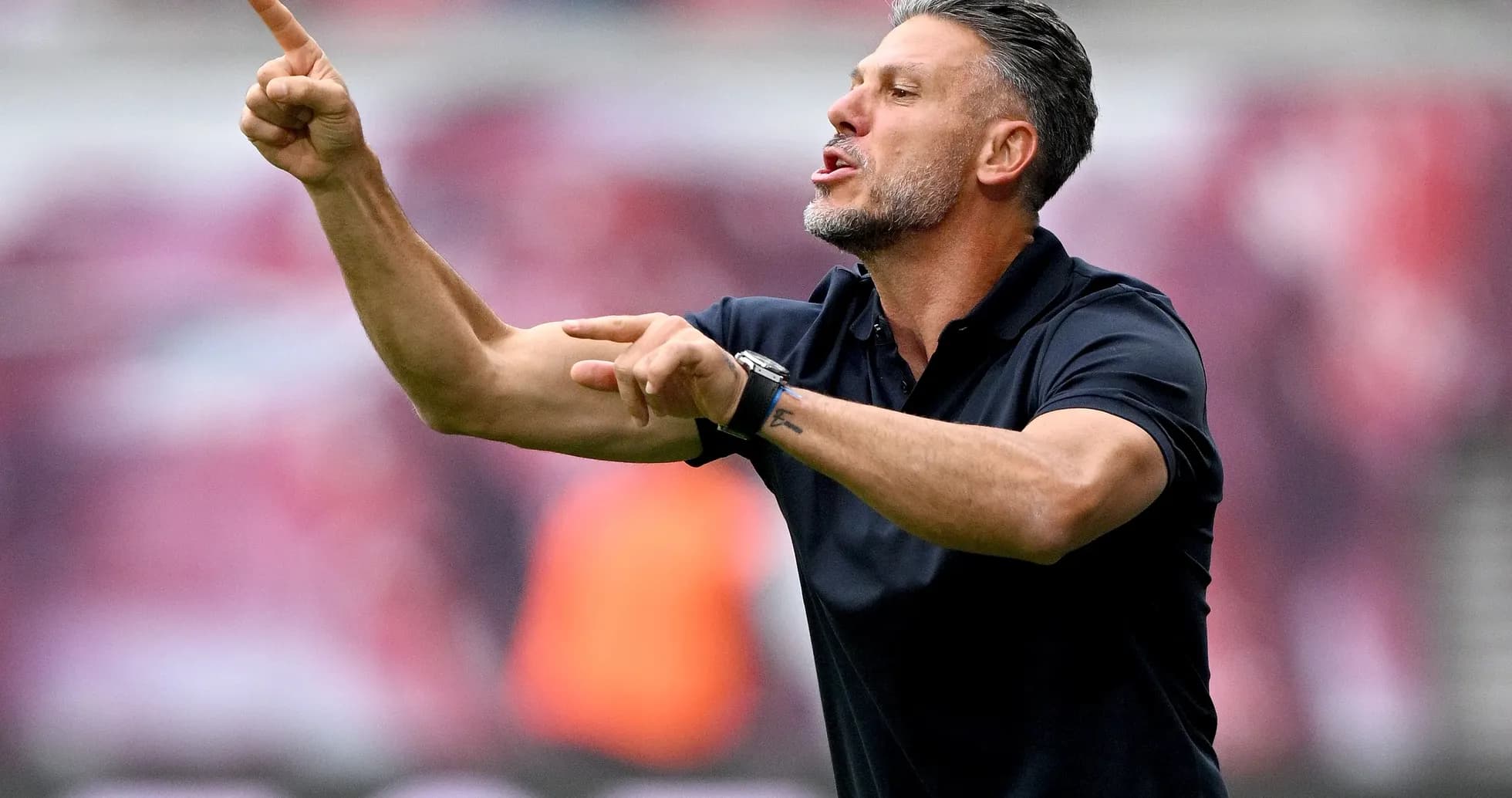
Martin Demichelis arrived at RB Leipzig in the summer with the aura of a former Bayern Munich stalwart and the weight of a surprise appointment. At 45, he was handed a high‑pressure job after the abrupt dismissal of Ole Werner. What he didn’t bring with him, though, was the language to fully command the room.
In a club that prides itself on clarity, intensity and detail, Leipzig’s dressing room has become a maze of translation.
Demichelis, an Argentinian, reportedly speaks neither enough German nor enough English to deliver his tactical instructions straight to the entire squad. So his team talks resemble a relay race. The message leaves his mouth, then gets passed along in fragments.
Team manager Babacar N'Diaye takes care of the French-speaking players. Goalkeeping coach Frederik Gößling relays the ideas in English. Assistant coach Cristian Fiél, the German-Spaniard, operates as a crucial bridge between head coach and group. Several voices, one game plan.
It is an unusual structure for a Champions League club with title ambitions. And it is starting to creak.
German players are said to regularly find themselves huddled together afterwards, trying to decode what exactly their coach wanted, piecing together phrases that have already passed through two or three intermediaries. The tactical content may survive. The tone rarely does. The original emotion, the urgency, the edge that a coach wants to inject before kick-off or at half-time – much of it gets diluted on the way.
At this level, that matters.
Results Turn Up the Volume
Language issues are awkward when you are winning. They become a problem when you are not.
Leipzig’s start to the season has been uneven, and every dropped point has amplified the doubts around Demichelis. The 1-3 league defeat at Werder Bremen raised eyebrows; the 1-4 collapse against FC Como 1907 in the Champions League set off alarm bells.
Those nights did not just damage the points tally. They cut straight into Leipzig’s self-image as a club that should be dictating games, not chasing them in confusion.
Demichelis did not hide from the pressure. After the defeat in Como, he spoke plainly about the unforgiving nature of the job. He knows the rules, he said. At a big club, time is short, and when you do not win, everything is judged harshly. There was no plea for sympathy, just a recognition that in this environment, patience is always in short supply.
Then came HSV.
Leipzig’s 5-0 demolition job last weekend felt like a deep breath after weeks of tension. The team played with freedom, aggression, and clarity. For 90 minutes, the noise around the coach faded. The win did not erase the earlier setbacks, but it gave Demichelis a foothold, a result he could point to as proof that his ideas can land, even through the linguistic fog.
Still, the scepticism lingers. Last season’s third-place finish raised expectations. Leipzig see themselves as a permanent fixture near the top, not a side drifting in and out of form. Early stumbles in both league and Europe have already put that ambition under strain.
The coming weeks feel decisive. Demichelis needs more than isolated statements; he needs a run of convincing performances to show that this is a project gaining structure, not a dressing room straining to hear the message.
Club Leadership Backs the Project – For Now
Inside the club, the official line is clear: no panic.
Sporting managing director Marcel Schäfer stepped forward last week to address the growing criticism. His response was measured but firm. Leipzig, he said, would stay calm and focused. The club stands together – employees, players, entire coaching staff. Everyone has the support and trust of the hierarchy.
It was a call for unity and patience, a reminder that this is a newly assembled team that still has to develop automatisms and routines. Building that takes time, and the club wants to avoid being blown off course by early turbulence.
Yet Schäfer did not sugarcoat the situation. The recent results, he admitted, do not meet Leipzig’s standards. Internally, the issues are being dealt with clearly and directly. No one is pretending that a 1-4 in Como can be brushed aside.
In practice, his words amount to a formal vote of confidence for Demichelis. Public backing, but with a very obvious subtext: the trajectory has to change.
The expectations could not be more straightforward. Communication between coach and players must become sharper, cleaner, faster. The tactical instructions have to land in real time, not be reconstructed in small language clusters after the whistle. And the results must reflect that progress.
If those two lines – understanding and performance – rise together, the storm around Martin Demichelis in Leipzig will ease. If they do not, the question will not be about translations anymore, but about how long a big club can afford to have its main voice struggle to be heard.