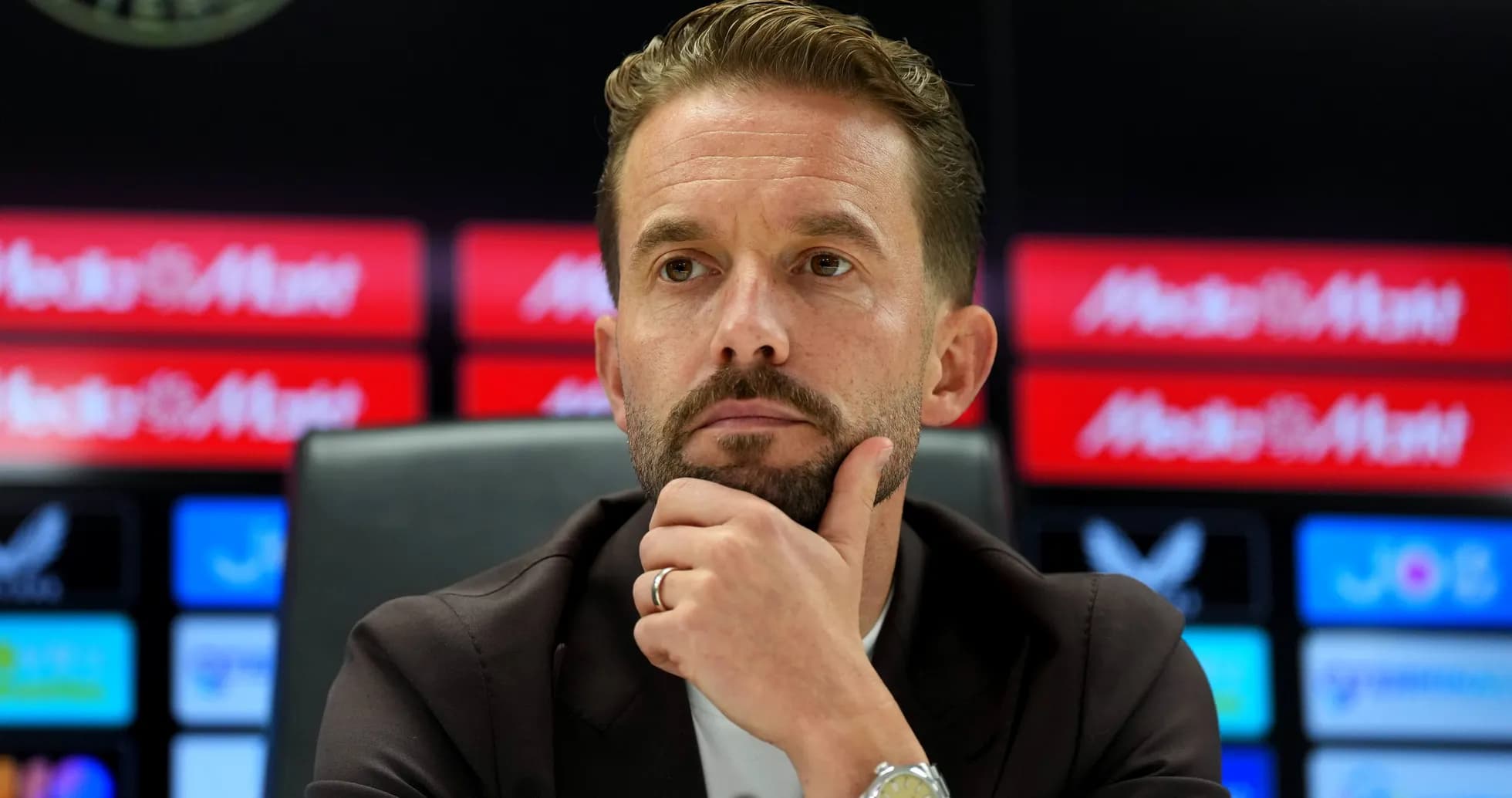
Dévy Rigaux has barely closed his first transfer window at Feyenoord and already the knives are out. In De Telegraaf’s Kick-off podcast, Valentijn Driessen and Mike Verweij tear into the club’s new technical director and question whether he is remotely the right man to follow Dennis te Kloese.
Verweij doesn’t bother to circle the issue. He says he “fears the worst” after watching Rigaux’s recent round-table session with journalists, and immediately reaches for a name that still makes Ajax supporters wince: Sven Mislintat.
“I hope this does not become the new Sven Mislintat,” Verweij says, framing Feyenoord’s summer in the shadow of Ajax’s disastrous 2023 recruitment drive.
Transfer Window Branded a Failure
For both Driessen and Verweij, the verdict on Rigaux’s first window is brutal: no success at all. The criticism isn’t about one missed target or a single bad deal. It’s about the way Rigaux talks, the way he positions himself, and the reality they see behind the presentation.
Verweij seizes on Rigaux’s comments about Hadj Moussa as a symbol of that disconnect. Rigaux insisted that “no club is allowed to talk to Hadj Moussa, because he has an ongoing contract.” To Verweij, that line shows a worrying lack of feel for how the market really works.
“That is very naive, because it happens everywhere,” he says. Clubs talk, agents talk, players talk. Pretending otherwise doesn’t convince seasoned observers.
Then comes the case of Read. Rigaux stated there was no bid of 30 million, pointing instead to an “official” offer of 26 million. Verweij counters that version, saying that in telephone contact Roma immediately indicated they were prepared to move towards that 30 million mark. For a technical director under scrutiny, that gap between formal wording and football reality becomes a stick to beat him with.
Echoes of Mislintat
Verweij doesn’t stop at one comparison with Mislintat. He keeps going, building a pattern he believes Feyenoord fans should worry about.
“He brings in players from the second Bundesliga,” Verweij notes, another direct nod to Mislintat’s much-criticised talent hunting in Germany’s lower tier during his time at Ajax. To him, the parallels are too sharp to ignore.
There’s another similarity, he says: the reception in the media. “You can sense in the media that everyone is over the moon with Rigaux, as if a world wonder has walked in. That was also the case with Mislintat.” The suggestion is clear. Dutch football has seen this movie before: a smooth-talking outsider arrives, gets glowing write-ups, then leaves behind a squad full of question marks.
Driessen hears enough and steps in.
“Scandalous” Round Table
“It was truly a scandalous round-table discussion!” he explodes. The focus shifts to how Rigaux spoke about his predecessor, Dennis te Kloese, the man widely credited with helping restore Feyenoord to the Champions League stage.
According to Driessen, Rigaux didn’t openly attack Te Kloese, but he did “let all kinds of things slip” about the previous regime: too many players, wages too high, too many write-downs. The subtext, in Driessen’s view, was unmistakable – a subtle attempt to distance himself from the problems and place them at Te Kloese’s door.
“He knew what he was getting into, didn’t he?” Driessen snaps. If Rigaux accepted the job, he argues, then lamenting the state of the squad and the balance sheet rings hollow.
His irritation grows when Rigaux speaks about working in a “completely different way” from Te Kloese. Different is one thing. Matching the output is another.
“I’m very curious whether in that, according to him, ‘completely different way’ he is going to achieve the same results as Dennis te Kloese,” Driessen says. That’s the heart of the debate. Te Kloese delivered trophies and Champions League football. Rigaux, so far, has delivered questions.
Champions League Warning
The conversation then cuts straight to the pitch. Driessen looks at the current squad and sees danger at the highest level.
“You can go into the Champions League with this team,” he says, “but you will finish bottom without a chance.” It’s a stark prediction, and it carries a financial sting. If Feyenoord crash out early, what does that do to the value of their key assets?
“And then what is the value of Read, Hadj Moussa and Zechiël?” he asks. It’s not just a sporting concern; it’s a warning about the club’s transfer strategy and the risk profile of the current rebuild.
“Everyone Falls for His Slick Talk”
Verweij then adds a fourth and final comparison with Mislintat, this time aimed at Rigaux’s communication style and the way his ideas are being received.
“Everyone falls for his slick talk!” he says. The example he gives is Tjark Ernst, talked up as potential material for Die Mannschaft. For Verweij, that kind of framing jars with what he sees on the pitch.
“Every diagonal ball is a goal conceded!” he snaps, reducing the lofty projection to a brutal on-field reality.
The message from the podcast is unmistakable. In the eyes of two of the Netherlands’ most prominent football journalists, Feyenoord’s new technical director has started his reign with big words, contentious decisions and a growing list of uncomfortable comparisons. The club wanted a new architect for its sporting future. The question now is whether Rigaux is building something stable – or laying the foundations for the next crisis.