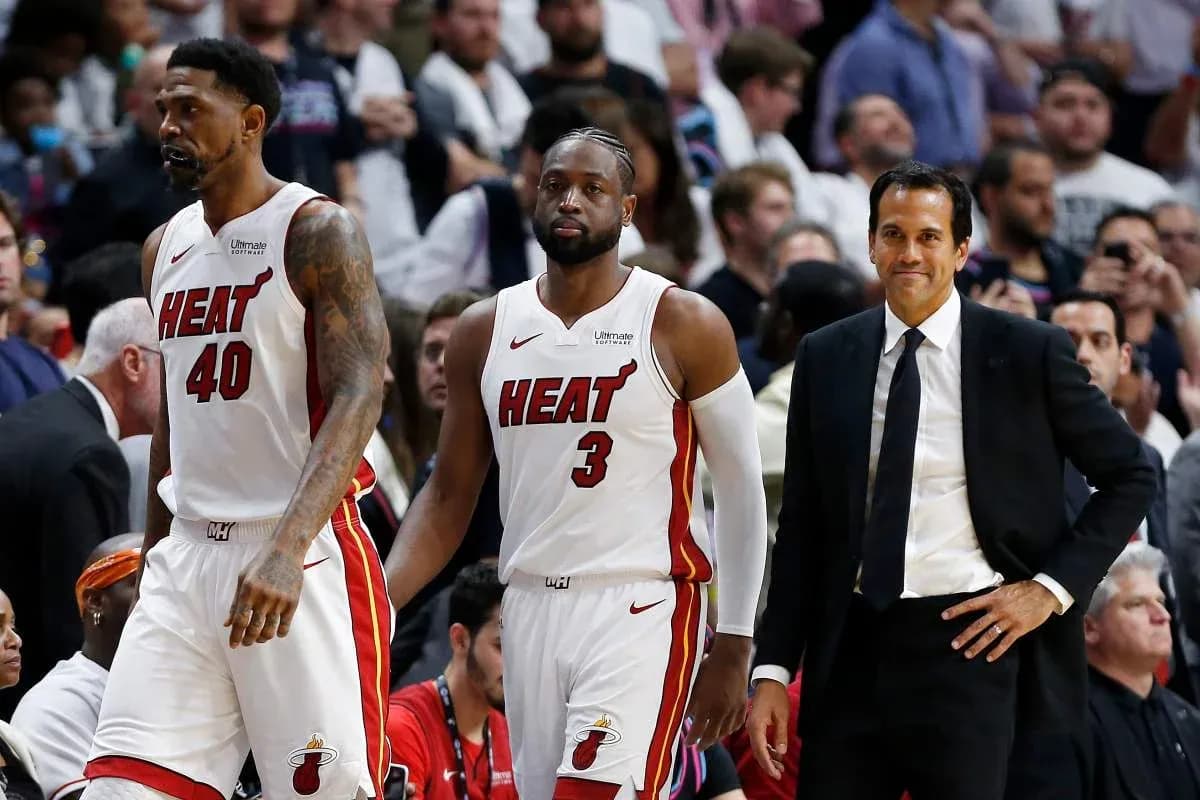
Dwyane Wade's Journey: From NBA Star to LGBTQ Ally
Dwyane Wade spent a career carving up defenses, owning fourth quarters and delivering championships to South Beach. In Miami, his name sits alone at the top of the franchise’s history. But even for the Heat’s greatest player, not every battle was fought on the floor.
Some of the most complicated ones were in the locker room.
When the jokes stopped being funny
Wade recently opened up about the tension he felt in NBA locker rooms after his daughter Zaya came out as a trans woman. The same space that had always been his sanctuary – loud, macho, unfiltered – suddenly sounded very different.
He described the shift in himself when Zaya’s journey became public, even before the family spoke openly about it.
He started listening instead of just hearing. The casual jokes about the LGBTQ community, the throwaway lines that had long been part of the background noise, now cut through. What once blended into the soundtrack of a “masculine, toxic environment,” as he put it, began to grate against his growing awareness and his responsibility as a father.
He stopped laughing. He walked out of the room when certain things were said. The distance grew, not because he was above anyone, but because he was changing – and the room wasn’t.
In a league where no active player has ever come out as gay, that culture has lingered for decades. Jason Collins only came out after his playing days, a decision shaped by the same atmosphere Wade was now confronting. This time, though, the issue was no longer abstract. It had a name. It had a face. It was his daughter.
A captain’s conversation
The turning point didn’t come in a meeting with executives or a league initiative. It came in a quiet, honest conversation with the one teammate who embodied Miami as much as Wade himself: Udonis Haslem.
Haslem noticed the change first. The franchise lifer, the enforcer, the voice in the huddle, saw that Wade wasn’t “in on the jokes” anymore. The laughter stopped. The exits from the locker room came quicker. Something was off.
Wade decided he had to address it.
He pulled Haslem aside. This wasn’t a star lecturing a role player. This was a brother talking to a brother. Wade told him how the language made him feel, how the words about “different communities” landed now that his own child was part of one of them. He explained that the same jokes he once joined in on now felt like an attack.
Haslem, Wade said, simply didn’t know. Not really. Not in that way. But once he did, he changed.
The veteran forward adjusted his thinking. He cleaned up his tone. He altered his verbiage. And then, crucially, his actions followed. One conversation, in a safe space between two men who trusted each other, shifted the temperature of a locker room that had always prided itself on being hard-edged.
That is “Heat culture” at its best: accountability, honesty, growth. Not just in late-game rotations and defensive schemes, but in how people treat one another when the cameras are off.
From franchise icon to outspoken ally
Wade’s evolution didn’t stop with that talk. As Zaya’s journey became public, he stepped firmly into the role of LGBTQ ally, using his platform with a conviction that has drawn widespread praise. The all-time great shooting guard, once defined by his slashing drives and fearless finishes, now finds himself pushing into a different kind of traffic – the ingrained habits and unexamined attitudes of professional sports.
He wanted to change the NBA locker room environment once it touched his own family. He started where every real culture shift begins: with someone you trust, in a room you thought you already knew, asking whether the old way of doing things still has any place in the future.