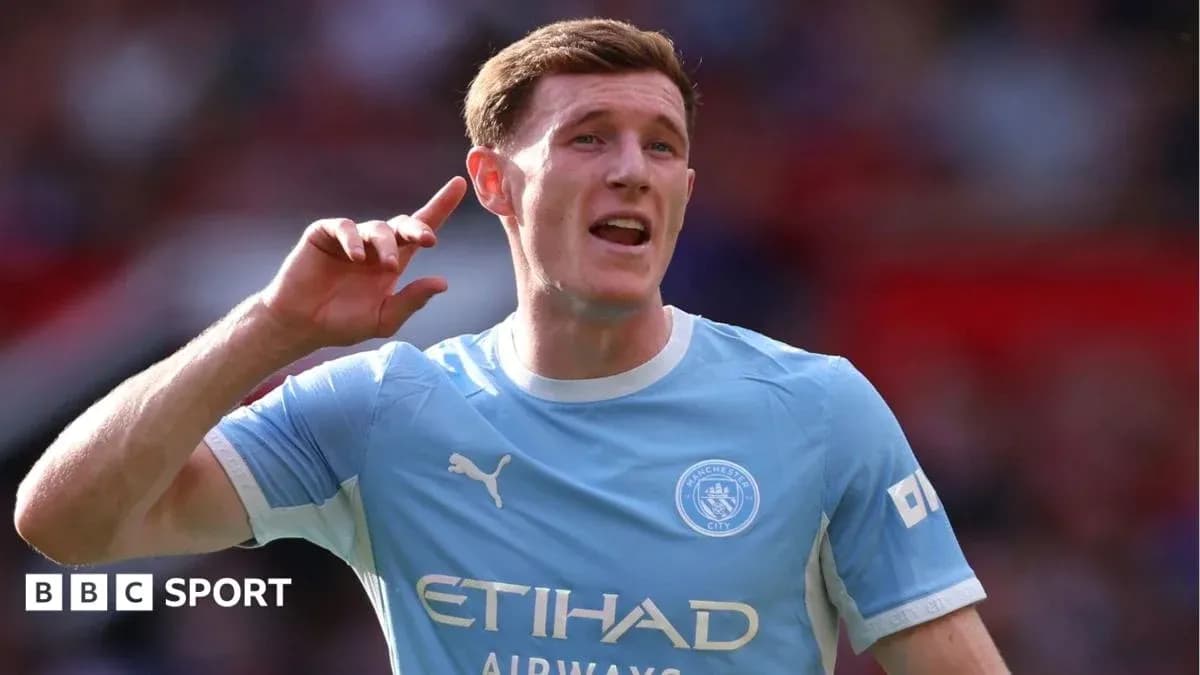
Elliot Anderson walks back into the City Ground on Saturday as the £116m midfielder who outgrew Nottingham Forest – and as the man Manchester City now trust to run their games and, in time, England’s.
The journey has been rapid, but it has not been accidental.
From Forest heartbeat to £116m gamble
At Forest, Anderson was never just another promising midfielder. He was the system.
Across two seasons he dragged a revolving-door side – four managers, constant turbulence, a squad looking over its shoulder at the drop – into something resembling a functioning Premier League team. The numbers were outrageous for a club fighting relegation: more touches than almost anyone, constant duels, endless recoveries, fouls drawn by the dozen. When Forest needed control, they gave him the ball. When they needed bite, he provided that too.
It is no surprise that Manchester United and Arsenal circled. City did more than circle. They paid.
The fee, £116m, was a statement that bordered on a dare: this is not a squad piece, this is the future of our midfield. This is a player you build around, not one you hide.
“The key player for England, not just City”
Inside the game, the belief in Anderson’s ceiling is blunt and unfiltered.
European football analyst Guillem Balague revealed on BBC’s Match of the Day that he had asked City manager Enzo Maresca in the summer whether he wanted Bournemouth’s Alex Scott or Crystal Palace’s Adam Wharton. Maresca’s response was short and decisive: “No.” Then the punchline: “Anderson is going to become the key player for England, not just City.”
That is the scale of expectation now attached to a 24-year-old who only recently made himself indispensable at Forest and for Thomas Tuchel’s England, helping them to a third-place finish at this summer’s World Cup.
On Saturday, when he steps out at the City Ground, he will feel that weight in a different way. Forest fan Ellie Molloson expects the stands to echo with the chant that became his anthem: “Geordie Maradona”.
“It will be bittersweet because we miss him,” she told BBC Sport, “but we are quite proud of just how fantastic a player he is.” Few Forest supporters, she says, will “begrudge him for his whopping move”.
They know what they had. They can see what he is becoming.
Replacing two players at once
City did not just sign Anderson to pad out a stacked midfield. They signed him to do something more complicated: to replace, in effect, both Bernardo Silva and Rodri.
That is the scale of trust. One player, two roles.
Anderson’s tireless running, appetite for duels and ability to live on the ball have allowed Maresca to remodel the centre of the pitch. He now operates as a deep-lying number six, the player who sets the rhythm and absorbs pressure, yet still steps out to press and drive play forward when the trigger is right.
He has not yet reproduced the sheer statistical dominance he enjoyed at Forest last season, when he topped league charts in areas from touches to duels contested to fouls won. But his numbers at City are still elite.
No one in the Premier League has drawn more fouls this season than Anderson’s 28. Only one player has won more duels than his 66. He sits third for successful passes (610) and for touches (851). Only Tottenham’s Jan Paul van Hecke and Arsenal’s Declan Rice have completed more successful passes in the opposition half and more line-breaking passes – and Anderson has played at least 66 minutes fewer than both.
This is not a player drowning under the step up. This is a player bending the game to his tempo in a title-chasing side.
Subtle brilliance, not headline numbers
Look at the raw attacking output and it can feel modest: one goal and two assists in 14 games. For a £116m midfielder, that invites scrutiny.
Look at the role and the picture changes.
From that deep base, Anderson is the launchpad rather than the finisher. His job is to build the platform for others to shine. He still finds moments to decide games, as he did in midweek, threading the pass for Erling Haaland’s winner against RB Leipzig in the Champions League.
“He has been amazing,” Haaland said afterwards. “He has had an amazing start to his City career and that is what you expect. You have to come straight in and perform. It is not easy to come in, you need to adapt and new players and a new coach, so he has been impressive. Respect.”
There was a glimpse, too, of how he operates away from the cameras. At Tuesday’s open training session before the Leipzig trip, some City players wandered out in groups, laughing and chatting. Anderson emerged alone. Ball at his feet, head down, doing kick-ups with a narrow, fixed focus.
It was a small detail, but it matched everything City staff say about him: a player who lives in the details, who treats a rondo or a warm-up like a test he has to pass.
In one group drill involving a slalom with the ball and a finish into a mini net, he stepped up first. He finished first as well.
Maresca’s project player
Inside the City camp, Anderson is already seen as a manager’s dream.
“Knowing him now, he is a guy who wants to learn every day and we sat with him with video [analysis],” Maresca told BBC Sport. “He wants to understand things, he wants to learn and improve and for a manager it’s a dream because you know that he wants to learn and you can do different things.”
Those “different things” are already visible. Maresca has experimented with Ayyoub Bouaddi alongside Anderson in midfield, especially in games like the one against PSG, when Anderson’s instinct to step out and press leaves space behind him. A second holding midfielder can plug those gaps while Anderson refines the positional discipline required of a pure number six.
It is a familiar story at City. In 2021, Pep Guardiola reflected on Rodri’s first season and admitted the Spaniard “moved too much” in that role. “The holding midfielder has to be there, don’t move, be there,” Guardiola said. Three years later, Rodri had the Ballon d’Or in his hands.
City believe Anderson can follow a similar arc, but on his own terms.
Forest’s pride, City’s future
Back at Forest, the feeling is not bitterness but a kind of shared ownership of his rise.
“The way Anderson reads the game, the way he dominates midfield, he is such an intelligent football player and he is so young, there is still so much more to come from him,” Molloson says. “He is a leader on the pitch and I just think he is phenomenal. I think Forest fans would definitely have him back in a heartbeat.”
They will not get that chance any time soon. City are too invested, too convinced. Inside the Etihad, there is a quiet satisfaction that Anderson’s debut season has already started better than Rodri’s did in 2020. The numbers back that up, but so does the eye test: the calm on the ball, the bite in the tackle, the refusal to hide.
And yet, there is still an edge to this story. The positional understanding is not finished. The decision-making when to sit and when to go will sharpen. The chemistry with those around him will deepen. That is the evolution City want – the moment when Anderson stops merely replacing Rodri and starts redefining what that role looks like.
On Saturday, as the “Geordie Maradona” chant rolls down from the Trent End, Forest will celebrate the player they helped create. City will watch the same player and see something else entirely.
Not just the man who left. The man they expect to anchor their next era – and, if Maresca is right, England’s too.