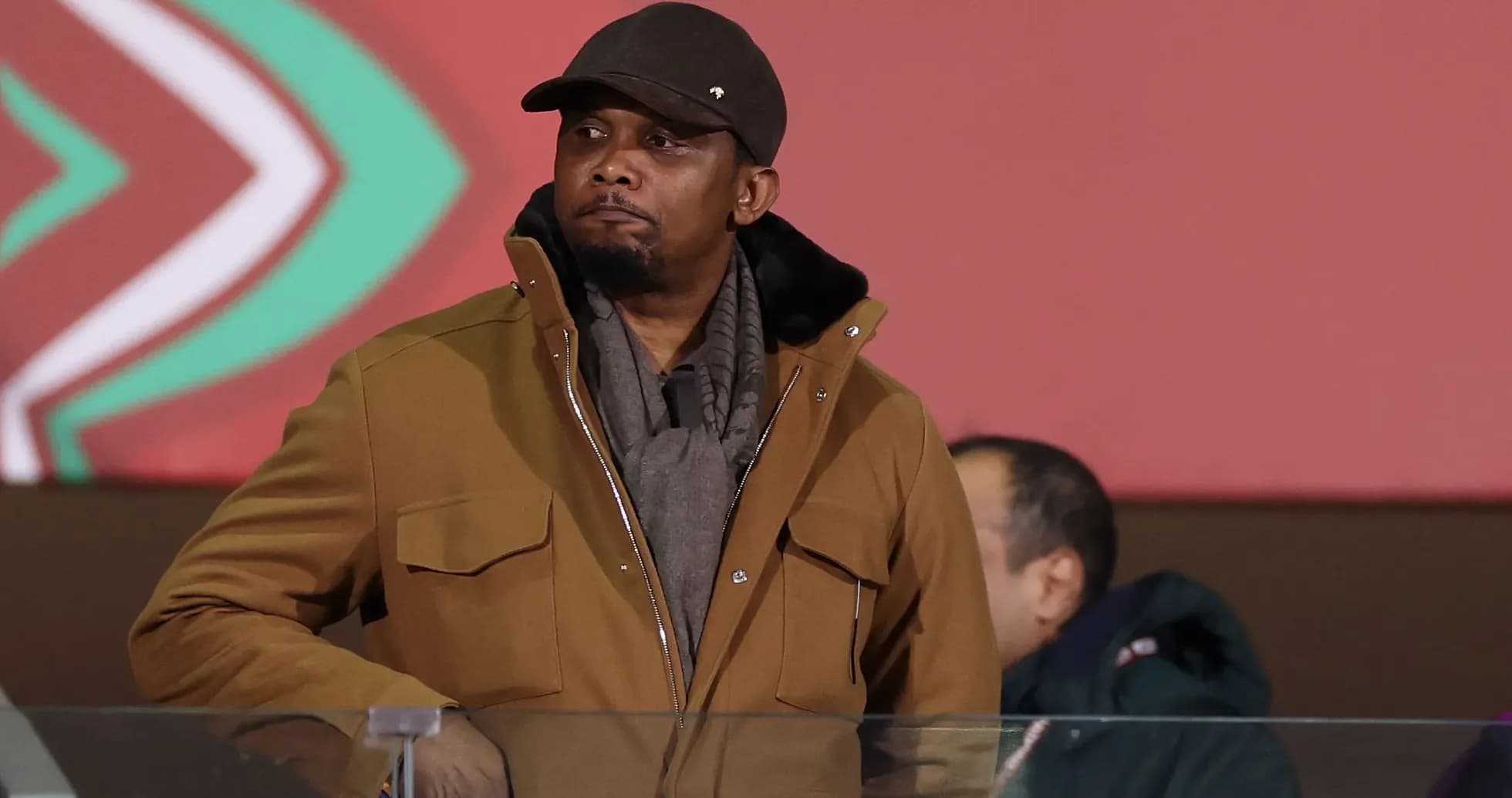
What should have been a routine ceremony for a new class of Cameroonian referees has exploded into a full-blown storm at the top of the country’s game.
Samuel Eto’o, the president of the Cameroon Football Federation, used the platform not to hand out polite congratulations, but to fire off one of the most incendiary accusations African football has heard in months.
In front of the new officials, and with cameras rolling, Eto’o spoke darkly of a “former referee and army officer” who, he claimed, had tried to work against the interests of both Cameroon and Morocco in past African competitions. He talked about attempts to influence international matches. He talked about “negative roles” and betrayal of national interests.
He did not talk about proof.
He named no one. He presented no documents, no recordings, no specific match, no beneficiary country. Yet the impact was immediate.
A Shadow Falls on Alioum Sidi
Eto’o’s description – a former international referee, an army officer, a powerful figure in refereeing circles – fit one man so precisely that speculation did the rest.
Alioum Sidi.
The ex-FIFA referee, Cameroonian army officer and current president of the Association of Cameroonian Football Referees suddenly found himself at the centre of a storm, even though Eto’o had never actually said his name.
Eto’o, speaking in remarks carried by Cameroonian network CFOOT, claimed this unnamed figure had “tried to influence Morocco in favour of another country” and had “repeated the same thing when the Cameroon Lionesses were taking part in the most recent edition of the Women’s Africa Cup of Nations.”
No match was identified. No competition was specified beyond the women’s continental tournament. No explanation was offered of what “influencing Morocco” meant in practice or which nation supposedly stood to gain.
The accusations hung in the air, heavy and vague. The football public filled in the blanks.
Sidi Hits Back: “Prove It”
If Eto’o had hoped to send a veiled warning and move on, the response from Sidi showed he had picked a fight with someone unwilling to stay silent.
Sidi treated the comments as a direct attack. In a sharp, formal statement, he rejected “any accusation, insinuation or interpretation” that painted him as a man who tried to influence a match for another country or to sabotage Cameroonian interests.
He did not mince his words. He turned the spotlight back on the federation president and demanded specifics.
What matches? What actions? What evidence?
Sidi challenged Eto’o to clearly set out the facts behind the claims and to produce “objective evidence” to back them. Without that, he warned, the matter would not stay in the court of public opinion. He would take it to judicial authorities and to the relevant sporting bodies to defend his honour, his reputation and his integrity.
The subtext was clear: this is no longer just a war of words. It could become a legal battle.
A Crisis with CAS in the Background
This clash does not come out of nowhere. In the background, another conflict has been simmering.
Sidi pointed directly to the ongoing dispute between the Association of Cameroonian Football Referees, which he leads, and the Cameroon Football Federation. That case is currently before the Court of Arbitration for Sport (CAS), the highest legal authority in global sport.
According to Sidi, that institutional battle is not separate from Eto’o’s outburst. He linked the federation president’s remarks to what he described as Eto’o “losing his composure”, a pointed and public swipe at the most powerful man in Cameroonian football.
The suggestion is stark: that these explosive allegations are not about protecting the game, but about settling scores in a bitter governance war.
A Federation on Edge
The timing, the setting, the choice of words – they all raise the stakes.
Eto’o chose to speak at the graduation of new referees, the very people who will shape the credibility of Cameroonian football in the coming years. Instead of reassurance, they received a warning about “certain individuals” and a story of a senior figure allegedly undermining his own country.
The message was unmistakable: there are enemies within.
Sidi, for his part, has drawn a line in the sand. He has refused to accept even the implication of wrongdoing, and he has dragged the conflict into the open with the threat of legal escalation.
Now the issue stretches beyond a personal feud. It touches on the integrity of match officials, the governance of the federation, and the image of Cameroonian football on the continental stage.
The next move will not be played on the pitch, but in meeting rooms, courtrooms and committee chambers. And when the dust settles, one question will linger over Yaoundé and beyond: can a football project led by Samuel Eto’o withstand this kind of internal war without tearing itself apart?