
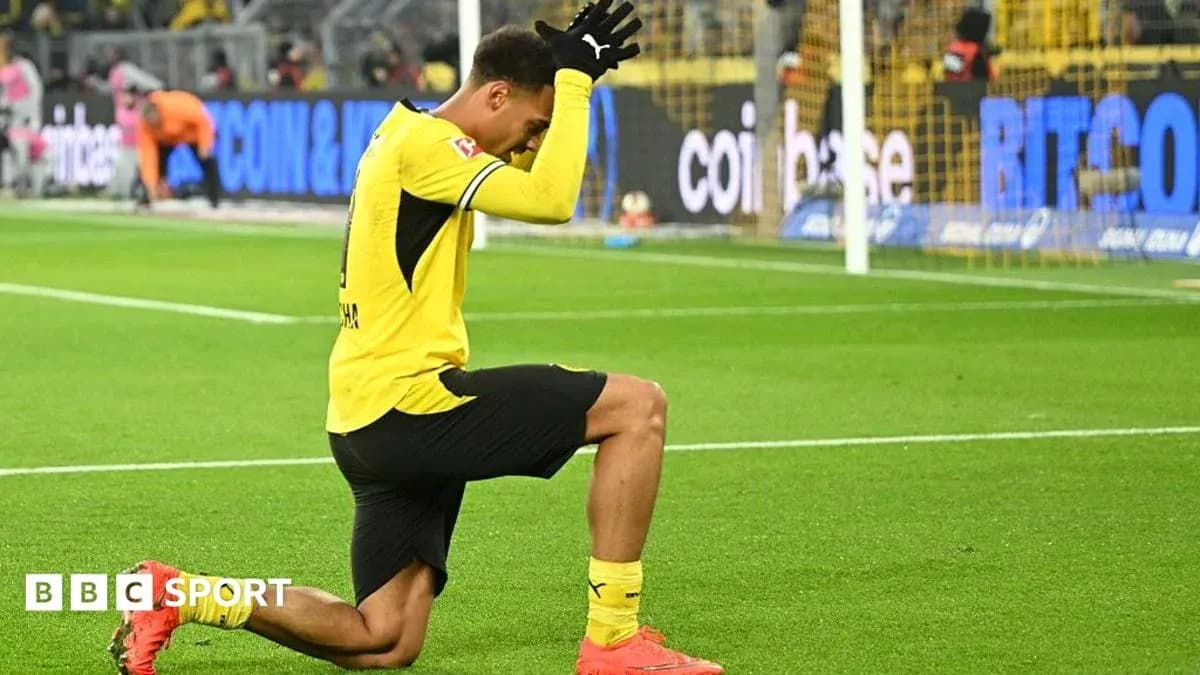
Felix Nmecha’s winner against Elversberg should have been a simple story: a midfielder scoring twice in a hard-fought 2-1 victory, a player trying to settle into life at Borussia Dortmund with decisive contributions.
Instead, what followed his celebration has dragged the club, and a growing Christian movement in football, into the centre of another debate over belief, identity and where the sport draws its lines.
A Gesture, a Campaign, a Backlash
After each of his goals on Saturday, Nmecha pointed to the sky, then mimed lifting a crown from his head and placing it on the ground. To some, it looked like a standard religious celebration. To others, it was a direct nod to a campaign called “The King’s Return”, run by the Christian organisation Ballers in God.
A Dortmund supporters’ group objected. They linked the celebration to the campaign and accused it of promoting views that clash with the club’s stated values of tolerance and diversity.
Citing an investigation by German broadcaster ARD, the group argued that “extremely conservative positions against homosexuality and transgender identity are advocated” by the movement, and highlighted messaging that describes abortion as “Satan’s plan”. For a fanbase that has long prided itself on anti-discrimination work, that was a red line.
The pressure built quickly. Social media lit up. The conversation shifted from tactics and line-ups to theology and human rights.
Nmecha: “Misunderstandings” and a Denial of Hate
Nmecha moved to calm the storm. He insisted the gesture had been misunderstood and distanced himself from the idea that he was using his platform to push intolerance.
He said there had been “misunderstandings” around the celebration and stressed that it was “not intended to promote myself or any organisation”. His message, he added, “has never been about promoting intolerance, discrimination, or hate in any form.”
It was a deliberate attempt to draw a line: a player expressing his faith, he argued, not a public endorsement of every statement associated with a campaign.
Ballers in God Responds
Ballers in God, founded by former Crystal Palace and Tottenham midfielder John Bostock, now sits squarely in the spotlight. The organisation promotes Christian beliefs and has attracted high-profile followers, including England internationals Marc Guehi and Bukayo Saka, as well as former Brazil forward Kaka.
Confronted with the criticism, the group issued a statement defending its stance and the player-led initiative behind “The King’s Return”.
“We are encouraged by player-led movements such as The King’s Return, where footballers themselves take the initiative to express their faith in Jesus,” the statement read. “Our desire is not only to share our hope, but to demonstrate love and respect towards everyone, including those who do not share our beliefs. Our focus has always been, and will always be, to point people to Jesus with grace and love.”
The words were carefully chosen: unwavering on faith, insistent on respect. For many supporters, though, the tension lies not in the language of love, but in the practical impact of views they see as exclusionary.
A Wider Fault Line in the Modern Game
This is not an isolated flashpoint. Football, increasingly, is wrestling with how visible both faith and LGBTQ+ inclusion should be in its rituals and branding.
Last year, the Premier League stepped back from the Rainbow Laces campaign and ended its partnership with LGBTQ+ charity Stonewall, a move that signalled a shift in how centrally the league wanted to place that particular initiative.
On the pitch, individual acts have laid bare the fault lines. In 2024, then Ipswich captain Sam Morsy, a Muslim, said he did not wear a rainbow armband because of his “religious beliefs”. Marc Guehi, captaining Crystal Palace, wrote “I [heart] Jesus” on his rainbow armband, a personal twist that tried to blend support for a campaign with an explicit declaration of faith.
At Manchester United, plans to wear a jacket in support of the LGBTQ+ community were dropped after a player refused to take part. One decision in a dressing room meeting, and a club-wide initiative disappeared.
Each of these moments has forced football to look at itself. Clubs promote inclusion campaigns, but squads are made up of players with sharply differing convictions. Governing bodies talk about “the game for everyone”, yet regularly run into situations where “everyone” does not agree on what that looks like.
Where Does the Line Get Drawn?
Dortmund’s fans have made their feelings clear: any association with messaging they view as hostile to LGBTQ+ people or women’s rights runs counter to the identity they believe the club should protect. Ballers in God insists its mission is rooted in love and respect. Nmecha says his celebration was about personal faith, not institutional politics.
All three positions now coexist in the same space: the Westfalenstadion, the Bundesliga, the modern game.
The next time a player lifts his hands to the sky or writes a message on an armband, the question will surface again: how far can football accommodate personal conviction before it collides with the values it claims to champion?





